
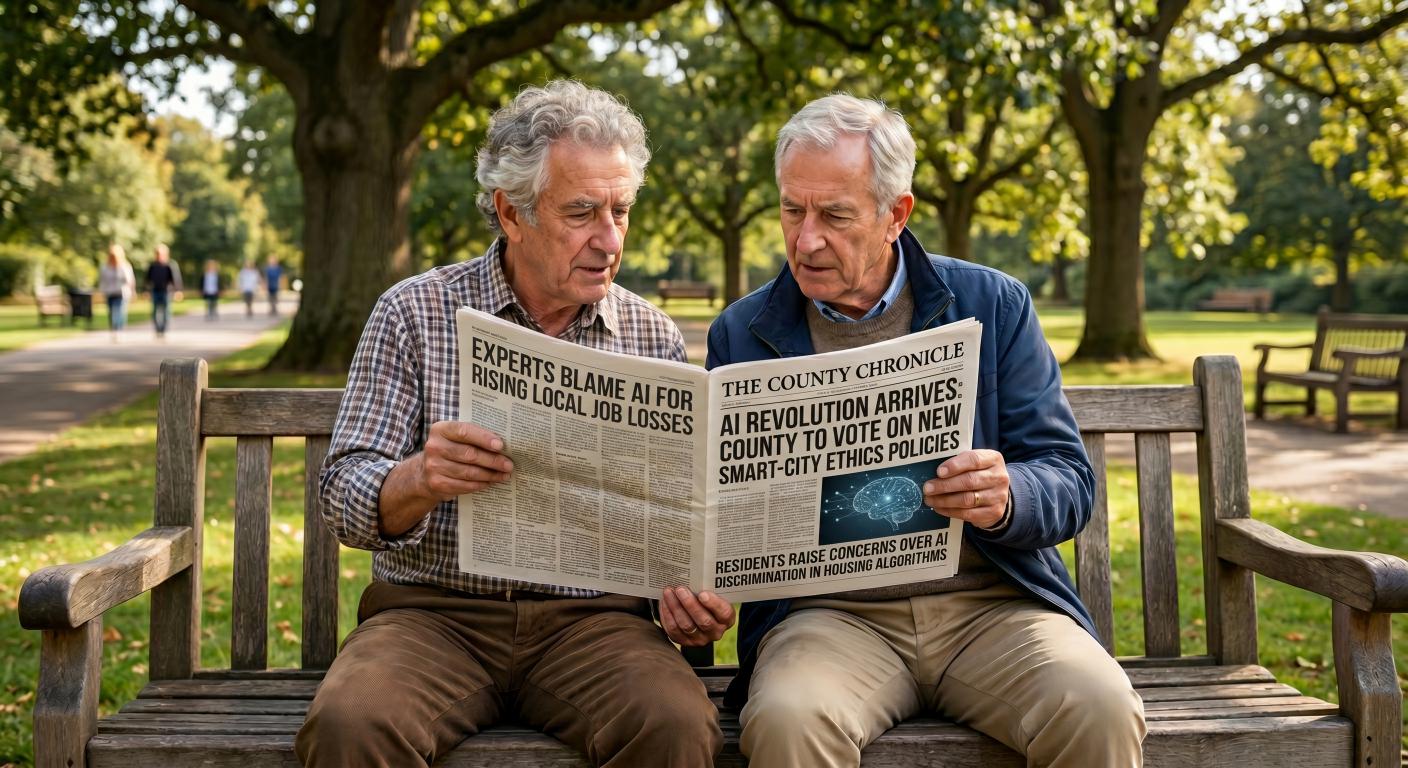
Demystifying AI: Why You Shouldn’t Be Afraid
The Gap Between Headlines and Reality
If we’ve read a newspaper or scrolled through social media at any point in the last year, you’ve likely been told that we are on the precipice of a digital apocalypse. Depending on which headline we click, AI is either going to take every job on the planet by Tuesday or it’s developing a personality and planning to lock us out of our own houses. It’s a lot to take in, and it’s perfectly normal to feel a bit of trepidation when a new technology is framed in such dramatic, almost cinematic terms.
But if we take a step back and look at what is actually happening, the reality is much less like a sci-fi thriller and much more like the early days of the internet or the spreadsheet. The fear usually comes from the unknown, and right now, there is a massive gap between the headlines and the practical utility of the software. When we start using it properly, we realise it isn't a mysterious force; it’s just a very efficient tool designed to handle the parts of our jobs that most of us don't actually like doing anyway.
We Have Been Here Before
It is worth remembering that this feeling isn’t exactly new. We have a bit of a history cycle when it comes to being nervous about big inventions. When the pocket calculator first arrived, there were genuine concerns that it would destroy our ability to do basic maths and ruin the education system. When the ATM was introduced, bank employees were convinced it was the end of their profession. Every time, we hear that it is "the end of work," but every time, we realise that these are just normal reactions to big changes. We adapt, we learn how to use the new tool, and eventually, we wonder how we ever got by without it.
Why "AI is Rubbish" is Usually a Misunderstanding
One of the biggest hurdles right now is a common experience: someone hears the hype, decides to give it a go, and asks it to do something complex without any context. When the result comes back messy or factually incorrect, the natural reaction is to shrug and say, "Well, that was rubbish. I don’t know what all the fuss is about." It’s an understandable conclusion, but it’s a bit like buying a high-end oven, putting a frozen pizza in there for three minutes at 50 degrees, and then claiming the oven is a failure because the pizza is still cold.
The truth is that AI, like any other piece of software, is only as good as the instructions we give it. We’ve spent decades learning how to talk to computers in their own language—clicking specific buttons, using exact formulas in Excel, or typing very specific keywords into Google. AI is different because it asks us to talk to it like a person, which, ironically, is something many of us mastered long ago but for some reason find difficult to apply to a computer screen.
In a business context, "using it correctly" usually just means being specific. If we ask a new member of staff to "write a report," they’ll probably stare at you blankly because they don't know what the report is about, who it’s for, or how long it should be. AI is the same. When people say AI doesn't work, it's often because they haven't learned the "prompting" side of things yet. Once you realise that a prompt is just a set of clear instructions—giving it a role, a goal, and some constraints—the "rubbish" output suddenly becomes incredibly useful.
Tackling the Digital Housekeeping
Think about the average workday. Most of us spend a significant chunk of our time on what we call "digital housekeeping." This includes things like sifting through long email threads to find a specific point, summarising meeting notes, or trying to draft a polite way to say "no" to a request for the tenth time that week. These aren't the tasks that require deep human empathy or complex moral judgment; they are just time-consuming.
This is where AI shines. It makes things run more smoothly by taking the "blank page" problem off your plate. It’s much easier to edit a draft than it is to write one from scratch. If we can use a tool to handle the first 60% of a task—the sorting, the outlining, the initial drafting—we’ve suddenly found an extra two hours in our day. That isn't a threat to our jobs; it’s a way to actually get our work done so we can go home on time for once.
An Accessibility Helping Hand
This isn't just about speed; it is also a massive benefit for the "everyday person" who might struggle with certain parts of their role for reasons we don't always talk about. For someone with dyslexia, for instance, AI takes the anxiety out of a blinking cursor and a blank white screen. It acts as a massive support for drafting emails that might otherwise feel exhausting.
That same support applies to a tradesperson who is a genius at what they do on-site but finds the "office" side of things—the quotes and invoices—completely draining. By taking the weight off those specific administrative hurdles, the technology lets us focus on the actual skills we were hired for. It levels the playing field so that being "good with words" is no longer a barrier to being good at business.
Machines Don't Have Good Taste
While it’s true that some tasks will change, AI is remarkably bad at understanding the nuance of a specific client relationship or the office politics of why a certain project is a sensitive subject. It doesn't have "taste," and it doesn't have a gut feeling. It’s a calculator for words and data, and just as the calculator didn't get rid of mathematicians, AI won't get rid of the need for people who know how to make decisions.
This is also why we need to avoid the "robotic cringe" that comes from unedited content. We’ve all seen those generic, soulless posts that just don't sound quite right. That happens when people let the AI run entirely on its own. The machine provides the engine, but we still have to provide the voice. Without a person to refine it and give it some character, the output lacks the "human spark" that actually makes people want to listen.
A Reality Check on the "Uprising"
If we want a reality check on how close we are to a machine takeover, we just need to look at how these programs struggle to draw a human hand. If AI were truly as omnipotent as the headlines suggest, it probably wouldn't still be giving people seven fingers and three elbows in its images. Look at the cover photo of this article, it took four attempts for AI to write words that were actually legible. We aren't being hunted by Terminators; we are just using a program that is brilliant in some ways but still a bit of a dork that needs constant supervision.
Using these systems doesn't mean we stop thinking; it means we finally have the time to think about high-level strategy and the bigger picture. By offloading the repetitive tasks that usually clutter a workday, we create the mental space to engage with the parts of the job that require real human judgment. We aren't being replaced; we are being freed up to do the work that actually matters.
Keeping Things Simple and Secure
We also have to address the fact that many people are worried about their data being "stolen." While it’s good to be cautious, a lot of this comes down to basic digital common sense. It is a bit like your house keys; you wouldn't leave them sticking in the front door for everyone to see, and you shouldn't put sensitive bank details or private client information into a public chat. If we stick to those very simple, non-technical rules, we can use these tools safely without worrying about where the data is going. AI learns from what it reads, just be sensible in what you show it.
The Danger of Standing Still
Instead of seeing AI as the primary threat, we should probably be more concerned about the inefficiency of staying stuck in the past. It’s like getting up to change the channel on the telly when the remote is sitting right next to you. We aren’t being replaced by the machine, but we are at a disadvantage if we continue to do everything the manual way while the world speeds up around us. It’s not a contest between man and machine, but a race between those who use the tool and those who don't. The real risk isn't the technology itself, but the act of doing nothing and getting left behind. Eventually, what feels like a 'threat' today will just be the bare minimum tomorrow
Start Small and Keep it Practical
If you’re still feeling hesitant, the best way to get over it is to stop reading the sensationalist stories and just try it for something boring. Don’t ask it to solve the mysteries of the universe. Ask it to look at a messy list of grocery items and organise them by aisle. Ask it to take a transcript of a recorded meeting and give you three bullet points on the action items. When we see it save twenty minutes on a Tuesday afternoon, the fear starts to feel a lot more like noise and a lot less like a threat. Also, don’t be afraid to use different chat models; some are better than others at certain tasks. You’ll find that some are really good at the technical, logical stuff but sound a bit robotic, while others are much better at writing like a normal person but might struggle with the details. They all have things they’re really good at and things they’re really not. If one doesn’t give you what you’re looking for, it’s usually just a case of trying another one to see if it 'clicks' with that specific task.
We should be less afraid of the technology and more concerned with the inefficiency that eats away at our work-life balance. If we can use a tool to make things run more smoothly, we’d be foolish not to. It’s not about being "hip"—it’s just about being practical. AI is here to help us clear our desk, not to take our place at it.
So, the next time we see a headline about the "rise of the machines," let's just remember that those machines still need us to tell them exactly what to do, how to do it, and why it matters. We are still in charge. The machines are just helping out with the admin.
Let's Talk More About AI
AI really shouldn't be scary, here's a few reasons why
Not only do we write about AI, we use it too. Every single day. See how we can use it here:
Why does AI give me rubbish results when I try to use it?
It's usually because the instructions aren't specific enough. AI is like asking a new employee to "write a report" without telling them what it's about, who it's for, or how long it should be. Give it clear instructions—a role, a goal, and some constraints—and the output becomes much more useful.
Is AI actually going to take my job?
No, AI is much more likely to handle the boring, repetitive parts of your job that you don't enjoy anyway—like sorting emails or summarising meeting notes. It's bad at understanding nuance, client relationships, and making decisions that require human judgment. You're not being replaced; you're being freed up to focus on work that actually matters.
What's the easiest way to start using AI without feeling overwhelmed?
Start with something boring and practical. Ask it to organise a messy grocery list by aisle or turn meeting notes into three bullet points. When you see it save you twenty minutes on a Tuesday afternoon, the fear quickly turns into appreciation for a useful tool.