
How to Appear in Conversational Search and Direct Answers
There was a time when looking something up online felt like a proper task. You had to sit at a desk, wait for the computer to dial into the internet, type a couple of clunky keywords, and then spend ten minutes clicking through various blue links to find what you needed.
Today, we are much lazier.
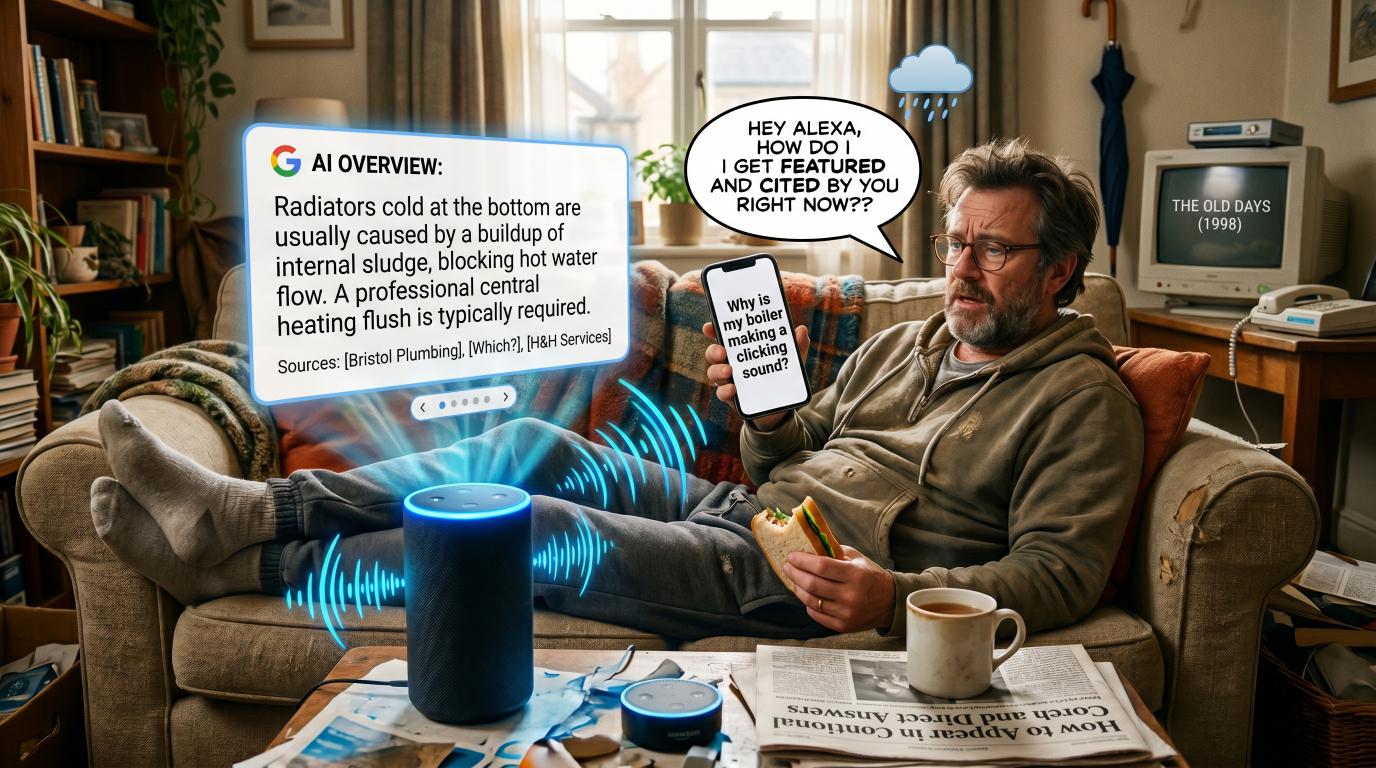
If we want to know if it's going to rain this afternoon, we don't research meteorological patterns. We shout "Will I need an umbrella today?" at a plastic cylinder sitting on our kitchen counter. If we are trying to find out how to reset a boiler, we type the exact question into our phone whilst crouching in a cold hallway, expecting Google to show us the exact steps right on the screen so we don't even have to click a link.
Search engines have adapted to this behavior. They are increasingly giving answers directly on the results page, bypassed by voice assistants and AI summaries. If you want your business to be the one they quote, you need to stop writing like a static brochure and start formatting your information so it's easy for these systems to grab.
What Are Direct Answers and Featured Snippets?
Before we look at how to win these spots, we need to understand what they actually are. When you ask Google a question, it often displays a box at the very top of the page with the answer already pulled out of a website. This is traditionally called a Featured Snippet or a Direct Answer.
These boxes usually come in three different formats:
The Paragraph: A short, sharp definition or explanation of about 40 to 60 words (though, as we will cover in a moment, modern AI models often prefer slightly meatier, self-contained blocks of 100 to 150 words).
The List: A step-by-step guide or a list of items (like a recipe or a tool checklist).
The Table: A clean comparison of data, like prices or sizes.
Google doesn't write these answers. It simply crawls the web, finds a page that has answered the question perfectly, and copies the text onto the search page with a link back to the source. If you win this spot, you are effectively leapfrogging everyone else on the page—including the companies that have spent years building up their traditional rankings.
In the search industry, these direct answer boxes were originally referred to as "Position Zero" because they sit above the very first traditional organic search result.
From "Position Zero" to AI Overviews
While traditional featured snippets are still incredibly common, conversational search has evolved into something much more complex. Today, search engines do not just pull a single paragraph from one website. Instead, they use AI to scan multiple sources at the same time and write a completely unique, conversational summary on the spot.
This is known as an AI Overview.
Understanding the difference between the old featured snippets and these new AI summaries is crucial if you want your website to stay visible:
| Feature | Traditional Featured Snippets | AI Overviews (AIO) |
|---|---|---|
| Source Selection | Lifted from a single, highly relevant webpage. | Synthesised from multiple web sources simultaneously. |
| Presentation | A clean, standalone paragraph, list, or table. | A conversational summary accompanied by a carousel of link cards. |
| Optimization Focus | Strict on-page HTML formatting (H2s and short paragraphs). | Authority, unique data, and a trusted brand footprint across the web. |
To appear in these conversational AI summaries, you cannot just rely on basic formatting anymore. You have to prove to the AI that your website is a trusted authority worth citing in its carousel of links.
How Conversational Search Changes What We Type
When we type a search query on a computer, we tend to use shorthand. We might type "boiler repair Bristol."
But when we search using our voices, or when we chat with an AI assistant, we speak in full, natural sentences. We say: "Who is the best boiler repair company near me that is open now?" or "Why is my boiler making a clicking sound?"
This shift from short phrases to natural questions changes how you need to think about your website's content:
Focus on questions: Your customers are looking for answers to specific who, what, where, why, and how questions.
Target the "long-tail": These longer, more natural phrases are often much easier to rank for than short, competitive terms because most of your competitors are still obsessing over the old, robotic keywords.
Write the way people speak: If you write in a stiff, overly formal tone, you are unlikely to match the conversational phrases people are actually shouting at their smart devices.
Formatting Your Content for the Instant Win
Search engines and AI crawlers are fundamentally lazy. They want to find the perfect answer without having to read a massive article. To help them, you need to structure your pages so the answer is sitting on a silver platter.
The Question-and-Answer Framework
The easiest way to win a direct answer or an AI citation is to structure your text like a conversation. Dedicate a section of your page to a specific, popular question, and then answer it immediately.
Use the question as a heading (H2 or H3): Write it out exactly the same way a human would type or speak it.
Put the answer directly below: Write a clear, concise, 40-to-60-word paragraph that answers the question directly without any filler. Keep this opening answer tight to target a traditional snippet, but let the full, self-contained passage span closer to 100 to 150 words. Modern AI engines look for these slightly meatier, data-dense blocks when synthesizing their conversational summaries.
Expand afterwards: Once you've given the quick answer, you can spend the next few paragraphs going into the deeper details for readers who want to stick around.
[ Heading 2 ] Why is my radiator cold at the bottom?
[ Paragraph ] A radiator that is cold at the bottom is usually caused by a
buildup of sludge and rust inside the system. This debris settles at the
bottom, blocking the flow of hot water. To fix it, you will need to have
your central heating system professionally flushed.
If a search engine crawler sees this clean layout, it can easily lift the heading and the paragraph together and display it as a featured snippet or use it as a key citation in an AI summary.
Pro Tip: If your answer involves a process, use a numbered list directly under your heading. For example, if your heading is "How to bleed a radiator," list the steps: "1. Turn off heating, 2. Locate the valve, 3. Turn the key." Google is highly likely to pull this list directly onto the search page.
Going Deeper: Behind-the-Scenes Structured Data
While writing clearly is the most important step, there is a simple technical trick you can use behind the scenes to tell Google exactly where your questions and answers are. This is called FAQ Schema.
FAQ Schema is a small bit of code you add to your page that translates your content into a format that computers can read instantly. It essentially tells the search engine: "Here is a question a user might ask, and here is our official, expert answer."
You might have heard that using this schema will help search engines display your answers with expandable drop-down menus right in the search results. Google completely killed off FAQ rich results for all websites in May 2026. Those drop-down menus are officially history across the entire web, and Google is spending the summer purging the reporting tools from its Search Console entirely.
However, FAQ schema is still incredibly valuable. Even though it doesn't show up as a visual menu anymore, AI crawlers read this hidden code to instantly pull clean, reliable data. By keeping this schema on your pages, you are making it much easier for AI engines to understand your expertise and link to you as a source.
Pro Tip: Make sure your FAQ schema answers match the text on your page exactly. If your code tells Google one thing and your visible text says another, the search engine will assume you are being deceptive and will ignore your markup entirely.
Beating the AI Summaries (Generative Engine Optimisation)
As search platforms integrate AI summaries directly into their results pages, some business owners worry that giving away quick answers means people will never click through to their websites.
To ensure you still get the traffic from these conversational searches, you need to practice Generative Engine Optimisation (GEO). This means writing content that AI search engines cannot easily replace, forcing them to cite your website in their link carousels.
1. Focus on Information Gain
AI search models are trained to filter out copycat content. If five plumbing sites all repeat the exact same 40-word definition of a boiler problem, the AI will just write its own summary and cite whoever has the highest overall authority.
To win the citation, you need to offer unique value that other sites lack. Include specific case studies, unique data you have collected, quotes from your own named in-house experts, or regional price breakdowns. The AI cannot generate real-world experience; it can only summarise it. If you are the only one providing that real experience, you win the link.
2. Build Your Off-Page Brand Footprint
Conversational engines (like Gemini, Perplexity, and ChatGPT Search) don't just look at your website. They scan the entire web to see what people are saying about you. If your business is frequently mentioned and recommended on forums like Reddit, listed in respected local directories, and cited in digital PR articles or local news, the AI is much more likely to name-drop your business as a trusted recommendation.
3. Clear Author Credentials (E-E-A-T)
AI search engines are deeply paranoid about serving bad or dangerous advice to their users. To protect themselves, they look for proof that the person writing the content actually knows what they are talking about.
Always include a brief author bio at the bottom of your articles, or link to an expert profile page that shows your qualifications, years of experience, and credentials. Establishing this human authority makes your answers look far more secure to a paranoid AI model.
Your Action Plan for Today
You don't need to rewrite your entire website to win these conversational search terms. Start with a few quick wins:
Find your questions: Look through your sent emails or ask your team what five questions customers ask most frequently before they hire you.
Create a dedicated FAQ section: Add these questions and their direct, 100-to-150-word answers to your main service pages or write a dedicated blog post for each one.
Format clearly: Make sure the questions are in H2 headings and the answers are directly below in simple, bulleted lists or short paragraphs so AI crawlers can easily digest them.
Claim your expertise: Add a short author byline to your guides, link to your credentials, and make sure your business is consistently mentioned across local directories to build your brand footprint and optimize for the AI citation carousel.
By structuring your knowledge this way, you stop being just another business shouting about how great you are. Instead, you become the trusted, helpful resource that both your local customers and the search engines are looking for.
More Practical SEO Help
If this article was useful, there is plenty more in our SEO section. We explain what matters, what can safely be ignored and which jobs are better dealt with before they turn into a weekend.
These three are a sensible place to continue:
The Technical Site Flaws That Drop Your Rankings
Why We Write About SEO
We write about SEO because it is part of building a website properly. The page structure, content and search foundations are considered from the start, rather than added later when somebody notices Google has wandered off.
If you choose our ongoing website management, we take care of the website after launch. We plan and write content, publish updates, case studies and reviews, keep important pages accurate, check that search engines can find them, and look after the design, hosting, security and everyday changes. The website stays useful without becoming another job on your list.
Would You Rather We Took Care of It?
Entirely reasonable. If you would like us to build a website with the search foundations in place — and continue looking after it once it is live — tell us what your business needs and we will take a proper look.
What is conversational search?
Conversational search is when somebody asks a full, natural-language question rather than typing a short string of keywords. Search engines then try to understand the intent and give a direct, useful answer.
How should content be written for direct answers?
Use clear headings, answer the question early and explain the detail in plain language underneath. Tables, short lists and well-labelled sections can help when they genuinely make the answer easier to follow.
Does conversational or AI search replace traditional SEO?
No. Helpful content, sound website structure, reliable technical foundations and clear evidence of expertise still matter. New search interfaces use many of the same signals in a different format.