
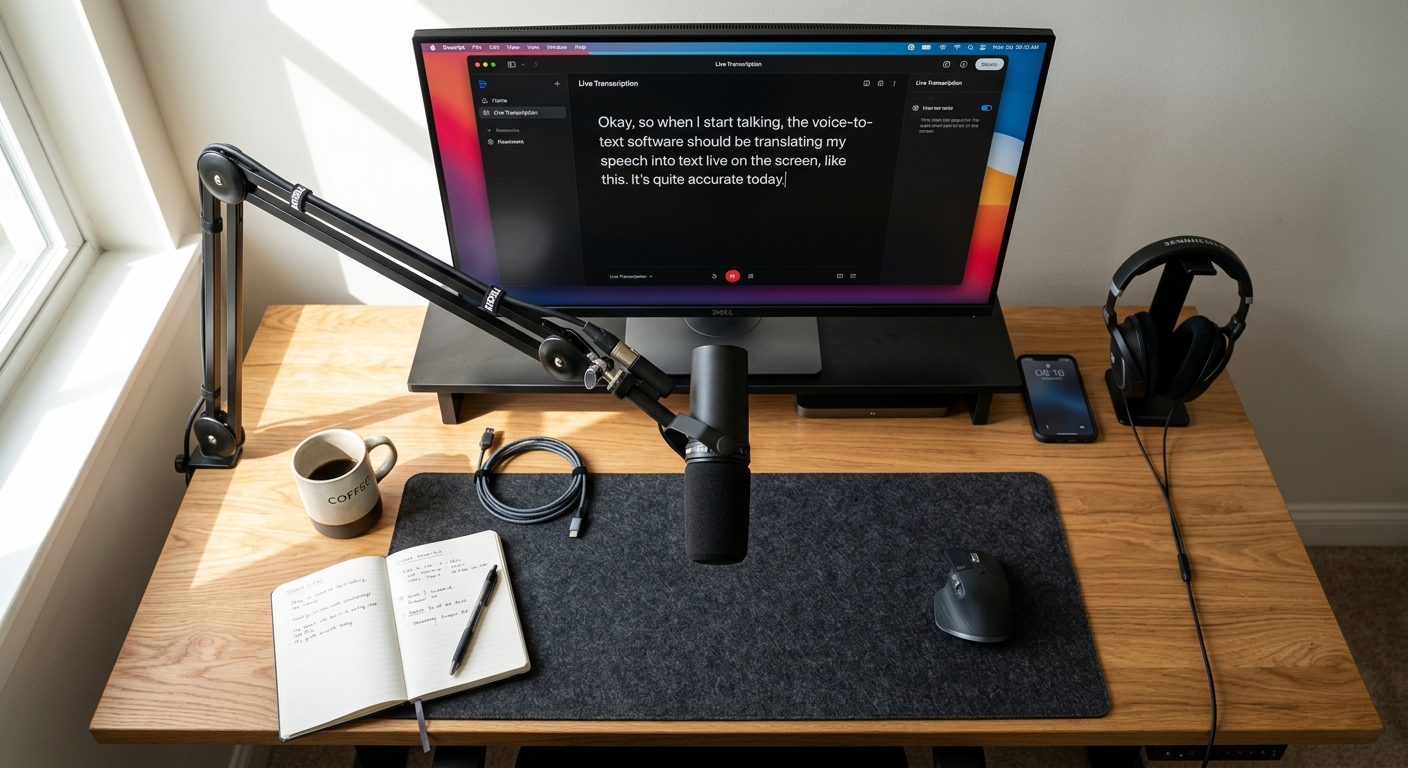
Less Typing, More Talking
Less Typing, More Talking
If you walked into an office thirty years ago, the loudest sound you would hear was the constant, rhythmic clicking of keyboards. It was the sound of work getting done. For a long time, we just accepted that if you wanted to be productive—whether you were writing a book, building a website, or coding a piece of software—your fingers had to do the heavy lifting. You were only as fast as your typing speed.
But things are changing. If you look around today, you'll notice more people wearing headsets or talking to their monitors. They aren't just on Zoom calls; they're actually working. The microphone has quietly moved from being a tool for chatting to being the primary way we create. We are finally moving into an era of less typing and more talking, and honestly, it's about time.
The microphone is becoming our most important tool
For decades, the keyboard was the gatekeeper. If you had a great idea but you were a slow typist, that idea stayed stuck in your head longer than it should have. Even for the fastest typists, there is a physical limit to how many keys you can hit in a minute. Most people can type maybe 40 or 50 words per minute if they're really focused. But we can speak at triple that speed without even breaking a sweat.
The shift toward using a microphone for work isn't just a "techie" trend. It's a practical response to a simple problem: typing is a bottleneck. When you use your voice to write code or draft an article, you're removing the middleman. You're taking the thoughts directly from your brain and putting them onto the screen. It's faster, it's more fluid, and it feels a lot more natural than hunting for the right key in the dark.
Think about how much more you can get done when you aren't fighting with a plastic board all day. We've reached a point where the microphone isn't just a peripheral you plug in for a quick call; it's the center of the workspace. It's the tool that actually lets the ideas out.
Talking is simply faster than typing
The most obvious benefit of voice-to-text software is pure speed. When you aren't limited by how fast your fingers can move, you can get through tasks in a fraction of the time. Think about the last time you had to write a long email or a report. Half the time spent "writing" is actually spent hitting the backspace key to fix a typo or reorganizing a sentence because your hands couldn't keep up with your thoughts.
With a microphone and the right software, that struggle mostly disappears. You can narrate your work while you're making coffee or stretched out on the couch. Because you're speaking at the speed of thought, you don't lose those little sparks of inspiration that often evaporate while you're busy trying to remember where the "percent" sign is on your keyboard. It turns out that when you stop focusing on the mechanics of typing, you have a lot more energy to focus on the quality of what you're actually saying.
It's not just about being "busy" either; it's about being effective. You can fill a website with content or draft an entire chapter of a book in the time it used to take to write a few paragraphs. That kind of productivity isn't just a nice bonus—it changes the way you view your workday.
Letting the software handle the spelling
One of the biggest hurdles people used to have with voice software was the fear of mistakes. We all remember the early days of voice recognition where you'd say "Send the file" and the computer would write "Mend the dial." It was frustrating and usually took more time to fix than if you'd just typed it yourself.
But we aren't in that world anymore. In 2026, the software hasn't just improved; it's evolved. The apps we use now don't just listen for sounds; they understand context. If you're writing a technical document, the software knows the terminology. If you're writing a novel, it understands the flow of a story.
This is especially huge for people who write code. Coding used to be about perfect syntax—one missing bracket or a misspelled variable would crash the whole program. Now, you can tell the computer what you want the code to do, and the software handles the formatting. It knows where the semicolons go. It knows how to spell "asynchronous" even if you don't. You provide the logic, and the microphone/software combo provides the grammar. It takes the stress out of the process because you know the system has your back. You can focus on the "what" and let the computer handle the "how."
Why thinking out loud makes for better work
There is a psychological benefit to talking that we often overlook. There's an old trick in programming where you explain your code to a friend—or even an inanimate object—just to find errors. It works because when you have to say something out loud, you're forced to clarify your thoughts.
Using a microphone to work is like having a constant sounding board. When we talk, we tend to be much more thorough. You might feel like you're being overly wordy or that your thoughts are a bit scattered as they come out, but that extra detail is exactly what the modern AI agent or app needs to see the full picture. By narrating your logic in full, you're providing the context that a short, typed sentence usually misses.
Even if you feel like you're going in circles, the software is smart enough to extract the meaning from that detail. When you see the result, it often makes far more sense than something you would have struggled to condense into a few keystrokes. It's a process of "thinking out loud," and it ensures that nothing important gets left behind.
You don't have to be a developer to build things anymore
This shift isn't just for the experts. In fact, it's probably most exciting for the people who aren't experts. For a long time, there was a barrier to entry for things like web development or software creation. You had to learn the "language" of the machine. You had to learn how to type in a very specific way.
Now, that barrier is falling. Because the software and the microphones have become so sophisticated, you can essentially talk your way into a new career. You can describe a website you want to build, and the software translates your speech into the necessary code. This opens the door for novelists, small business owners, and creative people who have amazing ideas but didn't want to spend years learning how to type complex syntax.
The microphone has become the ultimate equalizer. It doesn't care how fast you can type or if you know where the curly braces are on a keyboard. It only cares about your ideas.
Working wherever you want, not just at a desk
We've all been told for years that "work" happens at a desk. You sit in the chair, you look at the screen, and you type. But why? If the work is happening in your head, why does your body have to be locked in a specific position?
This is where "headless" work comes in. It sounds like a strange term, but it just means working without being tethered to a screen and a keyboard. With modern voice apps, you can develop software or write an entire book while you're walking in a park or sitting on your porch. You aren't just making a voice note to listen to later; the app is actively transcribing your speech into your project in real-time. You're actually getting the job done—regardless of whether you're genuinely on the move or just sitting in the garden debating if it's too early for a beer.
This is a massive shift for our health and our sanity. We weren't built to sit in chairs for eight hours a day staring at blue light. Being able to get up, move around, and still be productive is a game-changer. It makes work feel less like a chore and more like a natural part of your day. You can be out in the world, living your life, and still making progress on your projects.
Software that finally understands what we're saying
It's important to acknowledge that this wouldn't be possible without the massive leaps we've seen in voice recognition. For a long time, voice-to-text was a bit of a gimmick. It was fine for a quick text message, but you wouldn't trust it with a professional project.
Today, the software is smart enough to handle nuances. It understands accents, it filters out background noise, and it learns how you speak. It gets used to your speech patterns and your vocabulary. We've moved past the point where the computer is just guessing at our words. It's actually participating in the conversation.
Yes, mistakes still happen occasionally. No system is perfect. But the difference now is that the mistakes are minor. Fixing a word here or there is a small price to pay for the freedom and speed that the microphone provides. It's becoming more and more efficient every single day, to the point where typing starts to feel like the slower, clunkier option.
A more human way to build things
At the end of the day, using a microphone to work is just more human. We've been talking for thousands of years; we've only been typing for about a hundred and fifty. Talking is how we share stories, how we solve problems, and how we connect with each other. It's our most natural form of communication.
By leaning into voice-automated software, we're finally making the digital world catch up to us, rather than forcing ourselves to adapt to the machine. It makes the act of creation accessible to everyone. If you have a voice and an idea, you can now build something amazing. You don't need to be a world-class typist or a technical genius. You just need to speak up.
The times are changing, and while people will always have a use for the keyboard, it's no longer the only way to be productive. We've spent a century learning how to talk to computers; it's finally time they learned how to listen.
More on Tech Trends
If you enjoyed this article, we've got plenty more where that came from. Our Tech Trends section is full of insights on how technology is reshaping the way we work and build. Here are a few to get you started:
What Cursor is actually doing when it rewrites your code (and why it feels uncomfortably accurate)
No Internet, No Problem: The New Software That Works Perfectly Offline
We Build What We Write About
We write about new technology because without it, we wouldn't be able to make what we make. In fact, we've built our own voice-to-text app called RiWord, which is part of our portfolio of apps, RiCollection.
RiWord isn't just dictation software. It's designed for people who actually work with their voice. Speak naturally and watch your words appear in any Windows application—emails, documents, chat, anything. Need to search the web? Say "find headphones on Amazon" and a browser bubble opens right inside RiWord. No alt-tabbing required. You can even route your text to specific apps—Gmail, Notepad, Teams, Slack—so your words arrive exactly where they're needed.
It wakes with a wake word. Say "Hey RiWord" from across the room and it's ready instantly. No mouse, no keyboard, no interruption to your flow. You can teach it your industry terms and names with the Voice Dictionary, and it learns and applies them automatically. And with Voice Routines, you can create custom voice commands that trigger sequences of actions—multi-step automations, all by voice.
Let's Build Something Together
If you'd like us to customise RiWord for your workflow or build you something entirely new, we'd love to hear from you. So get in touch nd let's talk about what we can create together.
Price guides can be found at the top of the page
Is voice-to-text software actually accurate enough for professional work?
Yes, modern voice-to-text software has evolved dramatically and now understands context, accents, and industry terminology. It's accurate enough to handle technical documents and even coding, with only minor corrections needed here and there.
Can I really write code just by talking?
Absolutely. You can describe what you want the code to do, and the software handles the syntax, formatting, and even knows where semicolons and brackets go. You provide the logic, and the software translates it into proper code.
How much faster is speaking compared to typing?
Most people type around 40-50 words per minute, but you can speak at triple that speed without effort. This means you can draft documents, emails, or even entire chapters in a fraction of the time it would take to type them.