
Local Tag-Teaming: How to Grow Your Business by Helping Someone Else Grow Theirs
If you've spent any time trying to market a new business lately, you've probably noticed something frustrating: it is incredibly noisy out there.
Every business on the high street and on the internet is shouting at the top of their lungs, trying to get the attention of the same group of people. It feels like standing in the middle of a crowded football stadium, trying to have a quiet conversation with someone on the other side of the pitch. You can yell until your throat is sore, but most of what you say is just going to get lost in the din.
But what if you didn't have to shout so loud? What if, instead of trying to find thousands of strangers all by yourself, you teamed up with someone who already has a room full of people listening to them?
We call this local tag-teaming. It's not a complicated corporate merger or a dry legal contract. It is simply a friendly agreement between two businesses to share the spotlight. If you do it right, it's one of the easiest, cheapest, and most natural ways to find new customers.
The Golden Rule: Share the Customer, Not the Service
Before you start knocking on the doors of every shop in your town, we need to establish the ground rule of tag-teaming.
You cannot team up with a direct competitor. If you run a local coffee shop, you aren't going to walk into the cafe across the street and ask them to share their customer list. That's not tag-teaming; that's a hostage negotiation.
Instead, you are looking for businesses that share your exact customer, but sell something completely different.
Think of it like building a perfect dinner menu. You want things that complement each other, rather than fighting for the same space on the plate. Here are a few examples of perfect matches:
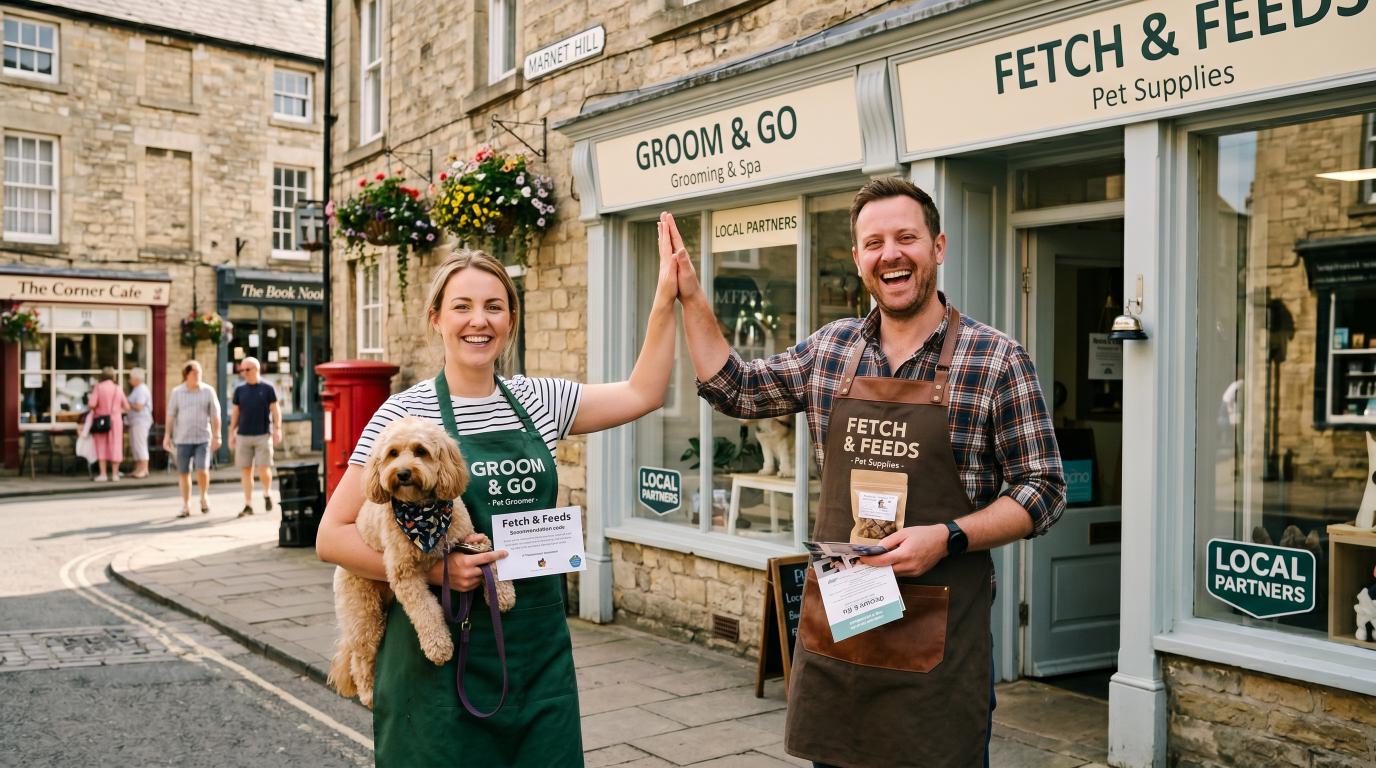
The Pet Groomer & The Local Pet Shop: They both talk to people who treat their dogs better than most people treat their children. But one washes the dog, and the other sells the food.
The Wedding Photographer & The Florist: Every bride needs flowers, and every bride wants photos of those flowers. They are chasing the exact same budget, but they don't compete.
The Bookkeeper & The Commercial Copywriter: Both serve local small business owners who are stressed out and trying to grow. One handles the numbers; the other handles the words.
When you find a business that fits like a puzzle piece with yours, you've found your tag-team partner.
Why This Works (The "Friend of a Friend" Effect)
Think about how you make decisions in your own life. If you need a reliable mechanic, do you trust a random flyer pushed through your letterbox, or do you ask your neighbour who they use?
You ask your neighbour. Why? Because you already trust them.
When you tag-team with another business, you are borrowing their trust. When a trusted local pet shop owner tells a customer, "Oh, if you need a groomer, you should go to Sarah down the road, she's fantastic," that recommendation is worth more than £1,000 of Facebook ads.
The customer isn't taking a gamble on a stranger anymore. They are taking advice from a friend.
The Catch: Don't Hand Your Reputation to a Cowboy
Borrowing trust is a beautiful thing, but it is also a double-edged sword. Trust is incredibly hard to build, and it takes about four seconds to completely destroy.
If that local pet shop recommends Sarah the groomer, and Sarah accidentally nicks a dog's ear or is incredibly rude to the owner, guess who the customer is angry with? Obviously they are angry with Sarah—but they are also quietly furious with the pet shop for recommending her.
Before you agree to partner with anyone, you must do your homework. Treat it like a secret shopper exercise.
Buy one of their products.
Book a small session with them.
Have a chat with some of their existing clients.
If they are disorganised, late, or poor at communicating, walk away. Never, ever put your own hard-earned reputation on the line for someone who doesn't treat their customers with the same care that you do.
How to Get Started: The "Easy Wins"
You don't need a massive marketing budget to start tag-teaming. In fact, the best ideas don't cost anything but a little bit of coordination. Here are four simple ways to set up a partnership:
1. The "Warm Hand-Off"
This is the simplest version of tag-teaming. You and your partner agree to actively recommend each other whenever a customer asks for help.
But don't just leave a dusty stack of business cards on each other's counters. Nobody looks at those. Instead, make it personal.
If you're a florist, and a bride mentions she's still looking for a photographer, you don't just say, "There's a photographer down the road." You say: "You should talk to James. His studio is just around the corner, and he's brilliant with outdoor weddings. Here is his card—tell him I sent you, and he'll take extra good care of you."
2. The "Welcome Basket" Swap
If you run a service-based business, you can create a small physical or digital "welcome pack" for new clients.
If you are a personal trainer, when someone signs up for your sessions, you can hand them a welcome folder. Inside, alongside your workout tracking sheet, you include a voucher for 10% off a local healthy meal-prep delivery service. In return, that delivery service includes your "How to start lifting weights" guide in their delivery boxes.
3. The Joint Workshop or Event
If you want to make a bigger splash, you can run a simple, informal event together.
If you are a local accountant and a commercial estate agent, you could host a free, one-hour evening seminar at a local library called: "Starting a Business in [Your Town]: How to Find Your First Premises and Keep Your Books Straight." Separately, you might struggle to get ten people in the room. Together, you can pool your efforts and present yourselves as the ultimate local experts.
?? A Boring (But Vital) Legal Warning: When hosting an event or sharing resources, do NOT simply swap spreadsheets of customer email addresses. Under UK data laws (GDPR), you cannot share people's private data without their explicit, ticked-box permission. Keep it simple: you email your list about the event, and your partner emails their list. No laws broken, no awkward fines.
4. The Digital Handshake
If you don't have physical premises, you can tag-team online in a matter of minutes:
Collab Posts: If you use Instagram, use the "Collaborator" feature when posting. It puts the exact same post on both of your profiles at once, instantly introducing you to all of their followers.
Website Link Swaps: Have a "Recommended Local Partners" page on your website and link to each other. This doesn't just help customers; Google loves seeing local businesses link to one another, which helps boost you up the search rankings.
Newsletter Shout-outs: Dedicate a tiny corner of your monthly email newsletter to a "Local Business We Love" feature, and ask your partner to do the same.
How to Track It (Without Becoming a Spreadsheet Nerd)
It is very easy to start a partnership with lots of excitement, only for it to fizzle out because neither of you knows if it's actually bringing in any business. You don't need fancy, expensive software to track this. Keep it beautifully low-tech:
The Partner Promo Code: Give your partner a unique, easy-to-remember discount code for their customers (e.g., FLORIST10 or GROOMERFREE). When a customer uses it, you instantly know who sent them.
The "How Did You Find Us?" Box: If you have an enquiry form on your website or a physical sign-up sheet, always include a simple question: "How did you hear about us?" Make sure there is space for them to type a name.
The QR Code: If you print a guide or a flyer to put in your partner's shop, pop a simple, free QR code on the back. You can set it up so that when they scan it, it takes them to a specific page on your website welcoming their customers.
What If It's One-Sided? (And How to Exit Without the Drama)
In a perfect world, every partnership is a 50/50 split of effort and reward. In the real world, things get messy.
One partner might have a bustling high-street shop with thousands of visitors, while the other works from a quiet home studio. Or, frankly, one business owner might just have more time and energy to put into it than the other.
If you send your partner five clients and they send you zero, resentment will start to build. To avoid high-street drama and protect your relationships, use these two simple rules:
Rule 1: Always Set a Trial Period
When you suggest a partnership, never present it as a permanent agreement. Frame it as a short-term campaign.
"Let's try this voucher swap for the summer season and see how it goes."
"Let's run this joint newsletter feature for six weeks, and then have a cup of tea to review it."
This gives you a natural, built-in review date. If it's not working, or if the other person is slacking, you don't have to "break up" with them. You just let the trial end naturally.
Rule 2: Prepare a Polite Exit Ramp
If a trial period ends and you want to pull the plug, you don't need to make an enemy. Keep it professional, polite, and focused on your own business capacity.
"I've loved working with you on this summer campaign, but looking at my calendar for the autumn, I need to focus my time on reorganising our internal systems, so I won't be able to keep up my end of the promotion. Let's wrap this up at the end of the month!"
No blame, no awkwardness, and you can still happily say hello to each other when you bump into them at the local supermarket.
The "What's in It for Me?" Trap (And How to Avoid It)
If you want this to work, you have to approach potential partners the right way.
The most common mistake new business owners make is walking into a local business, handing them a flyer, and saying, "If you put this in your window, I'll put yours in mine." This rarely works because it feels like a transaction. It feels like work. And most busy shop owners already have a million things on their to-do list.
Instead, when you pitch a partnership, you need to lead with how it helps them and their customers first.
The wrong pitch: "Hi, I'm a dog walker. Can I leave my leaflets here so your customers can hire me?" (This asks them to do a favour for a stranger).
The right pitch: "Hi, I know your pet shop gets a lot of busy professional clients. I've put together a simple, free guide called 'How to Keep Your Dog Happy on Busy Workdays' that you can email to your customers or print out. There's no hard sell in it—just genuine advice, with my contact info at the bottom if they need a hand. Would that be useful for your clients?" (This gives them a free, high-quality resource that makes them look good to their customers).
Always make your partner look like the hero. If their customers thank them for introducing you, the partnership will last for years.
Your First Step: Start Small
You don't need to launch a massive, complicated partnership campaign next week. In fact, starting too big usually leads to overwhelm, and the whole idea gets pushed to the bottom of your to-do list.
Instead, start with a simple mapping exercise. Grab a piece of paper and write down three non-competing businesses in your local area that serve the exact same types of clients you do.
Once you have your list, pick just one. Follow them on social media, see what they are up to, and find a natural moment to share one of their posts or leave a genuinely supportive comment on their page. When you are ready to reach out, send a brief, friendly message introducing yourself and mentioning something you sincerely admire about how they run things.
Building partnerships takes a little patience, but starting with a small, helpful gesture is the best way to lay the groundwork for a solid collaboration that helps you both win.
More Marketing Articles Worth Your Time
If you found this useful, we've got plenty more where that came from. We write quite a bit about marketing—partly because we're interested in it, but mainly because it's the sort of thing that comes up constantly when you're running a business and trying to persuade people to give you money.
Here are a few to get you started:
Fixing the "Leaky Bucket": Why the Best Marketing is Keeping Your Old Customers
The Lazy Creator’s Guide: Turning One Good Idea into a Month of Marketing
The honest reason most small business blogs fail (and it's not the writing)
Why We Write About Marketing (And What We Actually Do)
We don't write these articles for fun—well, not entirely. Marketing is part of what we do. When we build your website, we're not just thinking about whether the buttons are pretty or the forms work properly. We're thinking about whether your site actually persuades people to get in touch, whether your message is clear, and whether you're accidentally hiding the most important bits three clicks deep where nobody will ever find them.
Once your site's live, we also offer an ongoing management service where we take care of the boring bits—updates, backups, security, fixing things when they break—so you can focus on running your business rather than Googling "why is my contact form not working" at 11pm on a Sunday.
Would You Like To Work With Us?
If you'd like us to build you a website that actually helps your business grow, or if you've already got one that needs some serious attention, we'd be happy to have a chat about it. No hard sell, just a conversation about what you need and whether we're the right people to sort it out for you.
Get in touch, and we'll take it from there.
Ongoing Website Management Prices
Get To Know Us - Meet The Team
What kind of businesses should I partner with for local tag-teaming?
Look for businesses that serve the exact same customers as you, but sell completely different services. For example, a wedding photographer and a florist both serve brides but don't compete. Never partner with direct competitors—that's the golden rule.
Can I share my customer email list with my tag-team partner?
No, you can't just swap customer email lists—that breaks UK data laws (GDPR). Instead, you each email your own list about joint events or promotions. Keep it simple and legal.
What's the easiest way to start a local business partnership?
Start with a warm hand-off. When a customer asks for help with something you don't offer, personally recommend your partner by name and explain why they're great. It's free, natural, and builds trust immediately.