
The App Store Shortcut: How "Hybrid" Websites are Replacing Phone Apps
Remember 2012? It was a simpler time. Neon clothing was ironically cool, the Macarena of the day was Gangnam Style, and every business on Earth—from global airlines to your local corner bakery—insisted they absolutely needed a custom mobile app.
"There's an app for that" wasn't just a clever Apple marketing slogan; it was a corporate mandate. If your business didn't have a downloadable icon floating on a customer's phone screen, you were practically invisible. We all rushed to download flashlight apps, bubble-wrap popping simulators, and apps for restaurants we visited once a year.
Fast forward to today, and the mood has shifted dramatically. Our phones are bloated, our storage space is constantly crying for help, and consumers are suffering from what psychologists (and exhausted shoppers) call app fatigue.
Think about your own behaviour: when was the last time you voluntarily downloaded a brand-new app for a business you only interact with occasionally? You probably didn't. You used their website, grumbled if it didn't look right on your phone, and moved on.
For modern businesses, this creates a massive dilemma. You want the intimacy and premium features of a phone app—the ability to send notifications, an icon on the home screen, and smooth offline performance—but you don't want to burn your entire budget building something nobody wants to download.
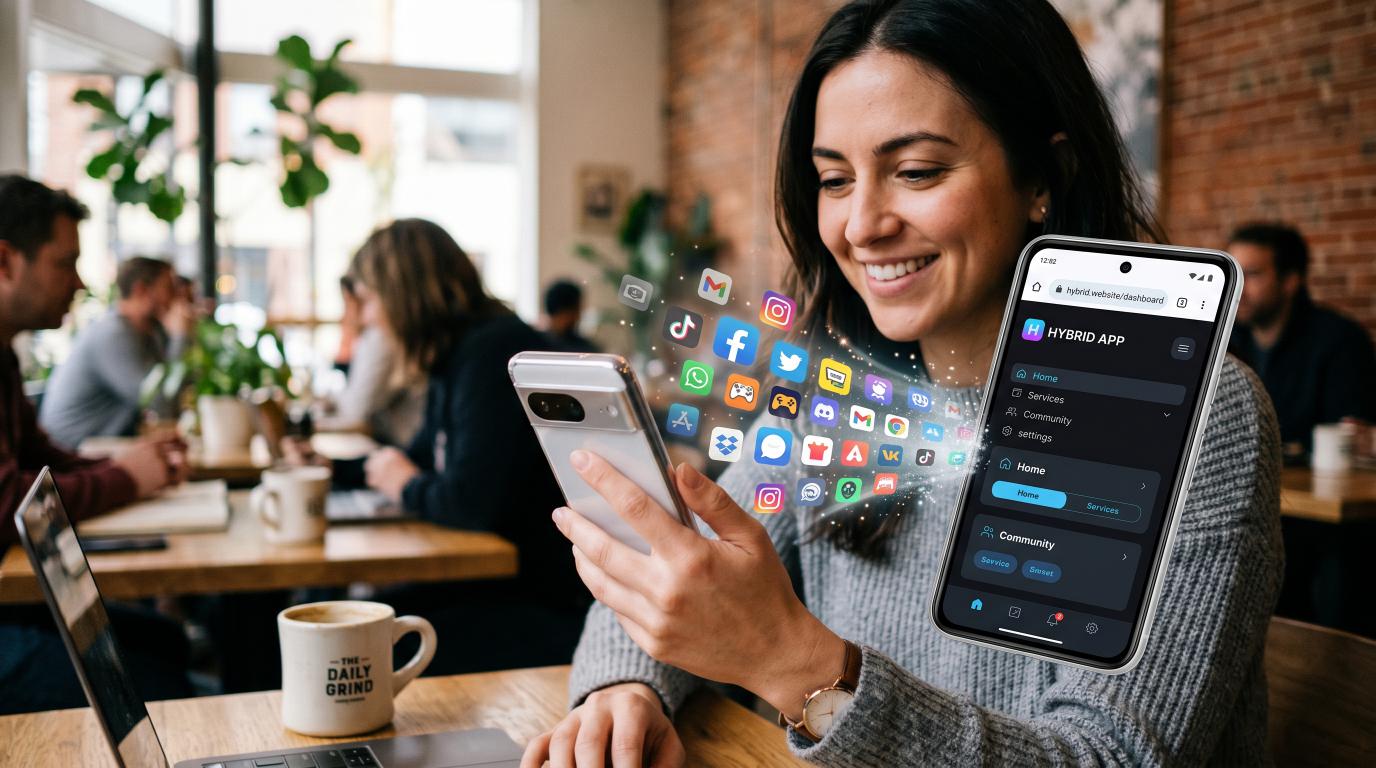
Enter the Progressive Web App (PWA), the digital world's favourite new hybrid shortcut. It is quietly rewriting the rules of the internet, allowing standard websites to act exactly like phone apps without ever forcing users to step foot inside an app store.
The Financial Nightmare of the Two-Room Mansion
To understand why this new hybrid approach is taking over, we have to look at why the traditional way of building apps is fundamentally broken for most businesses.
In the tech world, standard apps are called Native Apps. They are called "native" because they are written in the specific, native language of the physical phone they live on. iPhones speak one language (Swift); Android phones speak another (Kotlin/Java).
Imagine deciding to build a family home, but your household is split right down the middle. Half of them will only live in a house built entirely of red brick, and the other half will only step foot in a house made of blue vinyl siding. They refuse to share rooms. They refuse to share a kitchen. To make everyone happy, you have to build two separate houses from scratch.
This is exactly what a business does when it builds traditional mobile apps. To launch a native app, you have to hire:
An Apple development team to build the iOS app.
An Android development team to build the Android app.
A design team to make sure both versions look vaguely related.
The costs don't stop once the apps are built. Every time Apple or Google updates their phone software, your apps might break. Every time you want to change a sentence, update a price, or launch a new product, you have to update the code in both places, submit the new versions to the app stores, and wait on your knees for their review teams to approve your updates.
For a small to medium-sized business, this isn't just expensive; it's an ongoing financial migraine.
[Traditional Approach]
+-- iOS App (Written in Swift) --> Costs ££,£££ + App Store Approval
+-- Android App (Written in Kotlin) --> Costs ££,£££ + Play Store Approval
[Modern Hybrid Approach (PWA)]
+-- Single Web Codebase --> Works on iOS, Android, & Desktop instantly
The "30% Tax" and the Gatekeepers of the App Store
If the double development cost wasn't enough to make you pause, we need to talk about the gatekeepers: Apple and Google.
When you list a native app in their stores, you are playing in their backyard, which means you play by their rules. If you sell digital services, subscriptions, or virtual products inside your native app, Apple and Google take a massive cut of your revenue.
While you will often hear this referred to as the "30% App Store Tax", the reality is slightly more nuanced, though no less painful. Here is how it actually breaks down for UK businesses:
The Big Business Rate (30%): If your app brings in over $1 million (roughly £800,000) in annual revenue, you will pay the full 30% commission on every digital purchase or subscription.
The Small Business Rate (15%): For smaller businesses earning under that £800,000 threshold, both Apple and Google run "small business programmes" which reduce the fee to 15%.
The Crucial Loophole (Physical vs. Digital): This tax only applies to digital goods and services. If you are selling a physical dress from ASOS, a physical flat white from Starbucks, or a physical taxi ride from Uber, Apple and Google take 0%. But if you are selling an online course, a monthly membership subscription, a digital PDF guide, or premium features in a software tool, you are hit with the 15% to 30% toll.
Imagine losing up to nearly a third of your hard-earned digital sales just for the privilege of letting customers buy from you on their own phones. It is a margin-killer that has sparked fierce legal battles worldwide, including major regulatory scrutiny from the UK's Competition and Markets Authority (CMA).
Furthermore, getting your app approved is a bureaucratic hurdle. Apps are routinely rejected for minor, arbitrary design details, delaying your product launches by weeks or even months.
Progressive Web Apps offer a clean escape route. Because a PWA is ultimately a website, it bypasses the App Store entirely. You don't pay a 15% to 30% toll to tech giants, and you don't have to ask permission to update your own business's software. When you make a change, it goes live instantly to every user the moment they open the app.
What on Earth is a Progressive Web App?
If you stripped away the technical jargon, a Progressive Web App is essentially a website that went to the gym, got an expensive haircut, and learned how to mimic a mobile app perfectly.
To the average user, it looks, feels, and moves like an app you downloaded from the Apple App Store. It has an icon on your home screen. It launches in full screen without the messy web browser search bar at the top. It loads instantly and animates smoothly. But under the hood, it's just a highly advanced website.
Think of it like a chameleon. When a customer visits your website on a laptop, it looks like a beautiful, standard desktop site. But when they visit that exact same web link on their iPhone or Android device, the website recognises the screen size and says, "Hey, would you like to add this to your home screen?" With one tap, a shortcut icon lands on their phone. No app stores. No passwords. No waiting for a heavy download to finish while standing on weak mobile data.
The "Friction" Factor: Why App Stores are Leaky Buckets
In marketing, there is a concept called friction. Friction is any obstacle that stands between a customer and the action you want them to take. Every extra click, every form they have to fill out, and every second they wait for a page to load is friction. And friction is a conversion killer.
Let's look at the traditional journey a customer must take to use a standard mobile app:
[Ad/Promo] ? [Open App Store] ? [Search App] ? [Enter Password/FaceID] ? [Wait for Download] ? [Open App] ? [Create Account]
At every arrow, you lose 10% to 20% of your audience.
By the time they reach the end of that journey, a massive percentage of your potential customers have given up. They lost mobile signal, forgot their Apple ID password, or simply lost interest and decided to scroll through social media instead.
With a PWA, the journey looks like this:
[Ad/Link/QR Code] ? [Tap "Add to Home Screen"] ? [Use App]
That's it. You have bypassed the gatekeepers. Your customer didn't have to clear out storage space, and you didn't have to spend a single penny convincing them to visit an app store.
The Secret Superpowers of Hybrid Websites
You might be thinking, "Okay, so it's just a glorified bookmark on my phone screen. What's the big deal?" If it were just a bookmark, it wouldn't be replacing native apps. PWAs have access to modern browser engines that unlock true phone-like capabilities. Here are the three biggest superpowers they possess:
1. They Work Perfectly Offline
Traditional websites are incredibly fragile. If you lose your internet connection while reading an article or looking at a menu, you are immediately greeted by the infamous "No Internet Connection" screen or a sad cartoon dinosaur.
PWAs use a clever bit of background technology called a Service Worker. Think of a service worker as a tiny, hyper-efficient personal assistant that lives inside the website. The first time a user visits your PWA, this assistant secretly takes a snapshot of all the vital parts of the site—the images, the text, the layout—and saves them directly to the phone's internal memory.
If the user later goes into a Tube tunnel, boards an aeroplane, or walks into a mobile dead zone, the PWA doesn't crash. The personal assistant steps up and says, "No internet? No problem. I saved a copy of the product catalogue right here." The user can keep browsing, filling up their shopping basket, or reading content without a single hitch.
2. Real Push Notifications
One of the main reasons businesses love apps is the ability to send push notifications. It's the ultimate way to grab attention: "Your order is ready!" or "Flash sale ends in 2 hours!" For years, only native apps could do this. Now, modern web browsers allow PWAs to send those exact same pop-up notifications directly to a user's lock screen—yes, even on iPhones, which historically resisted this feature to protect their App Store business. You get a direct, uncluttered communication line to your customer.
3. They Are "Light" as a Feather
Traditional apps are heavy. The average mobile retail or travel app can easily take up 100MB to 500MB of space. If a user's phone is full, your app is often the first thing getting uninstalled to make room for new photos.
Because PWAs leverage the power of the phone's existing web browser, they are incredibly lightweight—often taking up less than 1MB. It is the digital equivalent of a feather versus a brick. A user will never feel the need to delete a PWA to free up space.
Who is Already Using This?
If you think this sounds like an experimental, indie technology, you'll be surprised to learn that some of the biggest brands in the world have already quietly abandoned their native apps in favor of PWAs.
Starbucks: Built a PWA for ordering drinks online. It is 99.8% smaller than their original iOS app, works seamlessly offline so commuters can order while deep underground in a tube station, and resulted in a 2x increase in daily active users.
Pinterest: Found that their native app was too much of a commitment for casual browsers. They built a PWA, and within months, users were spending 40% more time on the site because it loaded in under three seconds on slow mobile networks.
Uber: Designed their PWA to ensure that even users with incredibly old phones and terrible 2G internet connections could still successfully hail a ride without needing to download a massive app.
Is There a Catch?
We believe in candid honesty: no technology is a magical silver bullet for every single scenario. While PWAs are revolutionary for 90% of businesses, they do have a few limitations.
Because they run through a web browser, they don't have total, unrestricted access to every piece of hardware inside a phone. For example, if you are building:
A highly complex mobile game with intense 3D graphics (like Call of Duty Mobile).
An app that needs to constantly track a user's health metrics via smartwatches in the background.
An app requiring advanced biometrics or complex Bluetooth connections.
...then you still need a traditional native app. But if your business goal is to sell products, schedule appointments, share information, run a loyalty programme, stream media, or provide a slick customer dashboard, the limitations of a PWA won't touch you.
The Verdict: The Future is Frictionless
The internet is moving away from walled gardens. Consumers no longer want to download a separate app for every single store they interact with, and businesses can no longer afford to throw tens of thousands of pounds at two separate coding teams just to keep an icon in the App Store.
By turning your business website into a high-performing Progressive Web App, you get the best of both worlds. You get the discoverability, SEO benefits, and low cost of a standard website, paired with the speed, beauty, and engagement of a premium mobile app.
It's not just a shortcut around the App Store—it's a smarter, leaner way to build a digital business.
Want More Insights Like This?
If you found this article helpful, you're in luck—we regularly explore emerging technology trends, digital strategy, and the practical tools that are reshaping how modern businesses operate. Our Tech Trends section is packed with in-depth articles designed to keep you ahead of the curve, from artificial intelligence and automation to the evolving landscape of mobile and web development. Here are a couple to get you started:
No Internet, No Problem: The New Software That Works Perfectly Offline
Why We Stay on Top of Tech Trends
We don't write about progressive web apps, AI tools, and emerging digital platforms just because we find them fascinating (though we absolutely do). Staying on top of technology trends is essential to our work. We build real-world solutions for real businesses, and that means understanding not just what's possible today, but what's coming tomorrow.
For example, we've developed RiOrganise, a progressive web app that puts these exact principles into practice, and we're currently building a dedicated mobile app for TrailTrack—because while PWAs are revolutionary, sometimes a full native app is still the right strategic choice. Each project teaches us something new about what works, what doesn't, and where the technology is heading next.
Let's Build Something Brilliant Together
If you've made it this far, chances are you're thinking about your own digital presence—whether that's finally launching that app idea, transforming your website into something faster and more engaging, or simply wondering what the best path forward is for your business.
We'd love to hear from you. Whether you need a lightning-fast PWA, a polished native app, or just some honest advice on the smartest way to solve your specific challenge, we're here to help. Get in touch, and let's create something that doesn't just look good—but actually works for your customers and your bottom line.
Do I have to pay Apple or Google a percentage if I use a Progressive Web App instead of a native app?
No, you don't. Because a PWA is technically a website, it bypasses the App Store entirely, meaning you avoid the 15-30% commission that Apple and Google charge on digital sales through native apps.
Can a Progressive Web App send push notifications like a real app?
Yes, it can. Modern web browsers now allow PWAs to send push notifications directly to a user's lock screen, even on iPhones, giving you the same direct communication channel that native apps have.
How much does it cost to build a PWA compared to building separate iOS and Android apps?
A PWA is significantly cheaper because you only build one codebase that works on both iOS and Android, instead of hiring separate development teams for each platform. You also avoid ongoing costs like dual app store submissions and platform-specific updates.