
What is Vibe Coding?
For a long time, if someone told a stranger they were a "coder," the listener would picture a very specific type of person. They would imagine an individual sitting in a dark room, surrounded by empty coffee cups, staring at a screen filled with green text that looked like falling rain from The Matrix.
That image was not entirely wrong. For the better part of fifty years, coding was an elite, often exhausting craft. It required a unique willingness to sit in front of a monitor for ten hours a day, arguing with a machine that refused to meet a human halfway. But something has shifted recently. The world has entered the era of "Vibe Coding." It sounds like a buzzword invented by a marketing agency in East London, but it actually describes a profound change in how humans interact with machines—a term famously popularised by Andrej Karpathy in early 2025.
To understand where this is going, it is necessary to look at how developers spent the last half-century getting frustrated.
Fifty Years of Talking to Rocks
At its most basic level, coding is just the art of giving a very fast, very stupid rock (a computer chip made of silicon) a set of instructions. In the 1970s and 80s, those instructions had to be perfect. There was no "close enough" or "you know what I mean." If a programmer was lucky, they had a dusty textbook that weighed as much as a small dog to guide them. If they were unlucky, they were essentially guessing in the dark, typing commands into systems that had less computing power than a modern electric toothbrush.
The "traditional" way of coding required a person to learn a specific language—like C++, Java, or Python. These languages have "syntax," which is just a fancy word for the strict rules of grammar, spelling, and punctuation that a computer requires.
The problem is that computers are the ultimate perfectionists. If a person writes a letter to a friend and misses a comma, the meaning remains entirely clear. The friend's brain automatically fills in the blanks. If a person writes code for a computer and misses a comma, the computer does not try to guess the intent. It essentially throws its hands up, stops working, and refuses to do anything at all.
The Tyranny of the Semicolon: A Spot the Difference
To demonstrate the sheer fragility of this setup, consider a simple configuration list for a "Tea Tracker" application. In a working version of the app, a developer might write a line of setup code like: notifications: true, sharing: true, location: false.
In the broken version, it looks almost identical: notifications: true, sharing: true location: false.
It is incredibly difficult to spot at a glance, but the second version is missing a single comma after the first "true". In the old world of coding, this wouldn't just be a minor typo that the computer highlighted with a friendly warning. It would stop the entire system from building or running. A developer might spend three hours squinting at ten thousand lines of text, drinking lukewarm tea, just to find that one missing character.
This is why, for the last twenty years, developers spent about 20% of their time actually being productive and about 80% of their time acting as high-tech detectives, hunting down their own punctuation mistakes.
The Era of the "Big Website"
Before AI, the most important tool for any coder was not their brain—it was a website called Stack Overflow.
It was a giant, global library of people asking, "Why is my code broken?" and other, often quite grumpy, people replying, "Because you missed a semicolon on line 402, and this question has already been answered." It was a repetitive cycle of copying, pasting, searching, and hoping.
The culture of software development became less about pure logic and more about the patience to navigate forums. People lived in a world where one did not necessarily need to be a mathematical genius to code, but one did need the patience of a saint and the research skills of a private investigator.
A programmer was not so much a "creator" as a "translator." They had an idea in human language and had to painstakingly translate it into machine language. If they did not know the exact "spells" to cast, they were locked out of the room entirely.
Enter the AI
Then, a few years ago, things changed. Artificial Intelligence—specifically Large Language Models—showed up. Suddenly, the computer started to understand human language, nuance, and even sarcasm.
In the era of dusty textbooks, a developer wanting to make a button blue in a classic environment like Windows C++ had to write an intimidating, thirty-word command starting with CreateWindow and filled with cryptic terms like WS_TABSTOP, WS_VISIBLE, and GetWindowLongPtr. Even after writing all of that, they would still have to write several more lines of logic just to handle the colour change.
Today, a person can simply type: "Make the button blue and centre it on the screen." The AI then does the translation. It writes the syntax, handles the semicolons, closes the brackets, and translates the human request into the exact technical code the machine requires.
This was the birth of Vibe Coding.
So, What Actually is Vibe Coding?
Vibe Coding is the shift from "How" to "What." Whether a person is using Cursor’s Composer, Windsurf’s Cascade, Bolt.new, or any of the wide range of other tools available to choose from, the fundamental workflow remains the same: it is about intent.
In the old days, a person had to act like a camera operator, a lighting technician, and a film editor all at once. They had to understand the technical settings of the lens, the wattage of the bulbs, and how to physically cut the film together. If they did not know the mechanics, the screen stayed blank.
With Vibe Coding, the human takes the role of the Film Director. They are not worried about the technical specifications of the camera lens; they are worried about the story. They describe the "vibe" of what is wanted—the intent, the mood, and the goal—and the AI handles the mechanical heavy lifting.
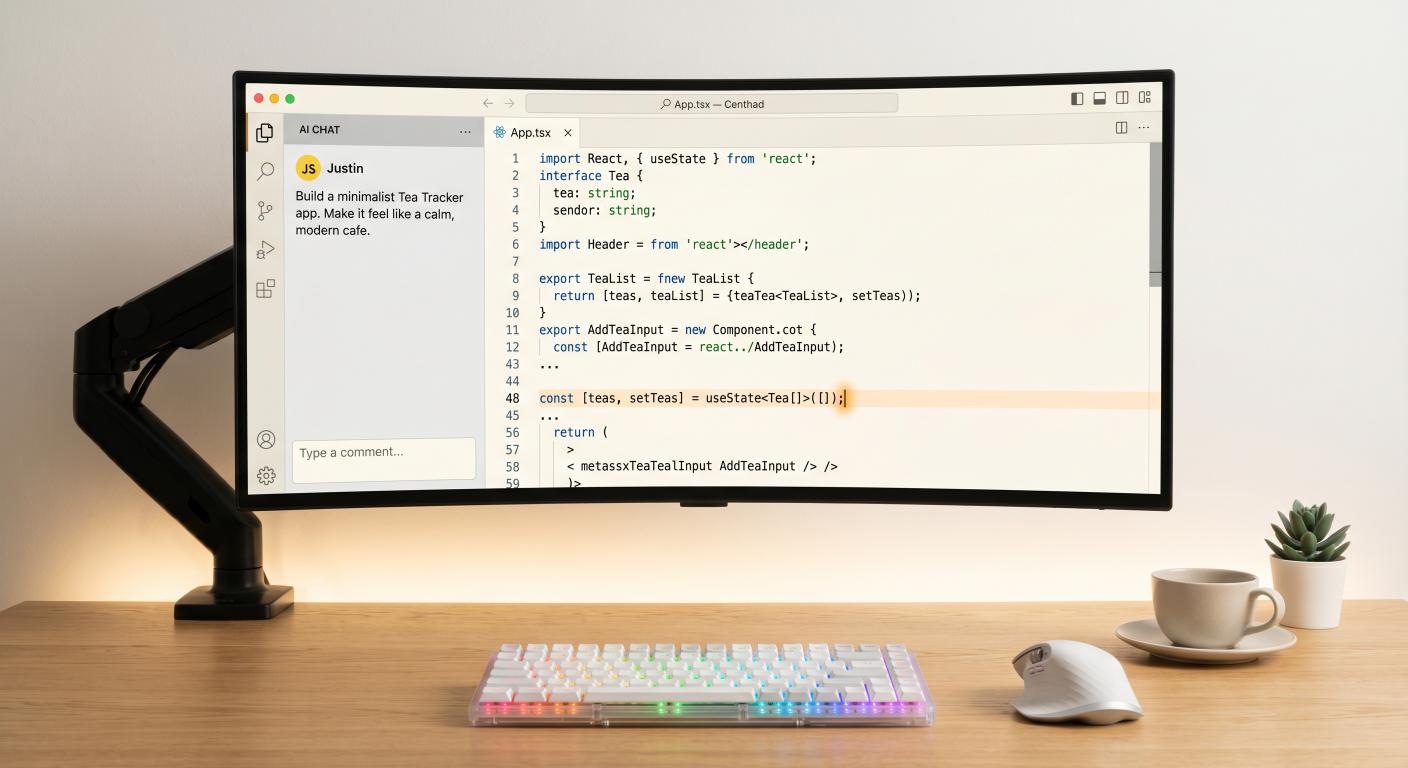
If someone wants to build an app that tracks how many cups of tea are drunk in a day, they do not start by writing "data structures." They tell the AI: "A simple, clean app is needed where a user can tap a teapot icon to save the time. It should feel like a calm, modern cafe."
The "vibe" is: calm, modern, tea tracker. The AI then produces the code. The human does not write a single line of syntax, but they direct the entire process through feedback and intent. If the button is in the wrong place, they don't rewrite the layout logic; they simply say, "Move it a bit to the left and make it look sleeker."
The Role of the Professional
This shift does not mean software developers are going away. In fact, their expertise is more critical than ever. While a person with no experience can now use AI to generate a simple prototype, they often lack the underlying knowledge required to make it stable, secure, or scalable.
An AI is essentially a highly sophisticated prediction engine. It does not "understand" what it is building in the way a human does; it simply predicts which characters and lines of code should come next based on what it has seen before. Because of this, it can make confident mistakes.
Professional developers are still required because they understand the fundamental logic that the AI is merely mimicking. An AI might generate a block of code that looks visually perfect but contains subtle security vulnerabilities that would allow a hacker to steal user data. It might write code that works perfectly for one user during testing but causes a complete system collapse when a thousand people try to use the application at the same time.
Furthermore, software requires constant maintenance and debugging. When a complex system breaks, an AI can struggle to identify "why" because it lacks a true understanding of the application's overall architecture. A human developer, however, possesses the structural knowledge to look under the bonnet, find the logical conflict, and fix it. They are the ones who ensure that the different parts of a massive system—databases, user interfaces, and external servers—all communicate correctly. The AI handles the repetitive labour, but the human developer ensures the integrity and safety of the final product.
The Democratisation of Ideas
The most exciting part of Vibe Coding is that it opens the gates for everyone else. For fifty years, if a person had a brilliant idea for a new tool or a community website, they were stopped by the "Syntax Wall." If they could not afford a computer science degree or did not have the time to learn where the semicolons went, their idea died.
Vibe Coding removes that wall. It allows an entrepreneur, a teacher, or a coffee shop owner to describe their vision to a machine and see it come to life. They can "vibe" their way into a working model.
As we move through 2026, this is already evolving into what is known as "Agentic Engineering." Users are no longer just prompting a single AI; they are managing a team of specialised AI agents—one for testing, one for the backend, and one for styling. The machine is no longer a stubborn rock that refuses to cooperate; it has become a collaborative partner.
The world is moving away from an era defined by how well a person can speak "Machine" and into an era defined by how well a machine can understand "Human." The future of technology is no longer restricted by a person's ability to memorise punctuation. It is now defined by the quality of their ideas. The machine is finally listening.
More Technology Worth Keeping an Eye On
Technology moves quickly, although not every new tool deserves a marching band. These three articles look at other changes that may genuinely affect how useful software is designed and built.
Why We Write About Technology
Keeping up with modern technology is part of building software well. We need to know which languages, platforms and development methods solve a real problem, which introduce new risks and which are mainly enjoying a noisy week on the internet. That knowledge helps us choose the right foundations for what we code, rather than simply reaching for whatever was fashionable last Tuesday.
A Few Things We Have Built
TrailTrack combines mapping, route planning, personal records and community features in one platform. RiCreate turns a complicated publishing process into a manageable workflow, while RiNet provides a foundation for internal tools and information. They are useful examples of modern technology being chosen for a purpose, not for the pleasure of adding another logo to a diagram.
Have Something You Want to Build?
Tell us what the business needs and what is getting in the way. We can decide which technology actually suits the job, build the system and leave the fashionable experiments somewhere safer.
What is vibe coding?
Vibe coding is an informal term for describing the result you want to an AI coding tool and iterating on what it produces, often without writing every line by hand.
Is vibe coding enough for production business software?
Not by itself. Production systems still need architecture, security checks, testing, data protection, accessibility and somebody who can understand and maintain the result.
How can experienced developers use AI coding tools safely?
They can use AI to explore ideas and accelerate routine work while reviewing the code, testing behaviour, checking dependencies and keeping responsibility for the finished system.