
The Lazy Creator's Guide: Turning One Good Idea into a Month of Marketing
According to the self-proclaimed internet "gurus," the secret to growing your business is simple: you just need to post on social media three times a day, every single day, until the heat death of the universe.
They insist that you need to be a filmmaker on TikTok, a philosopher on LinkedIn, and a photographer on Instagram—all while running your business, managing staff, and occasionally trying to see your family.
Frankly, it's exhausting just reading about it.
Most normal business owners start out with the best of intentions. They spend four hours on a Sunday night trying to edit a video with transitions and effects, post it on Monday morning, get seven likes (three of which are from their mum), and then feel so defeated that they don't post again for three months.
The problem isn't that you're lazy. The problem is that you are trying to be a full-time content creator when you already have a full-time job.
The secret to marketing your business without losing your mind is actually quite simple: Stop making new stuff. Instead, take one good idea and slice it so thin it feeds your audience for a month.
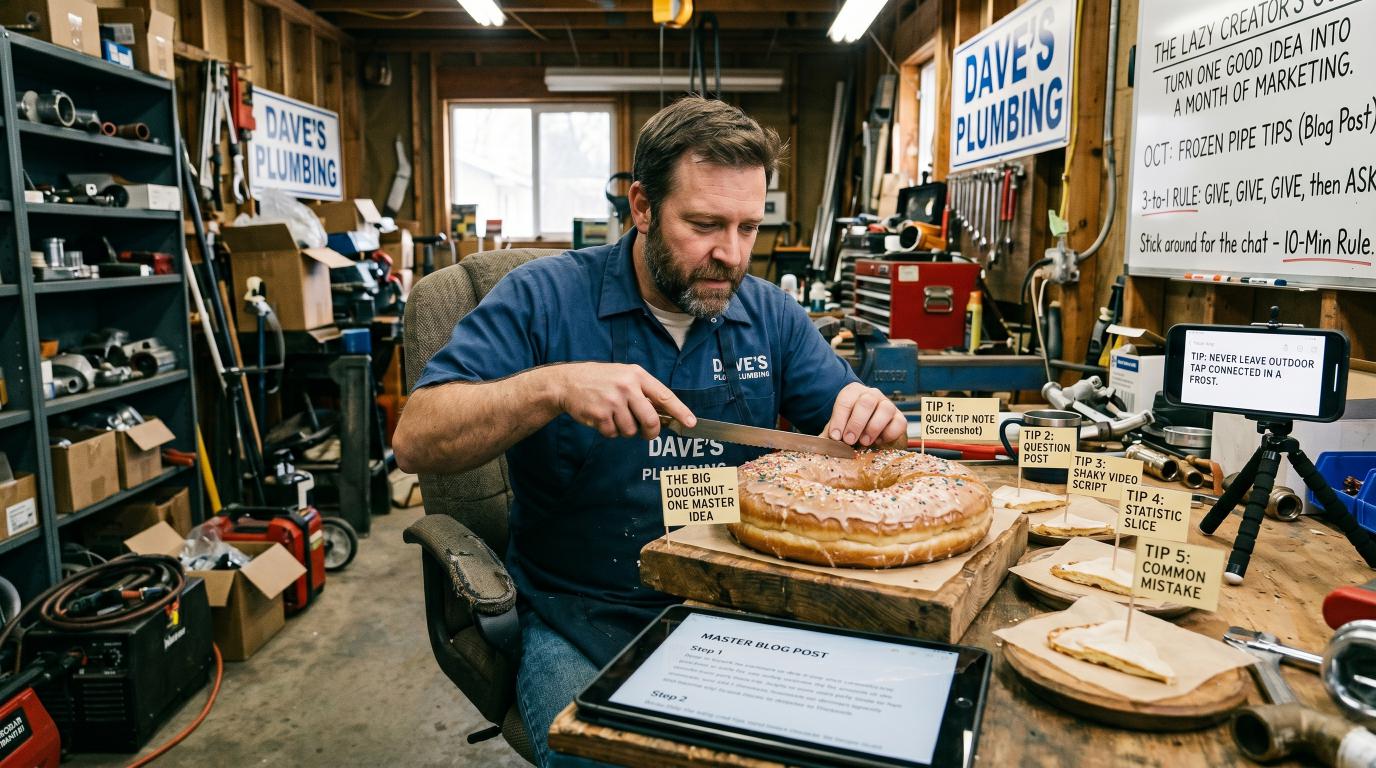
The "Big Doughnut" Method
To understand how this works, we have to look at the anatomy of an idea. Most of us think that if we want to post a few times a week, we need a constant stream of brand-new thoughts. We don't. We just need one "Big Doughnut."
Imagine you spend some time making a single, massive, perfect gourmet doughnut. You've got the dough right, the filling is spot on, and the glaze is beautiful. You don't just shove the whole thing into your mouth in one go.
Instead, you take a few pieces of the dough to make "doughnut holes." You save a bit of the filling to show people what's inside. You take a photo of the glaze.
In marketing terms, your "Big Doughnut" is one meaty, helpful piece of information that solves a common problem for your customer. Once you've created that, the rest of your month is just serving up the crumbs.
Step 1: Write Your Master Copy
Once a month, sit down for an hour. Don't worry about cameras, graphic design, or hashtags yet. Just think about one question a customer asked you this week, or one common mistake you see people in your industry making.
If you're a plumber, maybe it's how to stop your pipes freezing in a cold snap. If you're a gardener, it might be the three things you must do to your lawn in autumn. If you're a bookkeeper, it might be the most common receipt people forget to claim.
Write this down as if you are explaining it to a friend over a pint.
Now, instead of sending this as an email that will immediately get lost in your customers' inboxes, publish it as a blog post on your website first.
Don't panic—this isn't about mastering complex SEO keywords. It is simply about putting your helpful advice in a place where Google can find it. An email dies the second it is read. A blog post on your website lives forever. Years from now, when a local resident searches Google for help with a frozen pipe, your old post will pop up and win you a customer while you sleep.
Once it is published on your website, you can copy and paste the text into an email to send to your current customers. Step one is done.
Step 2: Let AI Do the Chopping
Now that your master post is live, you are going to slice it into smaller pieces. Normally, this is where you would have to spend time combing through your own text trying to find good quotes. But because we are being genuinely lazy, we are going to use a shortcut.
Open up a free AI tool. Copy your entire blog post, paste it in, and ask it to give you five short, punchy tips based on the text.
In about three seconds, the AI will do the hard work for you. It will hand you five simple, ready-to-use tips.
To post these on social media, you don't need to learn complicated graphic design. The absolute easiest way is the Notes app trick. Type one of your AI-generated tips into the Notes app on your phone, take a screenshot of it, and post that image to Instagram or Facebook. It sounds ridiculously simple, but people love reading short, informal notes on social media because they look like they were written by a real human, not an advertising agency.
Step 3: Record a Shaky Video
The final slice of your monthly doughnut is a quick video. People are often terrified of video because they think they need to look like a professional presenter. You don't. In fact, if your video looks too polished, people will probably just scroll past it because it looks like a corporate advert.
People buy from people. They want to see the real you, in your real environment, holding a real tool.
Take your phone, walk into your workspace, and spend 60 seconds talking about one of the points from your blog post. Don't edit it. Don't add dramatic music. Just say: "Hi everyone, I was just thinking about those freezing pipes I wrote about on our website this week. One quick thing people always ask is..."
That's it. You've just created your video slice. It is authentic, it is genuinely helpful, and it took you exactly one minute to record.
Stick Around for the Chat
If there is one trap that ruins this simple strategy, it is the "post and ghost" habit.
Modern social media platforms are not digital billboards where you just hang up a poster and walk away. If you just dump your screenshot or video and immediately close the app, the system won't bother showing your post to anyone. They want to see active conversations.
You don't need to spend hours on your phone, but you should commit to staying on the app for just ten minutes after you post.
Use that time to reply to any comments on your page, leave a friendly word on a couple of other local business profiles, or search for local tags and say a quick hello to people in your area. Treating the app like a quick chat down the pub, rather than an advertising megaphone, will instantly get your posts seen by more local screens.
What If Nobody Cares?
Because this is a monthly cycle, you might worry about choosing the "wrong" topic and wasting your time.
If your chosen topic for the month happens to be a bit of a dud, don't sweat it. You are only posting one master article, a handful of quick notes, and one short video over the course of four weeks. You haven't invested hours of sweat and tears into it.
If you notice that your posts are getting absolute silence, don't try to force it. Let the month finish, and simply pick a different, more practical question for the next month. If you are ever stuck for ideas, just ask your customers directly: "I'm writing next month's guide. Would you rather learn how to prune roses, or how to get rid of weeds?" Let them tell you what hurts, and then help them fix it.
Authenticity Beats Polish
The biggest hurdle for most business owners isn't a lack of time; it's the fear of looking "unprofessional."
But in the world of local business, "professional" often just means "boring." A photo of your actual, messy desk or a quick video of you in your work gear is a thousand times more engaging than a generic stock photo of people in suits.
Be the lazy creator. Spend less time worrying about being perfect, and more time just being helpful. Your customers—and your weekend schedule—will thank you for it.
More Where This Came From
If you found this useful, we've written quite a lot about marketing. It's not something we do for fun on rainy weekends—it's actually part of our job. When you run a web design company, you end up thinking about things like this whether you like it or not.
Here are a few more pieces to browse through:
Google Search Console for Beginners: Opening the Bonnet on What It Is (And Why You Need It)
Why your marketing probably shouldn't be on TikTok (even though everyone says it should)
Why We Write About Marketing
The reason we know a bit about marketing is because it's part of what we do when we build websites for clients. Getting the site built is only half the job—you also need people to find it and actually use it. That's where the marketing side comes in.
We also offer an ongoing management service where we look after all of this for you. The website stays updated, the content keeps flowing, and you get on with running your business. It's particularly useful if you'd rather not spend your Sunday evenings wrestling with blog posts.
If You'd Like to Work Together
If you'd like us to build you a website, or if you've already got one but wouldn't mind someone else taking care of the upkeep and marketing side of things, just get in touch. We're based in The Lake District, we speak like normal humans, and we're generally quite good at what we do. And modest.
Ongoing Website Management Prices
How often do I actually need to post on social media for my business?
You don't need to post three times a day like the gurus say. Instead, create one solid piece of content (like a blog post) once a month, then slice it into smaller pieces—a few social posts, a video, and some quick tips—to spread across the month without burning yourself out.
Why aren't people seeing my social media posts even though I'm posting regularly?
You're probably posting and then immediately leaving the app. Social platforms want to see engagement, so stick around for 10 minutes after posting to reply to comments, chat with other local businesses, or interact with your community—treat it like a conversation, not a billboard.
What if I pick a topic for my content and nobody seems interested?
It depends on how much effort you've invested, but with this method you've only created one blog post and a few quick posts, so just let the month finish and pick a different topic next time. If you're stuck for ideas, ask your customers directly what they'd like to learn about.