
The Three-Option Trick: Letting Your Pricing Do the Selling For You
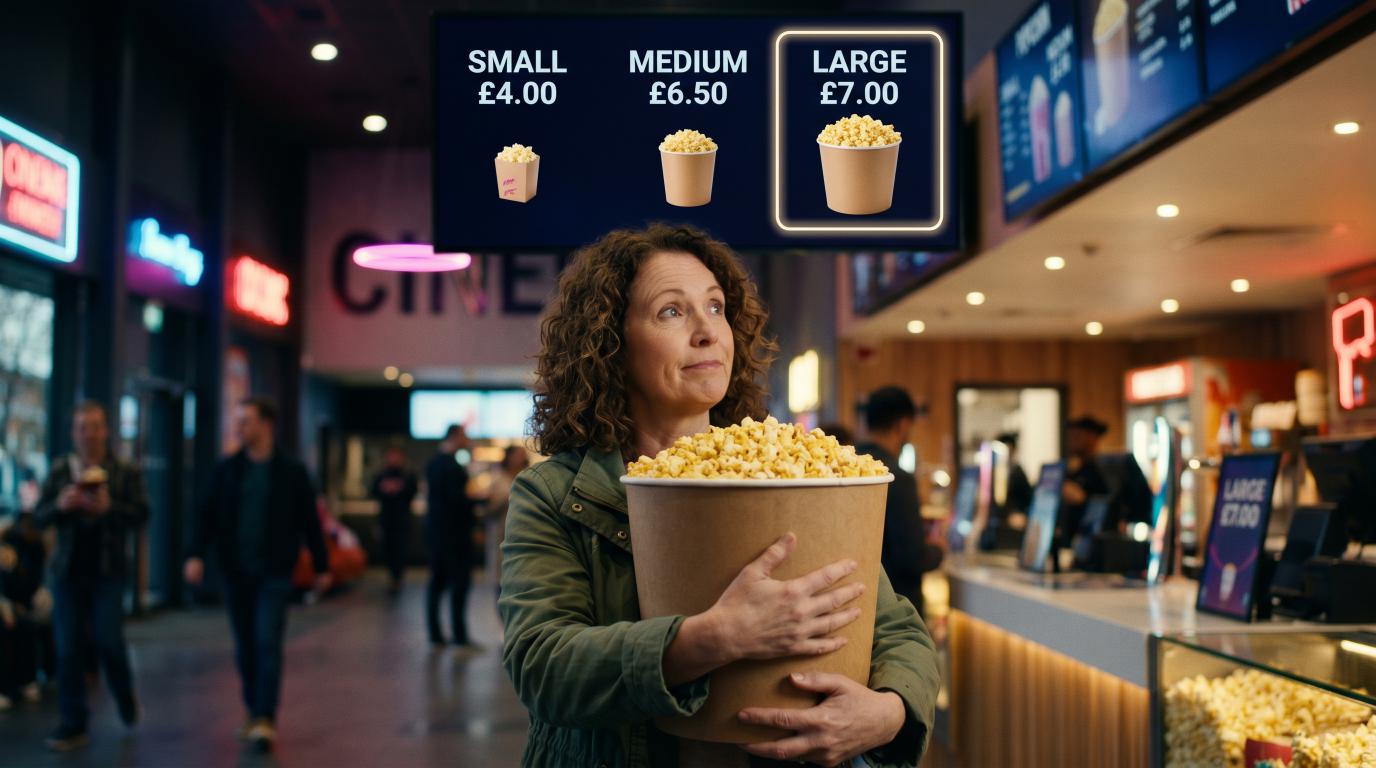
The next time you walk into a cinema, take a close look at the popcorn board.
You will almost certainly see three sizes. The small box is £4. The medium box is £6.50. The large box—which looks roughly the size of a builder’s bucket—is £7.
When you see those numbers, your brain does some rapid, unconscious maths. You look at the small and think, too tiny. You look at the medium and think, well, for just 50p more, I can get the massive bucket.
So, you buy the large. You walk away clutching a bucket of popcorn you didn't really want, feeling like you’ve somehow beaten the system.
But you haven't. The cinema didn't want you to buy the medium popcorn. In fact, the medium popcorn only exists to make the large popcorn look like an absolute bargain. It is a psychological decoy.
For a new business owner, this is incredibly good news. It means the way you list your prices can actually do the marketing for you. By giving people three carefully structured choices instead of just one, you change their internal question from "Should I buy this?" to "Which of these options is best for me?"
Why Two Options Fail (The "Yes or No" Trap)
Most small businesses start out by offering a single service at a single price.
"I am a copywriter. I will write a sales email for £200."
When you do this, you put your potential customer in a corner. You are forcing them to make a binary, "yes or no" decision. They either want to spend £200 with you today, or they don’t. Because they have nothing to compare your price to, they will often go looking for other copywriters to see if £200 is a normal price. You've sent them straight into the arms of your competitors.
If you offer two prices—say, a Basic and a Premium—you create a different problem. Human beings are naturally risk-averse. When faced with only two choices, we almost always default to the cheaper one because we are worried about overspending.
But when you introduce a third option, the entire psychology changes. Suddenly, the middle option feels like the safe, sensible, "just right" choice.
The Decoy vs. The Compromise
Before we build your three tiers, we need to make an important distinction.
Cinemas use a strategy called the Decoy Effect. Their goal is to force you to buy their absolute most expensive option (the Large popcorn). To do this, they make their middle option awkwardly expensive, so the top option looks irresistible.
However, unless you are selling physical goods like popcorn or software upgrades, your goal as a service-based business is usually different. You don't want to push everyone to your most expensive tier, because your top tier likely requires a massive amount of your personal time and energy to deliver.
Instead, you want to use the Compromise Effect. Your goal is to guide the vast majority of your customers comfortably into your middle option—your sweet spot. It is the option that is highly profitable for you, easy to deliver, and perfect for 80% of the people who find you.
To do this, we structure your pricing like the three bowls of porridge in the Goldilocks story: one is too cold, one is too hot, and one is just right.
The Goldilocks Strategy: How to Build Your Three Tiers
To guide people to your middle tier, you need to structure your three options with a very specific balance of price and value.
Tier 1: The "Too Cold" Option (The Budget Anchor)
This is your cheapest option. It should be a bare-bones version of your service. It gets the job done, but it doesn't include any frills, speed, or extra care.
The main purpose of Tier 1 isn't actually to be bought. Its job is to act as an anchor. It shows people what the absolute baseline price is, which makes your higher tiers feel like a massive leap in value.
Tier 2: The "Just Right" Option (The Sweet Spot)
This is the option you actually want to sell. It is packed with value, covers almost everything your ideal customer needs, and leaves them feeling completely looked after.
To make this the obvious choice, Tier 2 should offer a huge jump in value from Tier 1, but only a moderate jump in price.
Tier 3: The "Too Hot" Option (The Luxury Anchor)
This is your expensive, high-end package. It includes everything in Tier 2, plus highly personal attention, faster delivery, extra consultations, or premium features that require a lot of your time.
You should price Tier 3 significantly higher than Tier 2.
The beauty of the Luxury Anchor is that even if nobody buys it, it performs a vital function: it makes Tier 2 look incredibly reasonable. A £500 service feels expensive on its own. But a £500 service sitting next to a £1,500 service suddenly feels like a sensible, modest compromise.
The Magic Math (The Pricing Ratios)
You don't need to guess wild numbers to make this work. In pricing psychology, there is a simple formula you can use to calculate your gaps.
A brilliant rule of thumb for guiding people to your middle option is the 1x : 2x : 4x ratio.
Let’s say you run a local dog training business, and you decide that your baseline, bare-bones package (Tier 1) is £100. Using the ratio:
Tier 1 (The Baseline): £100
Tier 2 (The Sweet Spot): £200 (Twice the price of Tier 1, but contains three times the value)
Tier 3 (The Luxury Anchor): £400 (Four times the price of Tier 1, making Tier 2 look like an absolute steal)
By sticking to this kind of spacing, the jumps between your prices make logical sense to the human brain. The leap from Tier 1 to Tier 2 feels entirely worth it for the extra features, while the leap to Tier 3 feels like a luxury that most people will happily decline in favour of the safe middle ground.
The Visual Center Stage
The numbers on the page are only half the battle. How you present them visually is just as important.
Human eyes are lazy. When we look at a pricing page with three columns side-by-side, our eyes naturally gravitate toward the middle column. Psychologists call this the Center-Stage Effect.
You can use this visual habit to double the effectiveness of your pricing menu:
Highlight the Middle Column: Give your Tier 2 column a slightly different background colour, or make the box slightly larger than the other two so it physically stands out.
Add a Badge: Place a small, simple banner at the top of Tier 2 that says "Most Popular" or "Best Value".
Make the Button Stand Out: Make the "Buy Now" or "Enquire" button on Tier 2 a bright, solid colour, while keeping the buttons on Tier 1 and Tier 3 a more subtle outline style.
By doing this, you are silently telling your customer: "This is the one that everyone else buys, and it’s the safest place for you to click."
A Rose by Any Other Name (Tier Naming Psychology)
The words you use to name your packages can quietly nudge your customers upward, or accidentally scare them away.
The biggest mistake is calling Tier 1 "Basic" or "Cheap". Nobody wants to feel like a cheapskate. If a customer buys a package called the "Budget Plan," they feel a little bit of shame when they click the button.
Instead, you want to validate their choice. Frame Tier 1 with terms like "The Essentials" or "Starter". This tells the customer that they are being smart and practical, not stingy.
For Tier 2, use aspirational words that sound complete and satisfying—like "Standard", "Growth", or "The Core Package".
For Tier 3, use words that imply luxury and high-touch care—such as "Complete", "Premium", or "Pro". This makes the high price tag feel justified because it is clearly a premium tier.
The Danger of Choice Paralysis
Once business owners discover the power of pricing tiers, they often go a bit wild. They start offering a basic package, a silver package, a gold package, a platinum package, and a bespoke executive package.
Before they know it, they have a pricing menu that looks like a high-street takeaway leaflet on a Friday night.
This is a massive mistake. When you give people too many choices, their brains simply shut down. This is called "choice paralysis." When a customer gets confused by too many options, they don't buy the cheap one—they just close the tab and leave.
Keep your options strictly limited to three. If you can’t fit your business into three clear tiers, you are overcomplicating what you sell.
The "Fake Decoy" Warning
There is a fine line between clever pricing psychology and treating your customers like idiots.
Consumers today have an incredibly sharp radar for manipulative sales tactics. If you create a Tier 3 option that is ridiculously overpriced but offers absolutely nothing of actual value, people will see right through it. They will realise you are trying to manipulate them, and you will lose their trust instantly.
Every single option on your menu must be a genuine, high-quality offer.
If someone actually decides to buy your Tier 3 luxury package, you must be fully prepared to deliver an absolute masterclass in service that justifies the price. If you aren't prepared to do the extra work for Tier 3, do not put it on the menu.
What If You Don't Sell "Packages"?
If you run a business that sells standardized products—like a gym membership, a cleaning subscription, or a lawn care service—putting three packages on your website is easy.
But what if you run a bespoke service business? What if you are a commercial painter, a custom landscape builder, or a bespoke copywriter? You can't just put "Standard Garden Redesign: £2,500" on your homepage because every garden is completely different.
The secret here is to use the Three-Option Quote.
The next time a client asks you for a price on a custom job, do not send them a single number. Instead, send them a proposal with three different ways they can work with you on this specific project:
Option A (The Essentials): The absolute minimum required to solve their problem. "We will prep and paint the main office walls using standard trade paint." (£1,200)
Option B (The Premium Finish): The ideal solution. "We will prep and paint the walls using premium, wipeable paint, paint the ceilings and skirting boards, and complete the work over a single weekend so your team experiences zero disruption." (£1,800)
Option C (The Complete Overhaul): The dream scenario. "Everything in Option B, plus we will replace the old light fixtures, install custom feature wall panelling, and provide a free touch-up service in six months’ time." (£3,500)
By presenting your quotes like this, you stop negotiating on price. The customer is no longer trying to beat you down from £1,800 to £1,500. They are simply sitting at their desk, looking at the three options, and trying to decide which level of service they want to invest in.
Your First Step: Sketch the Tiers
You don't need to completely overhaul your website tonight to start using this. Just grab a scrap of paper and look at your most popular service.
If you currently sell it for a single flat rate, write that number in the middle of the page. That is your Tier 2.
Now, look at what you could strip away to make a cheaper, bare-bones version. That is your Tier 1. Finally, dream up the absolute rolls-royce version of that service—the one where you hold their hand through every step of the process. Price it high, and write it on the right. That is your Tier 3.
Give your customers the power of choice, and let your pricing menu do the hard work of selling for you.
What If You Just Want to Run Your Business?
Look, we know there is a lot to take in when it comes to marketing. You started your business to do what you love, not to spend your evenings agonizing over psychological pricing or screaming at Google's algorithm. If you don't want the stress of managing all of this, we can take the entire thing off your plate. We don't just build your website; we handle the ongoing management, SEO, and marketing from top to bottom. We do the heavy lifting behind the scenes so you can get back to doing what you actually do best. To find out more about both, you'll find these helpful:
Take a Look at our Ongoing Management
On the other hand, if you’re the type who loves peering behind the curtain and learning how this stuff works, you're in the right place. We have a whole library of practical, fluff-free articles just like this one, designed to help you outsmart your competition. Dive in, have a read, and start testing these tricks on your own business today.
The "First Date" Rule: Don’t Propose to Your Customers Too Fast
The Lazy Creator’s Guide: Turning One Good Idea into a Month of Marketing
Why Showing Your Mistakes and Bloopers Actually Sells
What's the ideal price gap between my three pricing tiers?
A good rule of thumb is the 1x : 2x : 4x ratio. If your basic tier is £100, make your middle tier £200 and your premium tier £400. This spacing makes the jumps feel logical to customers while making your middle option look like brilliant value.
How do I use three-tier pricing if every job I do is completely different?
Use the Three-Option Quote. Instead of sending a single price, send every potential client three different versions of how you could solve their specific problem—a bare-bones option, an ideal solution, and a premium version. This shifts the conversation from haggling over price to choosing which level of service they want.
How many pricing packages should I show on my website?
Stick to exactly three. When you give people too many options, they experience choice paralysis and often just leave without buying anything. Three tiers is the sweet spot—it gives enough choice without overwhelming people.