
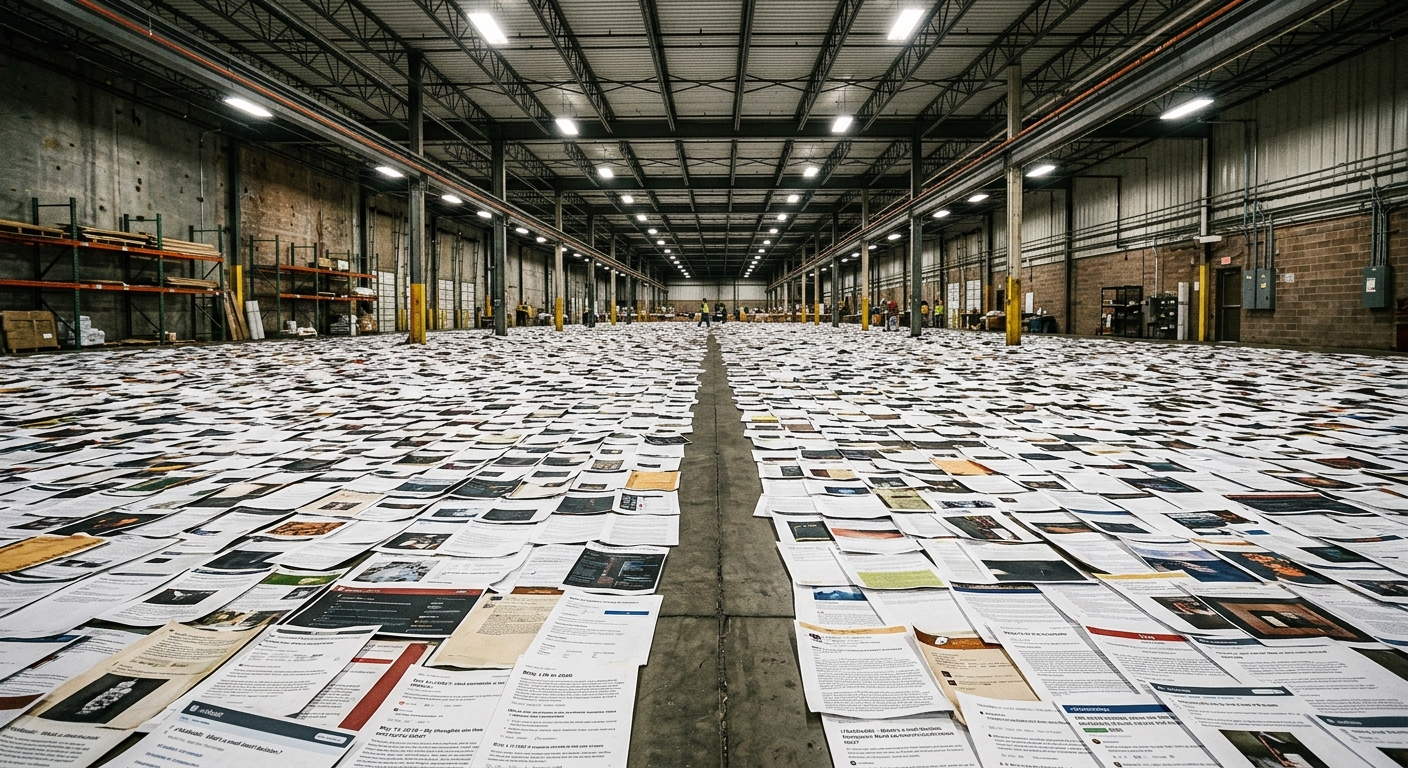
What AI training data actually includes (and why it definitely read your blog in 2019)
There's something faintly unsettling about the realisation that the AI you're casually asking to write your meeting notes was trained on a significant portion of everything publicly available on the internet between about 2016 and 2022. Not curated highlights. Not carefully selected educational material. Just vast, indiscriminate swathes of the web, hoovered up and compressed into mathematical relationships that somehow produce coherent sentences.
Which means yes, it almost certainly read your blog. And your competitor's blog. And that forum post you wrote in 2019 explaining why someone's technical implementation was completely backwards. All of it got fed into the machine.
The datasets everyone's built on
Most large language models were trained on some combination of Common Crawl (a non-profit that's been archiving the web since 2008), WebText or WebText2 (which is essentially "lots of pages that Reddit users linked to"), and various scraped datasets of books, Wikipedia, and academic papers. Common Crawl alone contains petabytes of data from billions of web pages, captured over more than a decade of monthly crawls.
When researchers say a model was trained on "the internet," they're being surprisingly literal. GPT-3, for instance, used roughly 570GB of filtered text data, with Common Crawl making up about 60% of the training mix. That's hundreds of billions of words. For context, the entire English Wikipedia is about 4GB of compressed text. We're talking about a very different order of magnitude.
What that actually means in practice
The practical implication is that these models have been exposed to an absurdly broad cross-section of human writing on the internet, which includes:
Corporate websites and company blogs (yes, including the one you published in 2018 and forgot about)
News articles from major publications and obscure local outlets alike
Technical documentation, Stack Overflow answers, and GitHub repositories
Reddit threads, forum discussions, and comment sections
Product reviews, cooking blogs, personal websites, and hobby forums
Academic papers and educational resources
E-commerce sites with product descriptions written by people who clearly stopped caring halfway through
The models don't remember specific pages or store your content verbatim (mostly—there are occasional exceptions). Instead, they've compressed patterns from all this text into billions of numerical parameters. They've learned that certain words tend to follow other words, that technical writing has different patterns than creative writing, and that when someone asks about JavaScript frameworks, the answer probably shouldn't be in iambic pentameter.
The Reddit factor
It's worth dwelling on Reddit for a moment, because its influence on these models is larger than you might expect. WebText, one of the datasets used for GPT-2, was created by scraping outbound links from Reddit posts with at least 3 karma. The logic was that if Reddit users upvoted it, it was probably more interesting than the average web page. Whether that's actually true is debatable, but it does mean these models have been disproportionately exposed to whatever Reddit found link-worthy between roughly 2005 and 2020.
This creates some interesting quirks. The models are quite good at Reddit's particular brand of conversational writing, they know a suspicious amount about niche hobbies that Reddit happens to care about, and they've been exposed to truly staggering quantities of opinions about which programming language is best. (It's a holy war with no winners, but the models have read every argument anyway.)
Quality is... variable
The thing about scraping the public internet is that the public internet is not uniformly brilliant. For every thoughtful, well-researched article, there are dozens of SEO-optimised content mill pieces, outdated tutorials that no longer work, conspiracy theories, partially finished blog posts, and automated spam that somehow made it through the filters.
The training process does include filtering—removing obvious spam, filtering out toxic content, de-duplicating repeated text—but it's imperfect. These models have been exposed to a lot of questionable information alongside the good stuff. They've read authoritative medical journals and also that forum post where someone's uncle reckoned his back pain was cured by magnets.
This is why AI models can be confidently wrong. They're not accessing a database of facts; they're generating text based on patterns learned from everything they've read, including the nonsense.
The knowledge cutoff problem
You've probably noticed that AI models have knowledge cutoffs—dates beyond which they don't know about events. GPT-4's training data goes up to September 2021, for instance. This isn't because the internet stopped existing after that point; it's because training these models is phenomenally expensive and time-consuming, so you can't just update them continuously.
This creates an odd situation where the model might know detailed information about your product launch in 2019, but nothing about your company's pivot in 2022. It's read your old blog posts but not your new ones. It knows the outdated version of that API you documented, but not the breaking changes you introduced last year.
For anyone creating content, this is worth remembering: there's a decent chance your writing from the pre-2022 internet is in there somewhere, quietly influencing how these models understand your industry or topic. Your 2019 blog post about emerging trends isn't just archived on the Wayback Machine—it's been compressed into the statistical weights of models that millions of people now use daily.
What this means for the answers you get
When you ask a model a question, its answer is shaped by everything it's read about that topic. If you ask about a common programming problem, you're getting a response influenced by thousands of Stack Overflow answers, documentation pages, blog tutorials, and forum discussions. If you ask about a niche topic that only a handful of websites covered, you're getting something much more limited, possibly based on just a few sources.
The model doesn't cite its sources (unless specifically designed to do so in newer systems) and can't tell you "this answer is based mainly on three blog posts from 2018, one of which might have been wrong." It just generates text that matches the patterns it learned. Sometimes that text is extremely useful. Sometimes it's a confident-sounding summary of outdated information or common misconceptions that happened to be well-represented in the training data.
The copyright elephant in the room
There's an ongoing legal and ethical debate about whether scraping public websites for AI training constitutes fair use or copyright infringement. Publishers, authors, and artists have filed lawsuits. Some website owners have blocked AI crawlers. Others have negotiated licensing deals. It's messy and unresolved.
But the practical reality is that if you published something publicly on the internet before 2022, and it wasn't behind a paywall or login, there's a reasonable chance it ended up in at least one training dataset. The models currently in use have already been trained. That horse has thoroughly bolted.
Looking forward
Newer approaches are emerging: smaller, more curated datasets; models trained on licensed content; systems that can retrieve and cite specific sources rather than just pattern-matching from compressed training data. But the models everyone's using right now—the ones embedded in products, services, and workflows—are still fundamentally built on those enormous 2016–2022 internet scrapes.
So the next time you're using AI to help with something, remember: it's not magic, and it's not accessing some perfect knowledge base. It's producing text based on statistical patterns learned from an unfathomably large pile of internet content that definitely included some rubbish alongside the good stuff. Your blog post about microservices. Three million Reddit comments. That one really good tutorial that everyone linked to. And yes, probably your competitor's marketing site too.
It all went into the pot, got reduced down into billions of numbers, and now generates sentences that are sometimes helpful and occasionally confidently incorrect. Understanding that doesn't make the technology less useful—but it does make its limitations and quirks considerably less mysterious.
More on AI and automation
If you found this useful, we've written quite a bit more about how AI and automation actually work in practice. Worth a look if you're trying to make sense of where this technology fits into real-world work. Here are some of our guides we would highly recommend:
How we're using AI ourselves
We use AI tools daily when we're building our websites or coding the RiCollection (our range of customisable business applications). It's particularly helpful for suggesting cleaner ways to structure code, and speeding up the bits of development that are necessary but tedious. If you're curious about how AI fits into actual software development rather than just the theory, then take a look at some of our apps - all of which have been built using AI to help. And because of AI, all of which can be customisable for your business:
RiVault - Encrypted Password Manager
RiCreate - Content and Social Media Creator
Why does AI sometimes give me wrong answers so confidently?
Because AI models generate text based on patterns learned from everything on the internet—including outdated tutorials, incorrect forum posts, and questionable information alongside the good stuff. They're not accessing a database of facts; they're pattern-matching from a massive pile of content that included plenty of rubbish.
How much of Reddit did AI actually train on?
A lot. One major dataset called WebText was created by scraping outbound links from Reddit posts with at least 3 karma, covering roughly 2005 to 2020. This is why AI models are particularly good at Reddit's conversational style and know a surprising amount about niche topics that Reddit cares about.
Can AI models remember specific pages they were trained on?
No, not really. The models compress patterns from billions of web pages into numerical parameters rather than storing content verbatim. They've learned that certain words follow other words and that technical writing has different patterns than creative writing, but they don't remember your specific blog post.