
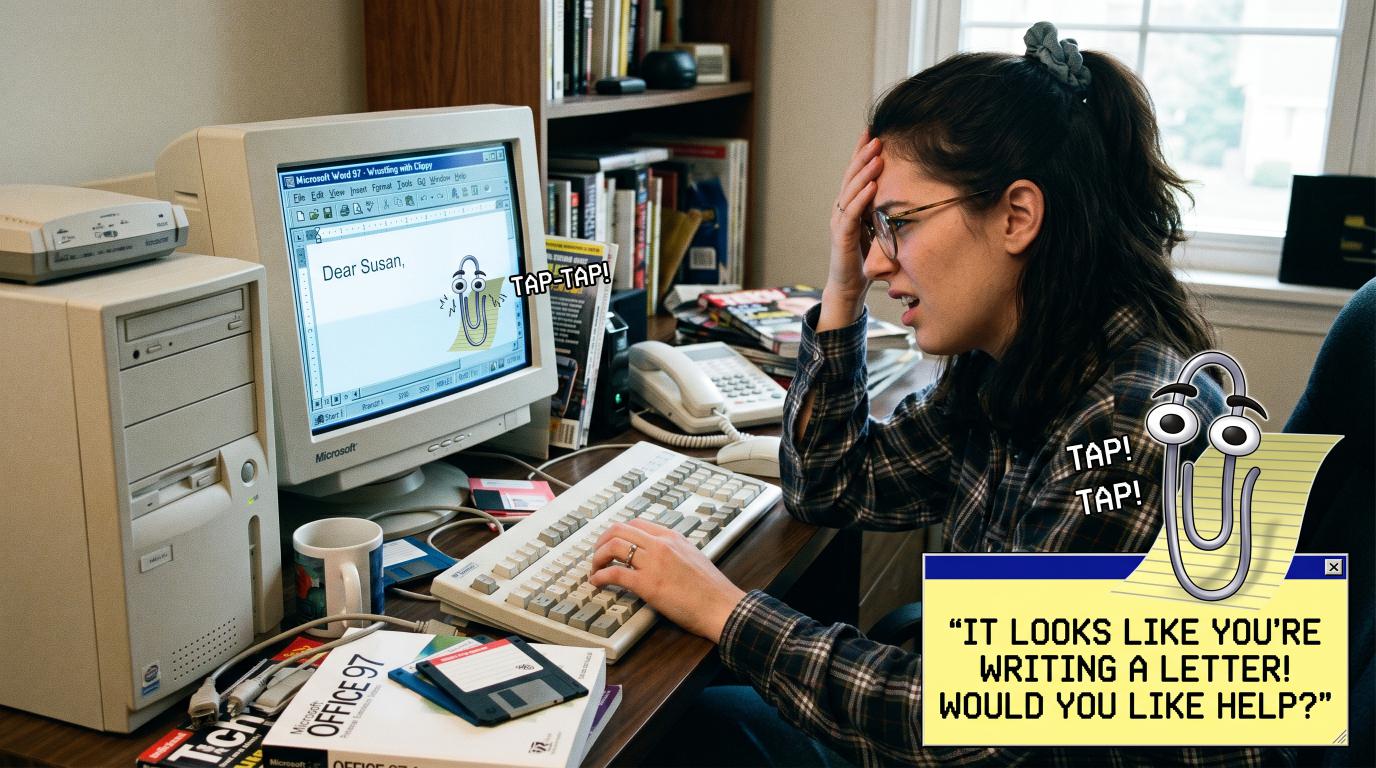
Wrestling with Clippy in Early Microsoft Office
We are currently living in the golden age of Artificial Intelligence. Today, you can ask a computer to write a three-course menu based on the random ingredients left in your fridge, translate a Japanese poem into Elizabethan English, or debug a complex piece of software code. It does all of this in seconds, silently and with an almost eerie level of competence.
But if we journey back to the late 1990s, our interaction with digital assistants was a little... different.
Back then, we didn't have neural networks or machine learning. We had a piece of steel wire with googly eyes, a thick set of expressive eyebrows, and a persistent habit of tapping on the inside of our computer screens.
His name was Clippit, though the world collectively and affectionately—or perhaps aggressively—knew him simply as Clippy.
For anyone who tried to type a letter, write an essay, or build a basic spreadsheet in Microsoft Office 97 or 2000, Clippy was an inescapable part of the landscape. He was the digital assistant we all loved to hate.
Let's take a stroll down the corridors of tech history and revisit the hilarious, brilliant, and deeply stubborn logic behind the world's most annoying paperclip.
The Ghost of Microsoft Bob
To understand why Clippy existed in the first place, we have to talk about a family tragedy. Clippy did not simply appear out of thin air; he was the direct spiritual descendant of one of the most famous, catastrophic failures in software history: Microsoft Bob.
In 1995, Microsoft was looking for a way to make personal computers less intimidating for the absolute beginner. They decided that standard folder structures and drop-down menus were too cold and mechanical.
Their solution was "Bob"—a software program that turned your computer screen into a literal, cartoonish virtual house.
To open your schedule, you didn't click on a calendar icon; you clicked on a physical calendar hanging on a virtual brick wall. To check your email, you clicked on a mailbox sitting next to a digital fireplace. Guiding you through this virtual home was a cartoon yellow dog named Rover.
+-------------------------------------+
| [ VIRTUAL HOUSE ] |
| |
| ( Calendar ) ( Mailbox ) |
| on the Wall by Fire |
| |
| Click to Open App |
+-------------------------------------+
Bob was a monumental flop. It was slow, patronizing, and made users feel like they were being treated like toddlers.
But Microsoft’s design team refused to let the dream of "social computing"—the idea that humans want to interact with characters, not interfaces—die. They buried Microsoft Bob in an unmarked digital grave, but they kept the underlying philosophy. They wanted to take the concept of a friendly guide and shrink it down so it could live inside a professional workspace.
The Birth of the Creepy, Ignored Assistant
The Microsoft team hired professional illustrators and Stanford psychologists to design a new cast of character guides. Out of dozens of proposals, a cheerful, slightly mischievous paperclip emerged as the frontrunner. He was cheap to render, didn't take up too much screen space, and hey, everyone knew what a paperclip was.
But before Microsoft pushed Clippy out into the world, they ran extensive consumer focus groups. They wanted to see how real people reacted to this friendly new office helper.
The feedback was brutal.
The focus groups—specifically female participants—overwhelmingly disliked the paperclip. They didn't find him helpful; they found him deeply "creepy." They noted that his massive, unblinking googly eyes made them feel like they were constantly being watched while they worked. They described his expressions as patronizing, and his constant interruptions as annoying.
But in a classic display of corporate stubbornness, Microsoft executives ignored their own data, overruled the focus groups, and shipped Clippy anyway in Microsoft Office 97.
What could possibly go wrong?
The Ultimate Irony: Clippy's "Genius" Brain
One of the greatest myths surrounding Clippy is that he was a simple, dumb piece of software guided by basic "if-this-then-that" rules.
In reality, the ultimate irony of Clippy is that he was actually Microsoft’s cutting-edge attempt at early artificial intelligence.
He wasn't powered by a few lines of basic code. He was driven by a highly complex mathematical framework designed by Microsoft Research called Bayesian belief networks.
This was serious, Nobel-prize-adjacent probability science. The idea was that Clippy would observe your behavior, calculate the statistical likelihood of what you were trying to accomplish, and step in to help when his certainty reached a certain percentage.
He was essentially trying to predict the future based on your keystrokes.
But there was a massive disconnect between the mathematical genius in his brain and the reality of his output. Because the designers set his trigger sensitivity incredibly high, Clippy was far too confident.
You would sit down at your bulky, beige desktop computer, open Microsoft Word, and type the first two words of your document:
Dear Susan,
Instantly, a sharp tap-tap-tap sound would emit from your speakers.
In the bottom right corner of your screen, a small yellow box would materialize. Clippy would enthusiastically tap on the glass of your monitor from the inside, arch his thick black eyebrows, and present you with a message:
"It looks like you're writing a letter. Would you like help with that?"
+------------------------------------+
| (o_o) It looks like you're |
| [|] writing a letter! |
| Would you like help? |
| |
| [ ] Get help writing |
| [ ] Just type the letter |
+------------------------------------+
No, Clippy. I do not want help. I have successfully written "Dear Susan." I am fairly confident in my ability to handle the "How are you?" that comes next without the intervention of a complex, probabilistic mathematical model.
Because his brain was so statistically over-eager, he turned what should have been a helpful tool into a highly intrusive nuisance. He was like a co-worker who stands over your shoulder, points at your screen, and says, "You know, if you press the backspace key, it deletes the letter you just wrote."
The Cast of Forgotten Characters
While Clippy became the poster child for Microsoft’s interactive helpers, he wasn’t actually the only option. If the paperclip started to grind your gears, you could actually dive into the settings and change your helper.
For the sake of nostalgia, let’s look at some of the alternative assistants you could summon to your desktop:
Hoverbot (The Robot): A sleek, silver robot that looked like a futuristic toy. He was supposed to appeal to the tech-savvy crowd, but he mostly just made strange mechanical whirring noises and hovered in place.
Rocky (The Dog): A bounding, enthusiastic golden retriever puppy who would sniff around the screen and dig up your help topics. (Not to be confused with Rover, the yellow dog from Microsoft Bob who had been demoted to Windows XP Search).
The Genius: A caricature of Albert Einstein, complete with messy white hair and a mustache. Having a Nobel-prize-winning physicist watch you struggle to double-space a paragraph felt deeply humiliating.
Scribble (The Cat): A loose, sketchy cat who spent most of her time sleeping in the corner of your document, occasionally waking up to stretch or bat at a ball of yarn.
The Dot: A simple red ball that bounced around the screen. It was designed for minimal distraction, but watching a red dot bounce around while you were trying to input data into a spreadsheet felt like a bizarre psychological experiment.
Despite this colorful cast, Clippy remained the default choice. Most users never figured out how to change their assistant, meaning Clippy bore the brunt of the world's collective frustration.
The Great Clippy Backlash
By the turn of the millennium, public annoyance with Clippy had reached a boiling point. He had transitioned from a well-meaning feature to a full-blown cultural punchline.
Comedians mocked him on late-night television. Early internet forums were filled with elaborate guides on how to permanently delete him from your computer’s hard drive. He was viewed as the ultimate symbol of corporate software bloat—a feature that nobody asked for, which took up precious system memory on computers that were already struggling to run.
Microsoft, to their credit, eventually got the joke.
When they were preparing to launch Office XP in 2001, they decided to lean into the hatred. They launched an entire marketing campaign built around the retirement of Clippy.
They created a humorous website where users could play mini-games to "fire" Clippy. They released animated short films showing Clippy trying to find a new job in the real world—such as working as a coat hanger or trying to hold a stack of papers together in a physical office, only to be rejected because "staples are just more reliable."
The official slogan for the new software suite was: "Office XP: Work smarter, not harder. (And no, it doesn't come with a paperclip.)"
In Office XP, Clippy was turned off by default. You had to go deep into the settings menus to turn him back on. By the time Office 2007 rolled around, the Office Assistant feature was completely removed from the code, buried in an unmarked digital grave.
Why We Secretly Miss Him
And yet, a funny thing happened once Clippy was gone.
We started to miss him.
Nostalgia has a beautiful way of buffing out the rough, annoying edges of our memories. Once we were no longer forced to wrestle with him just to write a resume, we began to look back on Clippy with a sense of warm affection.
Today, Clippy is a certified pop-culture icon. He has appeared on retro t-shirts, starred in countless internet memes, and even made a triumphant comeback as an official emoji in Microsoft Teams.
Perhaps the reason we look back at Clippy so fondly now is because of how honest he was.
He didn't want your data. He wasn't tracking your browsing habits to sell you targeted advertising for lawnmowers. He wasn't powered by a massive server farm that consumes more electricity than a small country.
He was just an early, brave, and slightly misunderstood attempt at artificial intelligence. In our modern world of complex algorithms and predictive text that tries to finish our thoughts before we’ve even had them, there is something incredibly comforting about a digital assistant who was, frankly, a bit dim.
So, here’s to you, Clippy. You tapped on our glass, you ruined our flow, and you drove us absolutely mad. But we’ll never forget you.
More Retro Technology to Revisit
If this brought back a very specific sense of irritation, there is plenty more in our Retro Tech section. We revisit the machines and software that shaped how we work now, including the bits that were genuinely clever and the bits that made everybody consider throwing the computer out of a window.
Saving Your Life’s Work on a Floppy Disk
Software Should Help Without Getting in the Way
Clippy remains a useful lesson in software design: a feature can be technically clever and still make the person using it want to hide under the desk. We build custom software around the work a business actually needs to do, so the useful information and actions are where people expect them and unnecessary interruptions are kept to a civilised minimum.
Not every business needs a system commissioned from scratch. The RiCollection gives us existing applications that can be configured and branded when there is already a sensible foundation. The decision starts with the problem you need to solve, not with finding an excuse to build the most complicated answer.
Need Software That Knows When to Leave You Alone?
Tell us what your current system makes awkward, slow or needlessly repetitive. We will look at how the work really happens and suggest a practical route, whether that means custom software or adapting something from the RiCollection. No animated paperclips will be assigned to the project.
Why did people find Microsoft Clippy so annoying?
Clippy interrupted people while they were working and often made confident guesses from very little evidence. Its help appeared when users had not asked for it, so an ambitious attempt to make software friendlier became a lesson in how quickly an intrusive feature can wear out its welcome.
Was Clippy an early form of artificial intelligence?
Yes, in a limited sense. Microsoft used Bayesian belief networks to estimate what a user might be trying to do and decide when to offer help. The underlying probability work was sophisticated for its time; the difficulty was that Clippy interrupted too readily and was often wrong.
When was Clippy removed from Microsoft Office?
Clippy was switched off by default in Office XP in 2001, although users could still turn the assistant back on. Microsoft removed the Office Assistant feature completely by Office 2007.