
Saving Your Life’s Work on a Floppy Disk
Let’s be honest with ourselves: we have become incredibly soft.
If you are working on a document, a spreadsheet, or a piece of code today, you don’t really think about saving it. You just... stop typing. The computer, in its infinite, invisible wisdom, has already whisked your keystrokes away to some sprawling, air-conditioned server farm in Iceland. If your laptop suddenly decides to take a permanent nap, or if you accidentally spill an entire mug of tea directly into the keyboard, you don’t panic. You just buy a new one, log in, and your life’s work is right there, completely untouched.
We live in an era of digital invincibility.
But if you rewind the clock to the late eighties or nineties, saving your work was not a silent background utility. It was an active, high-stakes sport. It was a physical ritual that required a sturdy plastic square, a prayer, and a quiet moment of negotiation with the universe.
We are talking, of course, about the floppy disk.
For some of us, just reading those words triggers a very specific, slightly anxious Pavlovian response. For others, the floppy disk is simply that mysterious, ancient relic that lives on as the "Save" icon in Microsoft Word.
So, grab a cuppa, take a seat, and let’s take a trip down memory lane to the days when your entire career, degree, or software masterpiece hung by a very thin, highly magnetic, and terrifyingly fragile thread.
The Great Plastic Lie
Before we go any further, we need to address the massive elephant in the room. If you used computers in the nineties, the disk you used most often—the iconic 3.5-inch square—was not floppy at all.
It was, in fact, incredibly rigid.
If you tried to flop it, it would snap in half with a sharp crack, probably sending a tiny, angry metal spring flying directly into your eye.
The name "floppy" was actually a hand-me-down from its older, much larger ancestors. Back in the seventies and early eighties, computers used massive 8-inch and 5.25-inch disks. Those original disks truly were floppy. They were housed in thin, flexible plastic sleeves that felt like cheap cardboard. If you held one by the edge, it would droop sadly under its own weight. They were so delicate that even writing on the label with a ballpoint pen could physically dent the magnetic material inside and ruin your data forever.
Eventually, the tech industry realized that letting humans keep their most valuable data on things that bent like wet cardboard was a terrible idea. Thus, the 3.5-inch disk was introduced. It was a masterpiece of industrial design. It had a tough, protective plastic shell, a little sliding metal shutter to protect the delicate innards, and a satisfyingly boxy feel.
But inside that armor? The actual recording medium was still a floppy, circular piece of magnetic film, spinning around like a miniature, silent vinyl record.
The Original Fidget Toy
Long before fidget spinners or bubble-wrap phone cases, office workers and students had the floppy disk shutter.
On the top edge of every 3.5-inch disk was a spring-loaded metal slider. When you pushed the disk into the computer drive, a tiny lever inside would slide this shutter open, exposing the dark, glossy magnetic film so the computer could read it.
When you pulled the disk out, the shutter would snap back into place with a wonderfully crisp, metallic click.
If you were waiting for a file to download, or if you were staring blankly at a blinking cursor trying to figure out how to write the introduction to your essay, your thumb would inevitably find that metal shutter. Slide, snap. Slide, snap. It was the unofficial soundtrack of creative block. Of course, if you did it too much, the spring would eventually pop out of its track, rendering the disk useless, but that was a risk we were all willing to take.
Let’s Do the Megabyte Math (Painlessly)
To truly understand how wild this era was, we have to look at the numbers. But don't worry, there is no exam at the end of this, and we aren't going to get bogged down in technical jargon.
The absolute pinnacle of floppy disk technology was the High-Density 3.5-inch disk. Its total storage capacity was 1.44 Megabytes.
To put that into perspective for anyone who has only ever known modern technology:
Photos: A single, average photo taken on a modern smartphone is about 3 to 5 Megabytes. You could not fit one single selfie onto a floppy disk. If you tried, the computer would likely laugh at you.
Music: A standard three-minute song in MP3 format is about 4 Megabytes. If you wanted to carry an album's worth of music around on floppy disks, you’d need a sturdy cardboard box and a gym membership to carry it.
Video: Absolutely out of the question. You could perhaps store about three seconds of highly pixelated, silent, black-and-white video, which would look like security footage of a ghost.
Yet, back then, 1.44 Megabytes felt like a vast, empty digital kingdom.
Why? Because software and files were built like luxury sports cars—stripped of all excess weight. Text takes up almost no digital space. You could easily fit a massive, 500-page novel, complete with formatting, onto a single disk. You could fit entire databases of customer records, complex spreadsheets, and fully functional software programs onto one piece of plastic.
Developers couldn't afford to be lazy. There was no room for bloated code, high-resolution graphics, or unnecessary features. Every single byte of data had to earn its place on the disk. It was a time of beautiful, forced efficiency.
The Sensory Experience: The Sound of Saving
One of the great tragedies of modern, silent solid-state drives is that we have lost the sensory feedback of computing. Today, when you save a file, nothing happens physically. There is no sound, no movement, just a tiny pixelated circle spinning on your screen for a fraction of a second.
Saving to a floppy disk, however, was a full-body experience.
You clicked "Save" (or hit Ctrl+S), and the computer drive immediately sprang to life. First came the loud, mechanical clunk-clack as the drive head physically clamped onto the metal center hub of the disk. Then, the internal motor would spin the disk up to speed with a rising, electric whirrrrr.
Finally, the read/write head would start stepping across the disk surface, making a series of rhythmic, chattering noises:
“Scrritch... scratch... click... chug-chug... scrritch.”
It sounded like a tiny, highly caffeinated woodpecker was trapped inside your computer casing, frantically carving your words into the plastic.
It was incredibly comforting. As long as the drive was making those familiar, rhythmic noises, you knew your work was being tucked safely into bed. If the drive suddenly stopped, made a horrible, dry grinding sound, or began a repetitive, rhythmic thump... thump... thump..., cold sweat would instantly break out on the back of your neck. That was the sound of a drive desperately trying—and failing—to read a corrupted sector of your disk.
The Arch-Enemies of the Floppy
Saving your life’s work on a floppy disk was essentially a daily exercise in blind faith. Because the data was stored magnetically on a fragile film, the world was absolutely teeming with invisible villains designed to destroy your hard work.
+-------------------------------------------------------------+
| THE HALL OF FLOPPY VILLAINS |
+-------------------------------------------------------------+
| |
| [ Magnet ] [ Cat Hair ] [ The Backpack ] |
| "I'll scramble "I'll scratch "I will crush |
| your essay!" the film!" your plastic!" |
| |
+-------------------------------------------------------------+
1. The Magnet
This was the silent assassin. If you put your floppy disk down on top of a stereo speaker, too close to an old bulky CRT monitor, or next to a fridge magnet, the invisible magnetic forces would instantly scramble the data. You wouldn't know anything was wrong until you put the disk back in and the computer politely informed you that the disk was now completely blank.
2. Dust, Pet Hair, and Crumbs
The sliding metal door was good, but it wasn't airtight. If a single speck of dust or a stray cat hair found its way onto the spinning magnetic circle inside, it would get caught under the read head. It would then act like a tiny plow, physically scratching a trench through your files as the disk spun.
3. The Backpack Abyss
Throwing a floppy disk loose into a school bag or briefcase was a high-risk gamble. Keys would slide into the shutter, bending it out of shape. Textbooks would crush the plastic casing. Half-eaten apples would introduce a sticky residue that would glue the disk mechanism shut forever.
4. Extreme Heat
If you left a floppy disk on the dashboard of your car on a warm summer afternoon, you would return to find a warped, sad-looking piece of plastic that resembled a piece of modern melt-art. Needless to say, your term paper did not survive the summer.
To protect against accidental deletion, the designers did include one stroke of absolute genius: the write-protect tab. In the bottom corner of every disk was a tiny, sliding plastic square. If you slid it to reveal a tiny, see-through hole, the computer was physically blocked from writing any new data or deleting what was there. It was the physical equivalent of locking a diary, and it saved countless projects from being accidentally overwritten by a sibling or colleague.
The Nightmare of the Multi-Disk Install
As software grew in size during the mid-nineties, it quickly outgrew the humble 1.44 Megabyte limit. Since developers couldn't fit their programs on one disk anymore, they had to start splitting them across multiple disks.
This led to the unforgettable experience of installing software from a literal deck of plastic cards.
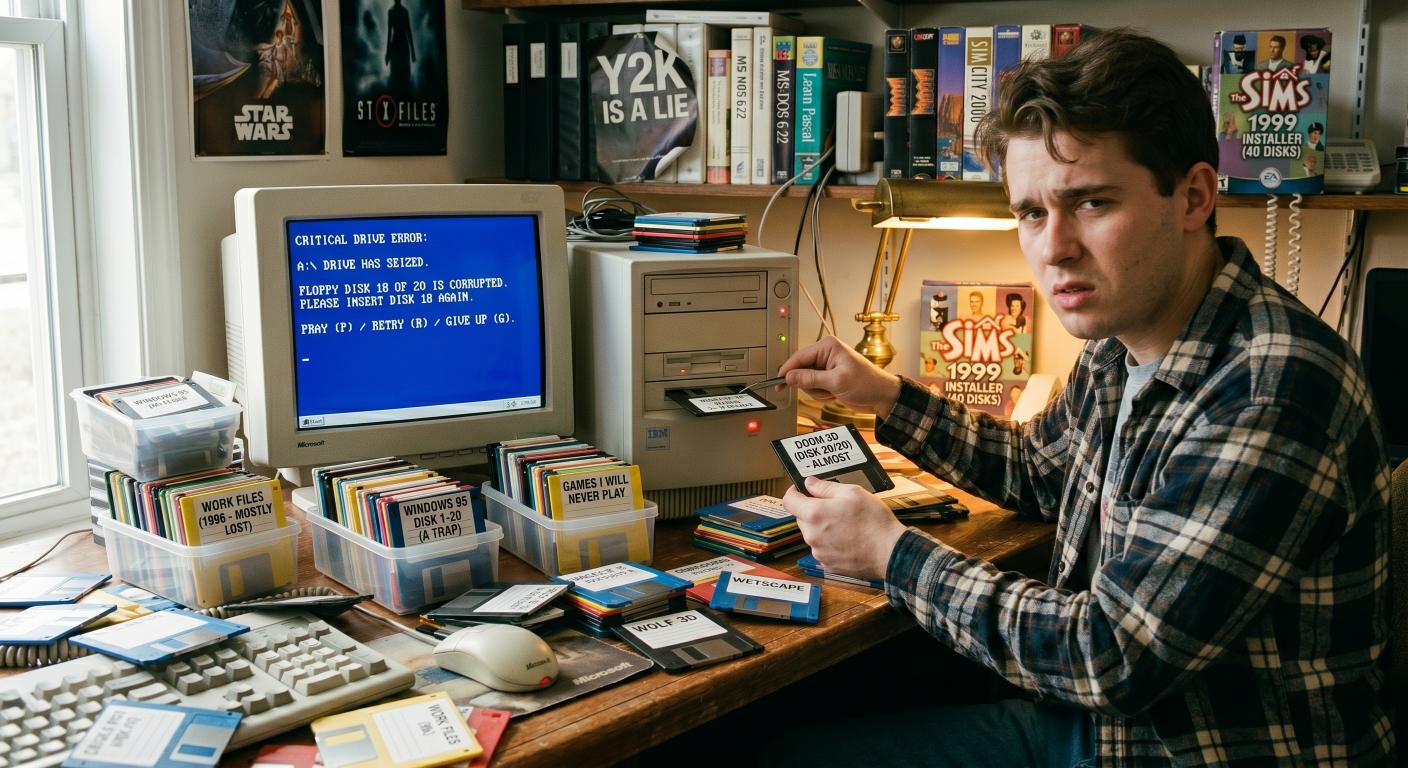
If you bought a new operating system or a cutting-edge computer game, you didn't get a sleek, downloadable installer. You got a heavy cardboard box that rattled when you picked it up. Inside, nestled in a plastic tray, would be ten, twenty, or sometimes even thirty numbered floppy disks.
You would sit in front of the computer, acting as a highly underpaid robotic arm:
Insert Disk 1. Wait five minutes while the computer grinds away.
“Please insert Disk 2 and press Enter.”
Insert Disk 2. Wait.
“Please insert Disk 3...”
You were trapped. You couldn't leave the room, because the moment you walked away to make a cup of tea, the computer would finish the current disk and sit there, waiting for the next one.
The ultimate tragedy—the story that still causes old-school developers to wake up in a cold sweat—occurred when you reached the very end. You would successfully feed the computer Disk 1 through Disk 21. You would slide in Disk 22 of 22. The drive would whir, scratch, clunk... and then emit an angry, high-pitched beep.
Error reading Drive A: Installation aborted.
That was it. The entire hour of your life was gone. One tiny scratch on the very last disk meant the entire software suite was completely useless. You had to pack the whole box up, walk back to the shop, and ask for a replacement.
The Ghost in the Screen
By the early 2000s, the floppy disk's reign was coming to an end. File sizes were exploding, and new technologies like writable CDs, Zip drives, and eventually the marvelous USB thumb drive offered thousands of times more space without the terrifying fragility.
When Steve Jobs stood on stage in 1998 and revealed the original Bondi Blue iMac—a computer that conspicuously lacked a floppy disk drive—the tech world gasped. Journalists called it madness. They claimed consumers would riot.
But Jobs was right. The floppy disk was dead; it just hadn't stopped spinning yet.
And yet, despite being physically obsolete for over two decades, the floppy disk achieved a level of digital immortality that no other piece of technology has ever managed.
If you open up Microsoft Word, Google Docs, Photoshop, or almost any professional software today, and you want to save your progress, you look for a specific button. It’s a small, square icon with a clipped top-right corner and a silver slider at the bottom.
You are looking at a 3.5-inch floppy disk.
An entire generation of digital citizens has grown up clicking that icon daily without ever having seen, touched, or clicked a real-life piece of square plastic. To them, it isn't a historical object; it is simply the universal, abstract runic symbol for "keep this safe."
A Gentle Nod to the Past
For those of us working in the modern tech world, building websites and complex software platforms, looking back at the floppy disk is more than just a fun exercise in nostalgia.
It’s a reminder of a time when computing required patience, physical care, and a deep respect for constraints. It teaches us that great things can be built within incredibly tight boundaries, and that sometimes, the most enduring designs are the ones born out of absolute necessity.
So, the next time you effortlessly save a massive, high-definition video to the cloud, or download a giant application in the blink of an eye, spare a quiet thought for that humble, clattering, 1.44-Megabyte square of plastic.
It did the heavy lifting so we could learn to fly.
If you enjoyed this guide then you are going to love these...
Wrestling with Clippy in Early Microsoft Office
Writing Your First Site in Notepad
You can see all our Retro Tech insights at the top of the page.
Of course, we don't just write about Retro Tech we also write about Tech Trends too. Why? Because we use it in everything we build. We have to keep one eye on the latest tools because we need to ensure that everything we make is powerful and works in the way we want. And we can only do that with technology that works. To see the sort of thing we make then our RiCollection is the place to look. Our ever growing portfolio which includes RiCreate, our very own content and social media generator and RiNet, the intranet you would be mad not to want!
Visit RiCreate (Demo Available)
How much data could a floppy disk actually hold?
A high-density 3.5-inch floppy disk held 1.44 Megabytes. That's less than a single modern smartphone photo, which is typically 3 to 5 Megabytes, but it was enough to store a 500-page novel or entire software programs back when files were built efficiently.
Why were they called floppy disks if the 3.5-inch ones weren't floppy?
The name came from the earlier 8-inch and 5.25-inch disks, which genuinely were floppy and housed in thin, flexible sleeves. The 3.5-inch disk had a rigid plastic shell for protection, but the actual magnetic recording material inside was still a floppy, circular piece of film.
How did people install software that was bigger than one floppy disk?
You had to manually insert each numbered disk one at a time, sometimes feeding the computer 20 or 30 disks in sequence. If any single disk was corrupted—especially the last one—the entire installation would fail and you'd have to start over or get a replacement.