
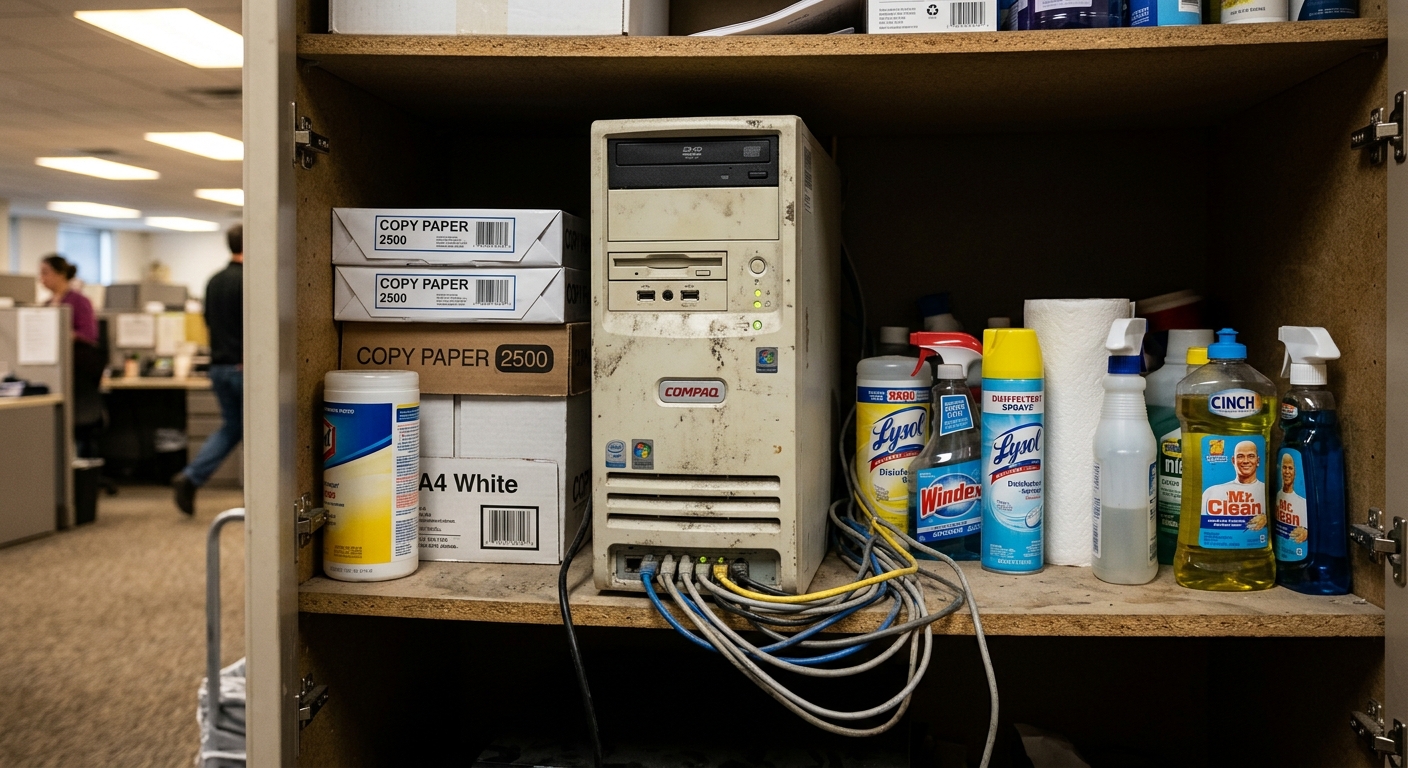
The Cloud, the Edge and the Server in the Cupboard
There's a type of architectural diagram that's become popular in enterprise tech circles lately. You know the one: clouds at the top, edge nodes fanning out in the middle, and sometimes a modest box labelled "on-premises infrastructure" tucked discreetly at the bottom. It looks comprehensive. It looks modern. It also, quite often, looks like three separate ways of doing essentially the same job.
Edge computing arrived with a sensible premise. Instead of sending every bit of data to a distant data centre for processing, handle what you can closer to where it actually happens. Lower latency, reduced bandwidth costs, faster responses. For certain use cases — industrial sensors, retail analytics, autonomous systems — this makes genuine sense. The trouble is that edge computing has evolved from a solution to specific problems into something more like an architectural layer that everyone feels obliged to include, whether they need it or not.
The Distributed Sprawl
The typical progression goes something like this. A business starts with cloud infrastructure because that's what you do now. Then someone mentions edge computing at a conference, and suddenly there's a case for processing certain things closer to customers or branch offices. Then it turns out the old on-premises server is still running because migrating that one legacy application would cost more than just leaving it alone. Before long, you're running variants of the same workload across three different infrastructure layers, each with its own bills, each requiring maintenance, and each adding another dimension to your disaster recovery planning.
The cloud portion handles your main application logic and storage. The edge nodes run a subset of processing for lower latency. The server in the cupboard (or the data centre, if we're being generous) keeps chugging along with that one critical system nobody quite trusts anywhere else. Technically, each layer serves a purpose. Practically, you've tripled your operational complexity and you're not entirely sure the benefits justify it.
When Edge Actually Matters
Edge computing does have legitimate use cases. If you're processing video streams from security cameras, analysing data from manufacturing equipment, or running point-of-sale systems across hundreds of locations, local processing can be valuable. Sending every transaction or sensor reading to a central cloud and back again would be slower and more expensive than handling what you can on-site.
The difficulty lies in distinguishing between workloads that genuinely benefit from edge processing and those that have been shunted there because edge is fashionable. A web application that serves customers across the country probably doesn't need edge infrastructure; a content delivery network caching static assets will do the job. A dashboard pulling data from a central database won't get meaningfully faster by adding edge nodes; it just means syncing data to more places.
Edge makes sense when the physics of distance actually matters to your application's performance or when intermittent connectivity requires local processing. Otherwise, you might just be adding infrastructure for the sake of completeness.
The Cloud Isn't Always the Answer Either
Cloud computing solved real problems. Elastic scaling, no upfront hardware costs, paying only for what you use — these are genuine advantages. But the cloud also introduced new costs that don't always get factored into the initial enthusiasm. Data transfer fees, particularly egress charges, can accumulate quickly. Reserved instances require capacity planning that undermines some of the flexibility benefits. And moving everything to the cloud sometimes means you're now paying monthly for resources that would have been sunk costs if you'd just bought the hardware.
There's a reason some businesses are quietly moving workloads back on-premises or to colocation facilities. For stable, predictable workloads that don't need to scale dramatically, owning infrastructure can work out cheaper over time. The cloud's economic model favours variability; if your demand is steady, the premium you pay for flexibility isn't necessarily worth it.
The Server That Wouldn't Leave
Then there's the on-premises infrastructure that was supposed to be temporary. Maybe it's the old file server that "we'll migrate next quarter" for the past three years. Perhaps it's the application that has licensing terms incompatible with cloud deployment. Sometimes it's just institutional inertia — the system works, nobody wants to be responsible for breaking it, so it stays.
These lingering systems aren't always irrational. Migrating complex infrastructure carries risk, and sometimes the sensible choice is to leave working systems alone. The problem emerges when you're maintaining on-premises infrastructure not because it's optimal but because nobody has made the decision to do otherwise. You end up with the worst of both worlds: cloud bills for your modern systems and maintenance overhead for the legacy ones.
Choosing Where Things Actually Belong
The question isn't which infrastructure model is superior in the abstract. It's whether each specific workload is running in the place that makes the most sense for its requirements and economics. Some applications genuinely benefit from the cloud's elasticity. Others work better at the edge. Some probably belong on dedicated hardware you own.
The useful exercise is auditing what you're actually running where, and why. Is that edge deployment processing data locally because latency matters, or because someone thought edge sounded modern? Is the cloud instance running constantly at the same capacity because your load is predictable and you're essentially renting a very expensive fixed server? Is the on-premises system still there because it needs to be, or because migration keeps getting deferred?
Infrastructure should follow requirements, not trends. If you need all three layers because you have workloads with genuinely different characteristics, that's fine. But if you've ended up with a distributed architecture primarily because you've accumulated solutions over time without retiring the old ones, you might want to rethink things.
Deciding What You Actually Need
The most useful approach is probably consolidation where practical. If edge processing isn't delivering meaningful latency or bandwidth improvements, bring that workload to the cloud or on-premises. If cloud costs are excessive for stable workloads, consider whether dedicated infrastructure would be more economical. If on-premises systems are only still running because migration is awkward, decide whether to commit to them properly or finally move them.
You might still end up with hybrid infrastructure — many organisations have legitimate reasons for running workloads in different places. But it should be hybrid by design, not by accumulation. Each layer should justify its existence based on what it does better than the alternatives, not on the basis that it's already there and nobody wants to turn it off.
Infrastructure decisions have a tendency to become permanent unless actively revisited. The cloud account you opened five years ago, the edge nodes you deployed for a project that's since evolved, the server that was meant to be temporary — they all keep running because stopping them requires a decision and some effort. Sometimes the right answer is to accept the complexity. Often, though, it's worth asking whether you're maintaining multiple infrastructure layers because you need them, or just because you haven't decided where things actually belong.
More Technology Writing
If you found this useful, we write regularly about technology trends and the practical reality behind the enthusiasm. Our Tech Trends section covers the gap between what's theoretically possible and what actually works in practice. Here are a few to get you started.
What Cursor is actually doing when it rewrites your code (and why it feels uncomfortably accurate)
The App Store Shortcut: How "Hybrid" Websites are Replacing Phone Apps
Why We Write About This
We write about technology trends because staying current is rather central to what we do. We build websites, create software, and work with businesses on technical projects where understanding what's genuinely useful versus what's just fashionable makes a material difference. If you're curious about the sort of work we do, we've got examples of things we've built.
Working Together
If you'd like us to build you a website, create software, or help sort out an infrastructure situation that's become more complicated than it needs to be, we'd be happy to talk. We're straightforward to work with, we don't oversell things you don't need, and we're reasonably good at building things that work properly. Get in touch if that sounds useful.
When does edge computing actually make sense for my business?
Edge computing makes sense when the physics of distance genuinely affects your application's performance — like processing video streams from security cameras, analyzing manufacturing equipment data, or running point-of-sale systems across many locations. If you're just running a standard web application or dashboard, a content delivery network for static assets is probably all you need.
Is the cloud always cheaper than running my own servers?
No, it depends on your workload. The cloud is economical for variable, unpredictable demand because you only pay for what you use. But for stable, predictable workloads that run constantly at the same capacity, owning your own infrastructure often works out cheaper over time since you're not paying a premium for flexibility you don't need.
Is it bad to have cloud, edge, and on-premises infrastructure all at once?
Not if each layer serves a genuine purpose based on different workload requirements. The problem is when you've accumulated all three over time without retiring old solutions, ending up with hybrid infrastructure by accident rather than by design — which triples your complexity without clear benefits.