
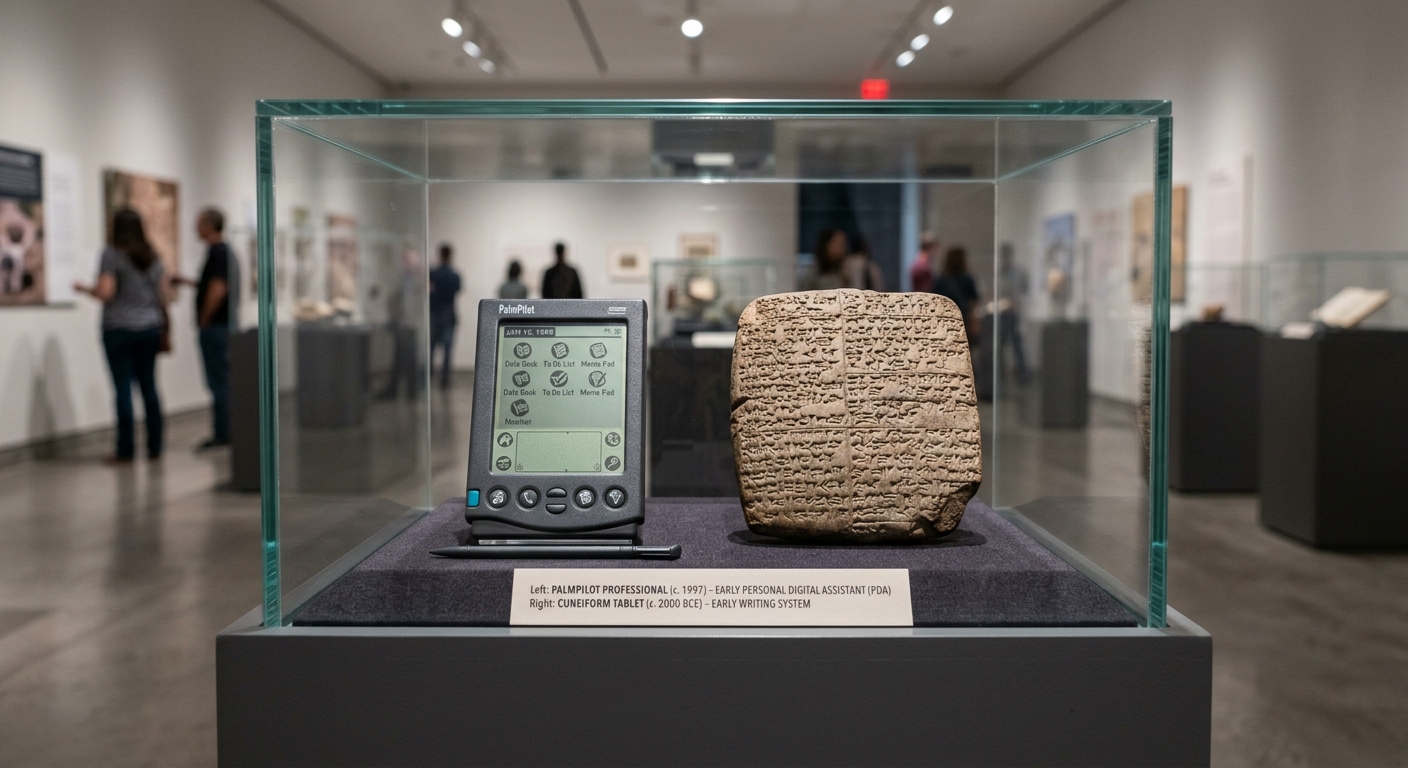
The Rise and Fall of the PalmPilot: Handheld Computing Before Smartphones
Before we all became glued to rectangles of glass that can do everything except make us happy, there was a different sort of device in people's pockets. The PalmPilot, launched in 1997, was a genuine phenomenon—a device that somehow convinced millions of people that what they really needed was a grey plastic thing slightly larger than a deck of cards that required you to learn a new alphabet.
And here's the peculiar bit: they were absolutely right.
What Actually Was a PalmPilot?
The PalmPilot was a Personal Digital Assistant, or PDA—a term that now sounds charmingly quaint, like "wireless" or "information superhighway." It was essentially a handheld computer that fit in your pocket and helped you manage your life without requiring a mains connection or a degree in computer science.
The original PalmPilot 1000 and 5000 were released by Palm Computing in March 1997, though the company had already released the less successful Pilot the year before. These weren't the first PDAs—that honour probably goes to the Apple Newton, which was approximately the size of a house brick and had handwriting recognition that was genuinely comedic. But the PalmPilot was the first one that people actually wanted to use.
It had a monochrome screen, about 128KB to 512KB of memory (yes, kilobytes—your phone's camera app uses more memory than that just thinking about starting up), and it cost around £300. For that, you got an address book, calendar, to-do list, and memo pad. Revolutionary stuff, clearly.
Except it genuinely was.
The Secret Sauce: Graffiti
The PalmPilot's killer feature was something called Graffiti—a simplified alphabet you drew on the device's touch-sensitive screen with a plastic stylus. Instead of trying to recognise your normal handwriting (which, let's be honest, you can barely recognise yourself), Graffiti required you to learn specific, simplified strokes for each letter.
This sounds like a terrible idea. Making users learn a new way to write? That's the sort of arrogance that sinks products. But here's what Palm understood: people were willing to learn something new if it actually worked. And Graffiti worked. After about twenty minutes of practice, you could input text faster than hunt-and-peck typing, and the recognition was remarkably accurate.
The stylus lived in a little silo in the device itself—a detail that seems obvious until you remember that we've all spent the past fifteen years losing Apple Pencils. Palm thought about these things.
What It Got Right
Palm Computing, led by Jeff Hawkins, had a philosophy that seems almost revolutionary by today's standards: make devices that do a few things brilliantly rather than everything badly. The PalmPilot didn't try to be a phone, a camera, a games console, or a multimedia powerhouse. It organised your life, and it did so without fuss.
The interface was immediate. You pressed one of four physical buttons, and you were instantly in your calendar, contacts, tasks, or notes. No loading screens, no updates to install, no notifications about things you don't care about. The whole operating system was designed around the idea that your time was valuable—a philosophy that seems to have been largely abandoned by modern technology companies who appear to think your time is best spent watching adverts and clicking through menus.
Battery life was measured in weeks, not hours. You could genuinely forget about charging it, which meant it was always there when you needed it. The device was responsive because it wasn't trying to do seventeen things in the background. It synced with your computer via a cradle—you'd pop it in, press a button, and your data would transfer. Simple, reliable, boring in the best possible way.
Palm also understood that people would want to expand functionality, so they created an ecosystem for third-party applications. This was 1997, remember—app stores weren't a thing yet. But you could download programs, beam them to other Palm users via infrared (infrared!), and genuinely customise your device. There were games, expense trackers, ebook readers, even medical reference tools. The platform was open enough to be useful but constrained enough to remain stable.
The Glory Years
For about five years, Palm absolutely dominated the PDA market. By 2000, they controlled about 80% of it. Everyone who was anyone had a Palm device. Doctors used them for patient notes, business people for contact management, students for revision notes. You'd see people in meetings tapping away with their styluses, looking terribly organised and important.
The company released new models with colour screens, more memory, and additional features. The Palm V, launched in 1999, was genuinely beautiful—slim, metallic, the sort of device you'd want to show off. Later models added wireless connectivity, better screens, and more processing power. Some even ran a version of Linux. Palm was innovating, iterating, and printing money.
Then everything changed, as it tends to do.
The Long Decline
Palm's downfall wasn't dramatic—it was a slow fade rather than a spectacular crash. Several things happened simultaneously, none of them individually fatal but collectively terminal.
First, mobile phones started getting good. Really good. The Nokia Communicator and later devices began offering PDA functions alongside phone capabilities. Carrying two devices started to seem silly when one could do both jobs reasonably well.
Second, Palm rather lost the plot with their product strategy. They split into two companies (PalmOne and PalmSource), which confused everyone including, one suspects, themselves. They released too many models with confusing names and overlapping features. They dabbled with Windows Mobile. They acquired other companies and merged and reorganised and did all the things companies do when they're not quite sure what else to do.
Third, and most significantly, in 2007 a chap called Steve Jobs walked onto a stage and showed everyone an iPhone. Touchscreen keyboards turned out to be good enough, especially when the device could also browse the web properly, play music, and do approximately everything else. The iPhone didn't need Graffiti because it had a full software keyboard and predictive text. It didn't need a stylus because your finger worked perfectly well.
Palm tried to respond with the Palm Pre in 2009, which was actually rather good—webOS was innovative and influential. But it was too little, too late, and marketed badly. HP bought Palm in 2010, then killed it off in 2011. The patents were sold to various companies, and that was that.
What We're Still Borrowing
Here's the thing though: every time you use your smartphone, you're using ideas that Palm pioneered or perfected. The concept of syncing your data between devices? Palm. The idea of an app ecosystem where third parties can extend functionality? Palm got there first. Touch interfaces, instant-on operation, the whole concept of a truly personal computing device that knows your schedule and contacts—Palm proved these things could work.
Even specific interface elements persist. When you tap a name in your contacts and immediately see options to call, message, or email them—that's pure PalmPilot thinking. The idea that a computing device should be a tool that gets out of your way rather than demanding constant attention? That was Palm's philosophy, even if we've rather lost sight of it.
Some people argue that smartphones would have happened anyway, that Palm was just a stepping stone. Perhaps. But Palm proved that people wanted portable, personal computing devices. They demonstrated that users would embrace new interface paradigms if they were intuitive and useful. They showed that simplicity and focus could triumph over feature bloat.
Looking Back
The PalmPilot feels like an artifact from a different, simpler era—which it is. It represented a moment when personal technology was about augmenting your capabilities rather than colonising your attention. You used a PalmPilot; you didn't scroll through it mindlessly or get notifications every seventeen seconds.
Would anyone want to go back? Of course not. Modern smartphones are objectively better in almost every measurable way. But there's something to be said for devices that respected your time, that did exactly what they promised without fuss, and that you could master completely rather than constantly discovering new "features" you never asked for.
The PalmPilot succeeded because it solved real problems elegantly. It failed because better solutions came along—which is, when you think about it, exactly how technology should work. Not every device can be the future, but the PalmPilot had a bloody good go at being the present. And occasionally, when your smartphone is updating itself for the third time that week or suggesting you might want to share your location with an app you don't remember installing, it's worth remembering that we once had devices that just... worked.
They were grey, they were plastic, and you had to learn a special alphabet to use them properly. But they never tried to sell you anything, they never tracked your every movement, and they never needed charging at 3 PM. Sometimes progress means losing things as well as gaining them.
Read More About Retro Tech
If you like this article then there plenty more you might want to read, like:-
Watching the Blocks Move in Disk Defragmenter
But if Modern Tech is More Your Thing
Then fear not, we have plenty for you to read too:-
Upgrading the Engine: The Fast New Language Speeding Up Web Development
No Internet, No Problem: The New Software That Works Perfectly Offline
Technology Then Compared To Now
Things have come on a long way since The PalmPilot and here at Richah we love that it has! Because it means that we can now use it to make things that make our life (and yours) so much easier, such as all the Apps in the RiCollection. The range is always growing so even if you've seen it before, you really should see it again!
What was Graffiti on the PalmPilot?
Graffiti was a simplified alphabet you drew on the PalmPilot's screen with a stylus. Instead of recognizing your normal handwriting, it used specific, simplified strokes for each letter that were highly accurate and could be learned in about twenty minutes.
Why did Palm fail when the PalmPilot was so popular?
It was a combination of things: mobile phones started offering PDA functions, Palm confused customers by splitting into two companies and releasing too many overlapping models, and the iPhone arrived in 2007 with a better solution. The Palm Pre in 2009 was too little, too late.
Could you install apps on a PalmPilot?
Yes, Palm created an ecosystem for third-party applications well before app stores existed. You could download programs, beam them to other Palm users via infrared, and customize your device with games, expense trackers, ebook readers, and more.