
When Adobe Shockwave was the premium version of Flash (and nobody could quite explain the difference)
If you spent any time on the internet between 1997 and 2010, you almost certainly had both Adobe Flash Player and Adobe Shockwave Player installed on your computer. You probably couldn't have explained what either of them actually did, why you needed both, or what the difference was between them. You just knew that occasionally a website would ask you to install one or the other, and you'd click 'Yes' because that's what you did in those days.
The truly confusing bit? Shockwave came first. It was the original multimedia plugin that was supposed to bring rich, interactive content to the web. Flash was the upstart, the simpler alternative that was only meant to do basic vector animations. Somehow, despite Shockwave being technically superior in almost every way, Flash became the household name whilst Shockwave faded into obscurity, installed on millions of computers but understood by almost no one.
Shockwave: The one that should have won
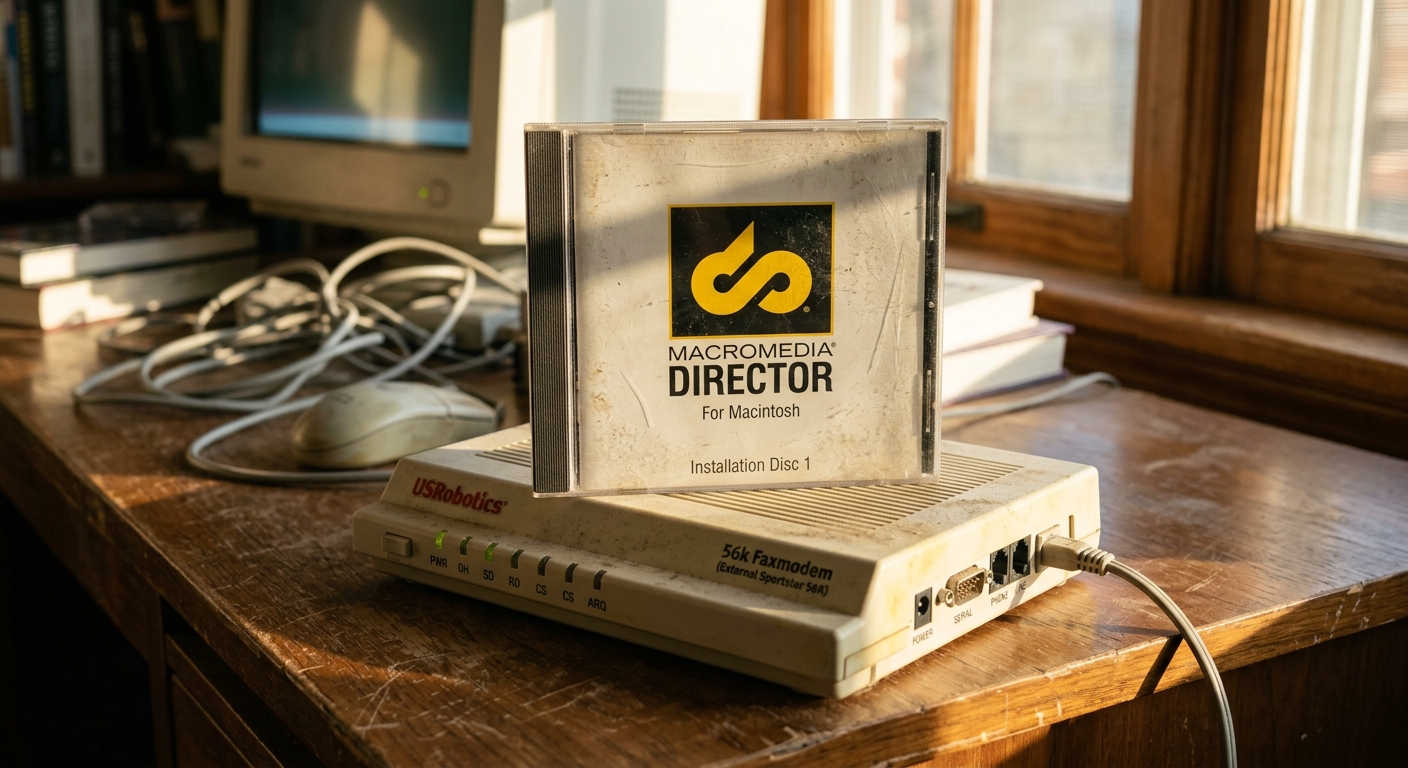
Shockwave started life in 1995 as a plugin for Macromedia Director, which was proper multimedia authoring software used by actual professionals. Director had been around since 1985, and it was the tool of choice for making CD-ROM games, educational software, and interactive presentations. It could handle 3D graphics, complex scripting, video, and genuinely sophisticated interactivity. When Macromedia created a plugin that could run Director content in a web browser, they called it Shockwave, and for a brief moment, it looked like the future of the web.
The problem was that Shockwave files were enormous. Director was designed for CD-ROMs, where you had 650 megabytes to play with and users expected to wait whilst things installed. On the web in 1995, people were still using dial-up modems. Waiting five minutes for a Shockwave game to load was technically impressive but practically useless for most websites.
Shockwave could do remarkable things. Proper 3D games, complex simulations, multimedia experiences that felt genuinely next-generation. There were Shockwave games that wouldn't have looked out of place as downloadable titles. The plugin gave you access to Director's entire feature set, which was comprehensive and professional. If you knew what you were doing, you could build something genuinely impressive.
Therein lay the second problem: you needed to know what you were doing, and you needed a copy of Director, which was expensive professional software. This wasn't something you'd pick up for a laugh on a Sunday afternoon.
Flash: Accidentally perfect for the web
Flash started life as FutureSplash Animator, a vector animation tool that was never meant to compete with Director. Macromedia bought it in 1996, renamed it Flash, and positioned it as a simple tool for making animated logos and basic interactive buttons. It used vector graphics, which meant tiny file sizes. You could make a spinning logo that downloaded in seconds on a dial-up connection.
Flash was simpler, cheaper, and good enough. That's what mattered. Web designers didn't need 3D graphics or complex scripting; they needed intro animations, navigation menus, and the occasional simple game. Flash gave them exactly that, and the files were small enough that people would actually wait for them to load.
The brilliance of Flash was accidental. Nobody at Macromedia initially realised they'd created the perfect plugin for web content. They thought Shockwave was the premium product and Flash was the basic version. But "basic" was exactly what the web needed in 1998.
Flash also had ActionScript, which started as a simple scripting language but gradually became more powerful. By Flash 5 in 2000, you could build proper applications in Flash if you wanted to. It wasn't as capable as Director's Lingo scripting language, but it was approachable enough that ordinary web developers could learn it, and powerful enough to build most things they wanted to build.
The difference nobody could explain
By the early 2000s, both Shockwave and Flash were Macromedia products (later Adobe, after they bought Macromedia in 2005), both required browser plugins, and both did "interactive multimedia stuff on the web". Ask someone what the difference was and you'd get a vague answer about Shockwave being "more powerful" or "for games", which was technically true but didn't really explain why you needed both plugins installed.
The honest answer was that Shockwave could run Director files and Flash couldn't. Director could do 3D graphics and more complex interactions, whilst Flash was limited to 2D vector graphics and simpler scripting. Shockwave files were .dcr or .dir files; Flash files were .swf files. In practice, 95% of interactive web content was made in Flash because it was easier and the files were smaller. Shockwave was for the occasional elaborate game or educational application that needed its extra capabilities.
But try explaining that to a normal person who just wanted to play games on Miniclip. They'd install both plugins because websites asked them to, and then never think about it again.
When it stopped mattering
There was a brief period around 2002-2005 when Shockwave 3D actually had a purpose. Macromedia added proper 3D capabilities to Director, and for a moment, Shockwave looked like it might be the way to deliver 3D content on the web. There were some genuinely impressive Shockwave 3D games and experiences that ran in your browser and looked remarkably good for the time.
But the moment passed. Flash kept getting more powerful with each version, eating into Shockwave's advantages. Flash could handle video (which became huge with YouTube in 2005), increasingly complex games, and even some 3D capabilities in later versions. Meanwhile, internet speeds improved, meaning file size mattered less, but also meaning that people could download actual games rather than playing them in a browser plugin.
By 2010, if you wanted to make a browser game, you'd use Flash because everyone had it installed and everyone knew what it was. If you wanted to make a serious game, you'd make a downloadable game in Unity or another proper game engine. Shockwave sat awkwardly in the middle, too heavyweight for casual web content and too limited for serious game development.
The iPhone arrived in 2007 without support for either Flash or Shockwave, and Steve Jobs's famous 2010 letter explaining why Flash would never come to iOS was the beginning of the end for browser plugins in general. HTML5 promised to do everything Flash and Shockwave could do without requiring a plugin at all. It took a while, but eventually it delivered.
The forgotten plugin
Adobe finally discontinued Shockwave Player in 2019, though by then it had been irrelevant for nearly a decade. Flash survived until 2020, partly because it had been so ubiquitous that untangling it from the web took years of effort. Shockwave just quietly disappeared, uninstalled from millions of computers by people who never really knew what it was for in the first place.
The story of Shockwave and Flash is a reminder that technical superiority doesn't always win. Shockwave was more powerful, more capable, and came first. Flash was simpler, smaller, and good enough for what people actually wanted to do. In the end, being good enough at the right time beats being technically impressive but impractical. And sometimes the "basic" version of a product accidentally becomes the standard because basic is exactly what everyone needs.
If you're feeling nostalgic and want to experience these relics of web history, there are preservation projects attempting to keep old Flash and Shockwave content playable. Otherwise, they're just two more entries in the long list of plugins you once installed and never thought about again — except this time, one of them was technically the premium version, not that it mattered.
More retro tech archaeology
If you've enjoyed this particular dive into obsolete browser technology, we've written about quite a few other digital relics that seemed important at the time and then vanished with barely a trace. Sometimes it's useful to look back at these things, if only to work out which patterns repeat themselves and which technological dead ends we might want to avoid second time around. You can read all about them here:
The Rise and Fall of the PalmPilot
The reality is that everything we build today stands on the shoulders of all this old, half-forgotten technology. Flash and Shockwave taught us what worked and what didn't about rich web content. Their failures informed HTML5. Their successes showed us what people actually wanted from interactive web experiences. Even the plugins that nobody remembers contributed something to how we think about the web now.
These days, we build rather different things, using rather different tools, but the lessons remain relevant. If you'd like to see what we're working on now — the modern equivalent of those ambitious Shockwave experiments, minus the five-minute loading times — there are examples below. And if you're wondering what any of it might cost, there's a link at the top of the page that'll point you in the right direction.
RiVault - Encrypted Password Manager
TrailTrack - The Best Ever Outdoor Hiking Website
What was the actual difference between Shockwave and Flash?
Shockwave could run content from Macromedia Director (professional multimedia software) and handle 3D graphics and complex interactions, while Flash was designed for simpler 2D vector animations with smaller file sizes. In practice, Flash became more popular because it was easier to use, files loaded faster on dial-up connections, and it was good enough for most web content.
Can you still play old Flash and Shockwave games anywhere?
Yes, there are preservation projects attempting to keep old Flash and Shockwave content playable, though the article doesn't specify which ones. Both plugins were officially discontinued (Shockwave in 2019, Flash in 2020), so you'll need to use these preservation projects rather than the original plugins.
Which came first, Flash or Shockwave?
Shockwave came first in 1995 as a plugin for Macromedia Director. Flash started as FutureSplash Animator and was bought by Macromedia in 1996, where it was initially positioned as the simpler, basic alternative to Shockwave.