
What misspellings in site-search data can tell you (beyond needing autocorrect)
When people type searches into your website, they get things wrong. Frequently. Sometimes spectacularly. And whilst the immediate instinct is to slap some autocorrect on it and move on with your day, those typos are actually trying to tell you something.
Not something profound about the human condition, sadly. But potentially something quite useful about how people interact with your site, what they expect to find, and where your content might be accidentally invisible to them.
The obvious stuff: people can't type
Let's start with the least interesting discovery: humans are rubbish at typing on small keyboards whilst walking, drinking coffee, or generally existing. You'll see predictable patterns – letters transposed, double letters where there should be one, adjacent keys hit by accident. "Accomodation" instead of "accommodation". "Recieve" instead of "receive". The greatest hits of the English language's most annoying words.
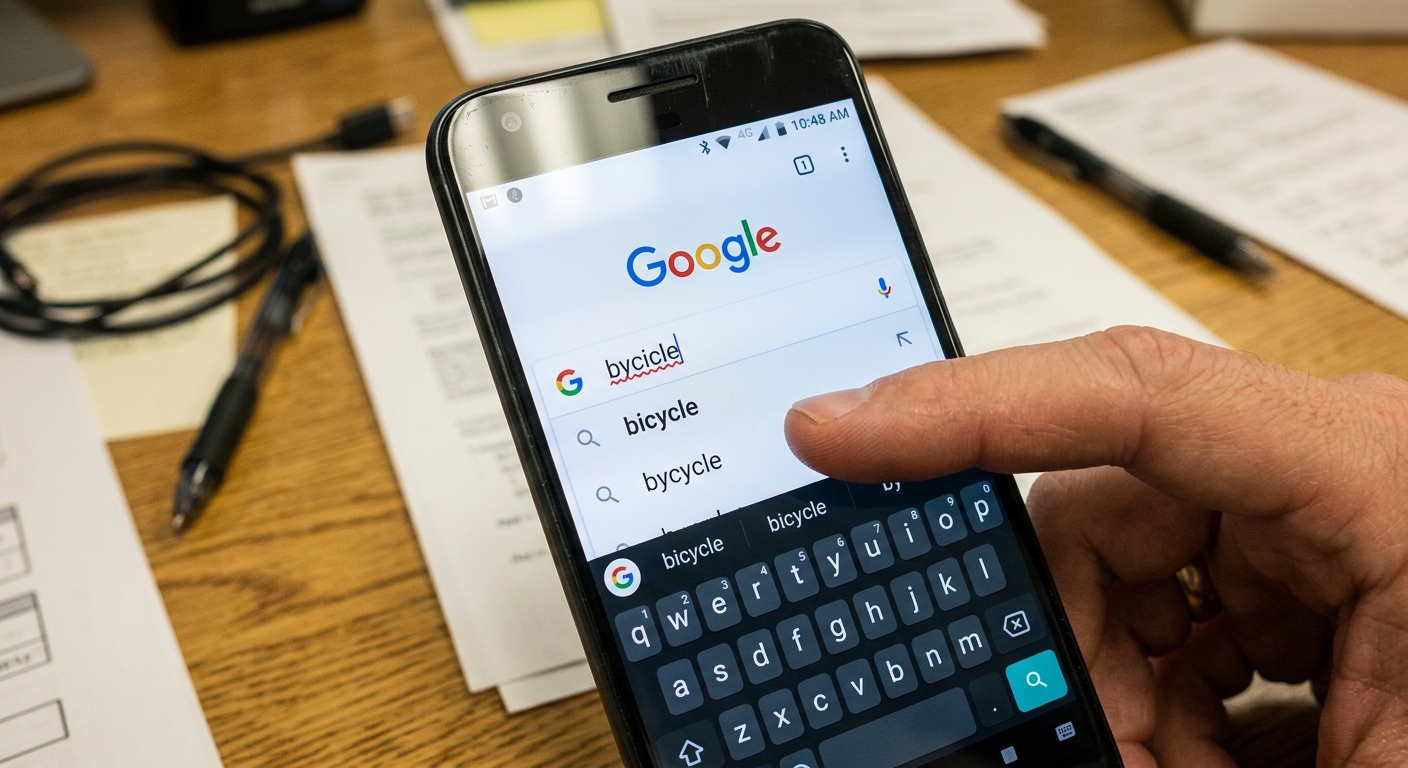
This is useful information, but only in aggregate. One person searching for "bycicle" is just someone having a bad day. Twenty people a week searching for "bycicle" means you should probably add it to your autocorrect dictionary or synonym list, because that particular misspelling is common enough to warrant action.
The more interesting bit: what people think things are called
Here's where it gets genuinely useful. When you see repeated searches for terms that aren't quite right but aren't exactly typos either, you're glimpsing what vocabulary people are bringing to your site.
Someone searching for "hoover bags" when you only stock "vacuum cleaner bags" isn't misspelling anything – they're using the brand name as a generic term. If enough people do this, you've got a decision to make: do you add "hoover" as a synonym in your search system, or do you actually change your content to include that term? Possibly both.
The same goes for industry jargon versus normal-person language. If your product pages all say "moisture-wicking technical fabric" but your search data shows people looking for "sweat-proof shirts", that's not a spelling problem. That's a vocabulary mismatch, and your fancy technical copy might be making things harder to find.
Product name confusion (or: when your naming convention is too clever)
If you sell products with names like "AquaFlow Pro 3000" and people keep searching for "AquaFlow 3000 Pro" or "Aquaflow Pro3000", congratulations – your product naming scheme is memorable but not quite memorable enough. People know roughly what it's called, they just can't remember the exact word order or where the spaces go.
This isn't really about misspelling either, but it shows up in the same data. And it tells you that your search system needs to be flexible about word order and spacing for product names, or that perhaps your next product range could benefit from slightly less baroque nomenclature.
Regional variations and alternative spellings
Depending on your audience, you might see searches for both "colour" and "color", "organise" and "organize", "grey" and "gray". These aren't mistakes – they're just different. If you're seeing a meaningful number of searches using the other variant from the one in your content, your search system should probably treat them as equivalent.
The same principle applies to abbreviations and full terms. "TV" and "television", "fridge" and "refrigerator", "laptop" and "laptop computer" – if people are searching for both, your system needs to understand they mean the same thing.
How to actually use this information
Looking at your search data once and going "hmm, interesting" achieves precisely nothing. The value is in spotting patterns that repeat often enough to be worth acting on.
Start by filtering your search queries to find ones that returned no results or very poor results. Look for repeated patterns rather than one-off oddities. If "bluetooth" keeps getting spelled "bluetoth" or "bluethooth", add those to your autocorrect or synonym list. If people keep searching for terms you don't use but understand, consider whether you should be using them in your content.
Your autocomplete feature should learn from common misspellings too. If someone types "acc" and the most common completion is actually "accomodation" (misspelled), your autocomplete should probably suggest the correctly spelled version – but it needs to know that pattern exists first.
What misspellings won't tell you
Just to set expectations at a sensible level: analysing search typos will not reveal the deep psychological motivations of your visitors, predict future trends, or decrypt their innermost desires. It won't tell you whether they're genuinely interested in buying or just browsing aimlessly. It won't explain why they abandoned their cart or why they clicked on that particular product.
What it will do is highlight friction points where the words people use don't match the words you use, or where their mental model of your product names differs from yours. That's useful, but it's a fairly practical, unglamorous kind of useful. Less "revolutionary insight", more "oh, we should probably fix that".
The implementation bit (which is less tedious than it sounds)
Actually putting this into practice means having a search system that can handle synonyms, autocorrect, and flexible matching. Most modern site search tools can do this – you just need to feed them the right information based on what you're seeing in your data.
Create a synonym list that maps common misspellings and alternative terms to the correct ones. Update your autocomplete suggestions to catch common typos before they become searches. Review your content to see if you're using industry terminology where normal human words would work better.
And then check back in a few months to see if the patterns have changed, because they probably will. Language shifts, product lines change, and new typos emerge to replace the old ones. It's not a one-time fix, but it's not exactly a full-time job either.
Read more about search analytics
If you've made it this far without falling asleep, you might actually be interested in this sort of thing. We've written quite a bit about search and analytics, mostly because we find it more interesting than we probably should. Here are a few to get you started:
Clicks vs. Impressions in Google Search Console: Reading the Performance Tab Without Drifting Off
Why we write about Analytics
We write about search and analytics because it's part of what we actually do. When we build websites for clients, setting up sensible search and tracking what people do with it is just part of the job – not an optional extra you have to remember to ask about.
We also run an ongoing management service for clients who'd rather not spend their time learning the finer points of search analytics and synonym lists. We handle the monitoring, spot the patterns, make the adjustments, and generally prevent your site search from becoming mysteriously useless over time. It's the sort of thing that's easy to ignore until it's obviously broken, at which point it's been quietly annoying people for months.
Would you like to work with us?
If you'd like us to build you a website that doesn't treat search as an afterthought, or if your current site could benefit from someone actually paying attention to how people use it, we should probably talk. We're quite good at this, reasonably pleasant to work with, and we don't do any of that tedious overselling thing where we pretend every minor improvement is going to revolutionise your business.
Get in touch and we'll have a proper conversation about what you actually need. Prices can be found below.
Ongoing Website Management Prices
How many people need to misspell something before I should add it to autocorrect?
One person misspelling something is just a bad day, but if you see the same misspelling 20 times a week or more, it's common enough to warrant adding to your autocorrect dictionary or synonym list.
Do I need to support both British and American spellings on my website?
If you're seeing meaningful numbers of searches for both variants (like 'colour' and 'color'), your search system should treat them as equivalent. The same applies to abbreviations versus full terms like 'TV' and 'television'.
Where do I start when analysing search misspellings?
Start by filtering your search queries to find ones that returned no results or very poor results, then look for repeated patterns rather than one-off oddities. Focus on what's happening frequently enough to be worth fixing.