
why dot matrix printers refuse to die
There's a particular sound that haunts certain corners of the modern workplace. A violent, rhythmic hammering that sounds like a small robot having a nervous breakdown. It's the unmistakable din of a dot matrix printer, and if you're hearing one in 2026, you're probably standing in a warehouse, a medical clinic, or anywhere that still uses multi-part carbonless forms.
The technology is positively ancient. Whilst the rest of the printing world moved on to whisper-quiet lasers and inkjets decades ago, dot matrix printers are still battering away, producing output that looks like it was printed in 1987. Because often, the software driving them hasn't been updated since 1987.
And yet they persist. Not through nostalgia or stubbornness, but because they do something that modern printers simply cannot: print through multiple layers of paper at once.
The genius of mechanical violence
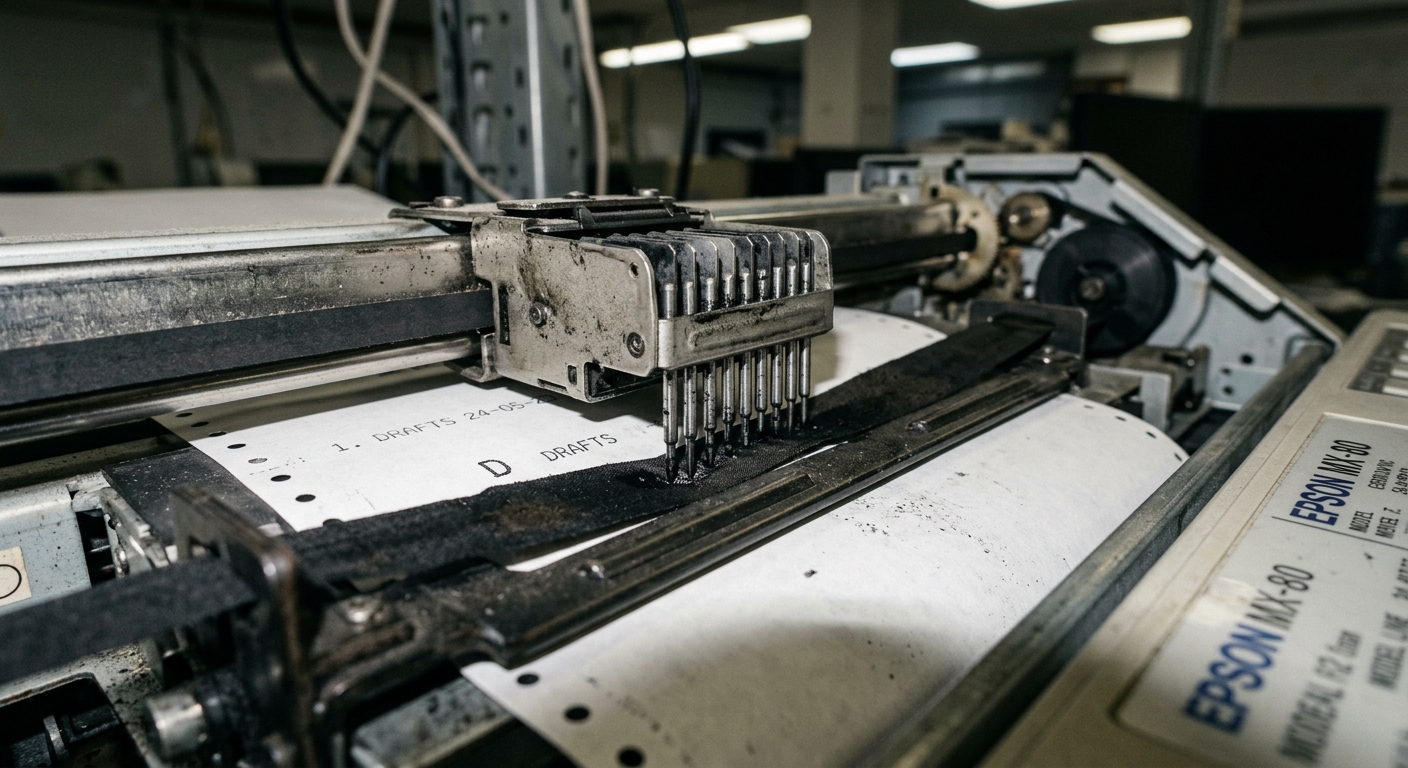
A dot matrix printer works by smashing tiny pins against an ink ribbon, which transfers dots onto paper. It's printing through brute force. The print head travels back and forth across the page, physically striking the paper multiple times to form each character. It's loud, it's slow, and it's completely brilliant for certain jobs.
The key advantage is impact. When you need to print through three, four, or even five layers of carbonless copy paper simultaneously, you need actual physical force. A laser printer melts toner onto a single sheet. An inkjet sprays microscopic droplets. Neither can create an impression that transfers through multiple layers. They're not built for it.
Dot matrix printers, on the other hand, hit the paper hard enough that the pressure transfers through carbonless copy paper, creating duplicates in one pass. No scanning, no photocopying, no printing the same thing multiple times. One brutal pass and you've got your white copy, yellow copy, pink copy, and whatever other colours your bureaucratic heart desires.
Where they're still earning their keep
Delivery drivers know the sound well. Every parcel collection comes with the characteristic screech of a dot matrix printer churning out multi-part consignment notes. The driver keeps one copy, one stays with the sender, one travels with the parcel. It's a system that's worked for decades, and the infrastructure built around it is vast.
Medical facilities use them for prescriptions and patient records, particularly where duplicate copies need to go to different departments simultaneously. There's something reassuring about a physical, mechanical copy rather than trusting everything to a network that might be down when you need it most.
Automotive workshops print job cards on continuous feed paper, tearing off each job with a satisfying rip. The paper is cheap, the printers are indestructible, and when you're working in an environment covered in oil and brake fluid, you want equipment that can survive the occasional catastrophic spill.
Manufacturing and warehouse operations run entire inventory systems on continuous feed paper. The printers sit in dusty corners, churning out picking lists and dispatch notes, covered in the kind of grime that would kill a modern inkjet in minutes. Dot matrix printers don't care. They've survived worse.
Built to outlast civilization
The reliability is almost absurd. Many dot matrix printers still running today are older than the people operating them. They're from an era when technology was designed to be repaired rather than replaced. Print heads wear out eventually, but they're replaceable. Ribbons are cheap and available. There are no complex electronics to fail, no proprietary chips that lock you into expensive consumables.
When something does go wrong, it's usually mechanical and fixable. A stuck pin in the print head. A worn drive belt. Problems you can diagnose with your eyes and fix with basic tools. Compare that to a modern printer that throws an error code requiring a service technician and a part that costs more than a new printer.
The running costs are remarkable too. Ink ribbons cost a few pounds and last for thousands of pages. They don't dry out if you don't use the printer for six months. There's no cleaning cycle wasting ink every time you turn it on. No firmware updates bricking your device. No subscription service trying to charge you monthly for the privilege of using hardware you already own.
The paper that refuses to modernize
Continuous feed paper is the other half of this equation. That long, perforated paper with the holes down each side that feed through a tractor mechanism. It's perfect for printing long lists, invoices, and reports without having to manually feed each sheet.
It's also brilliant for pre-printed forms. You can buy continuous feed paper with your company details, form fields, even security features already printed on it. The dot matrix printer just fills in the variable data. It's a system that's been working since the 1970s, and whilst it looks outdated, it's phenomenally efficient for certain workflows.
Modern printers struggle with this kind of specialized media. They're designed for standard A4 sheets, perhaps the occasional envelope if you're lucky. Try feeding continuous paper through a laser printer and you'll spend your afternoon with a service manual and a torch, fishing shredded paper out of the fuser assembly.
The software that time forgot
Many businesses are running ancient software specifically because it supports dot matrix printing. Accounting systems from the early 1990s. Inventory management built for DOS. These programs still work, they're reliable, and replacing them would mean retraining staff and potentially losing functionality that was custom-built decades ago.
The dot matrix printer is often the last physical link to these legacy systems. The computers might have been virtualized, running in emulation on modern hardware, but that printer is still the original unit from 1993, hammering away like it always has.
There's something rather wonderful about that continuity. In a world where phones become obsolete after three years, there's a dot matrix printer that's been printing the same invoices for thirty years, asking for nothing more than an occasional ribbon change.
The sound of stubbornness
The noise remains problematic. There's no getting around the fact that dot matrix printers are loud. Offices that still use them tend to hide them in back rooms or cupboards, where the incessant hammering won't drive everyone mad. Some people find the sound nostalgic. Those people are wrong. It's awful.
But that noise is the sound of something actually happening. Physical pins striking paper. Mechanical action producing a tangible result. In our increasingly digital world, where everything exists as electrons and cloud storage, there's something honest about a machine that makes that much racket doing its job.
Will they ever disappear completely? Probably. Electronic signatures and digital workflows are gradually replacing the need for carbon copies. Regulations change, industries modernize, and eventually the last dot matrix printer will hammer out its final page.
But that day isn't here yet. Somewhere right now, in a warehouse or clinic or delivery depot, a dot matrix printer is producing perfectly serviceable multi-part forms, just as it has done for decades. The technology might be ancient, but it's still the best tool for the job. And until someone invents a better way to print through five layers of paper at once, these mechanical dinosaurs will keep hammering away, refusing to die with all the stubbornness of a technology that knows it's still useful.
More from the archives
If you enjoyed this little journey into obsolete technology that refuses to become obsolete, you'll be pleased to know we've got plenty more where that came from. The Retro Tech section is full of stories about the gadgets, systems, and occasionally baffling design decisions that somehow refuse to leave us. Here are a few to get you started:
Saving Your Life's Work on a Floppy Disk
Why we care about old technology
We write about retro tech not because we're drowning in nostalgia or think everything was better in the old days. We write about it because understanding where technology came from helps us build better things today. Every website we create, every piece of software we develop, exists because someone invented dot matrix printers, or modems, or the absolutely barmy decision to use QWERTY keyboards.
The constraints of older technology forced clever solutions. When you only had 64 kilobytes of memory, you learned to write efficient code. When printing was expensive, you designed forms that actually worked. These lessons don't become irrelevant just because we've got more resources now. If anything, they're more important when everyone else is building bloated, inefficient systems because they can.
We've built software for businesses who need modern solutions that work as reliably as their old dot matrix printers. We've created websites that load instantly because we remember when every kilobyte mattered. We understand that technology should solve problems, not create new ones. To see more about we can make then take a look at these:
TrailTrack - The Best Ever Outdoor Hiking Website
Want to get in touch?
If you need a website that actually works, or software that solves a real problem rather than just looking flash in a presentation, we should probably talk. We're not going to promise to revolutionize your business or leverage any synergies, but we will build you something robust, efficient, and pleasingly devoid of unnecessary nonsense. Prices can be found at the top of the page.
Why do some companies still use dot matrix printers instead of laser or inkjet models?
Because they need to print through several layers of carbonless copy paper in one pass, which only impact printers can do reliably. Modern printers lack the physical force to create those multi-part copies.
Are dot matrix printers cheaper to run than today’s laser or inkjet printers?
Generally, yes. Ink ribbons cost only a few pounds and last thousands of pages, they don’t dry out, and there are no pricey consumable chips or cleaning cycles. Repairs are usually mechanical and can be done with basic tools.
Will dot matrix printers ever disappear completely?
Probably, but not anytime soon. As electronic signatures and digital workflows replace carbon copies, the demand will fade, yet many warehouses, clinics and legacy systems still rely on them today.