
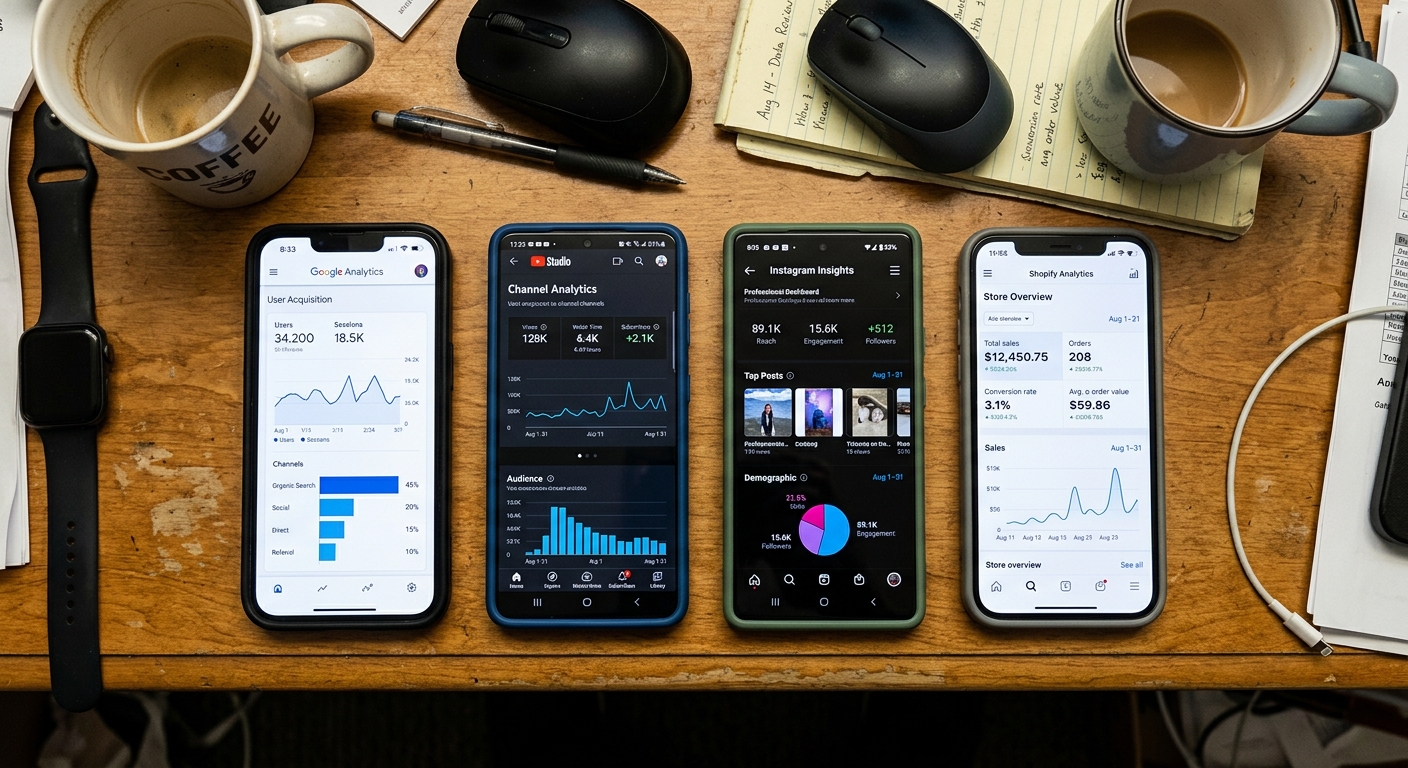
Why Your Traffic Split Across Four Platforms Doesn't Add Up to a Strategy
If you're running a small business online, you've probably been told that you need to be on every platform. YouTube for awareness, Instagram for engagement, Google for search traffic, TikTok because everyone's there now. The logic sounds reasonable until you actually try to work out whether any of it is helping you stay solvent.
The trouble isn't that the platforms don't work. It's that when your audience hops from one to another before they eventually buy something, measuring each channel separately gives you a fragmented picture that doesn't tell you much about what's actually driving revenue. And the new reporting tools that promise to unify everything? They're useful, but they can't solve the underlying problem: most small businesses are spreading themselves thin without knowing which channel is worth the effort.
The Problem With Platform-by-Platform Thinking
Each platform has its own analytics dashboard, and each one is eager to take credit for your success. Instagram will tell you your Reels got 10,000 views. Google will show you how many people clicked through from search. TikTok will report how many people saw your product. YouTube will count watch time. All perfectly accurate, all utterly useless when someone watches your YouTube video on Tuesday, searches for your brand on Thursday, scrolls past your Instagram post on Friday, and finally buys on Saturday after seeing a TikTok.
Which channel gets the credit? Depends which dashboard you're looking at. TikTok will claim the sale because it was the last touchpoint. Instagram will count it as engagement. Google will note the search. YouTube will have no idea a purchase happened at all. You end up with five different stories about the same customer journey, and no clear idea which bit you could actually stop doing without hurting your bottom line.
What Unified Reporting Actually Does
The appeal of unified analytics is obvious: one place to see everything. Google Analytics, for instance, will track visitors across multiple touchpoints and attempt to connect the dots between someone's first visit from organic search and their eventual purchase after clicking an Instagram link. It's genuinely helpful to see that people don't usually buy the first time they hear about you.
But here's what the unified dashboards can't tell you: whether you actually need to be on all those platforms in the first place. They'll show you the path people took, but they won't tell you whether that path would have been shorter and cheaper if you'd focused your energy somewhere more productive. A customer who touches five platforms before buying isn't necessarily proof that you need five platforms. It might just mean you're making people work quite hard to give you money.
The Attribution Puzzle
Attribution—working out which interaction deserves credit for a sale—is where this gets properly complicated. Different tools handle this differently, and understanding what you're actually measuring matters more than most people realise.
Take Google Analytics 4. When you're looking at conversion reporting, it uses data-driven attribution by default, which attempts to assign partial credit across multiple touchpoints based on patterns in your data. It works for any key event you're tracking, regardless of how many conversions you're getting or how much traffic you have. The model does get better as you collect more data—Google's fairly upfront about that—but you're not locked out if you're small. You just might not get the full benefit straight away.
Meanwhile, when you're looking at where your traffic came from in the first place—those source and medium reports that tell you someone arrived via Instagram or Google—that's typically based on last-click attribution for the session or user. The platform that brought them in most recently gets the credit for the visit, even if they'd already heard about you somewhere else.
None of this is wrong, exactly. It's just measuring different things in different ways, and if you don't know which report is using which method, you'll end up drawing conclusions that don't quite match reality.
The Real Question You Should Be Asking
Instead of trying to build the perfect attribution model, ask yourself a more practical question: if you stopped posting on one platform entirely, would anyone notice? More importantly, would your revenue drop?
This isn't about analytics at all. It's about focus. If you're spending five hours a week creating TikTok content and two hours on email, but email generates three times as many sales, your measurement problem isn't technical. You're measuring the wrong thing, or you're ignoring what you're measuring, or both.
The honest answer for many small businesses is that they're on four platforms because they feel they should be, not because they've tested whether it makes commercial sense. And that's fine as a starting point, but at some point you need to work out whether your YouTube channel is actually bringing in customers or just giving you something to feel busy about.
How to Work Out What's Actually Worth Your Time
Start with revenue, not traffic. If you're selling something, track which channel people last came from before they bought. Not because last-click attribution is perfect—it isn't—but because it's simple, consistent, and gives you a baseline. If 80% of your sales come from people who last clicked a Google ad or organic result, and 3% come from Instagram, that tells you something useful.
Then test whether the other channels matter. Stop posting on Instagram for a month. If your sales drop, it matters. If they don't, you've just freed up five hours a week. This sounds brutally simple because it is. You don't need a sophisticated attribution model to work out whether something is pulling its weight.
If you do want to understand the full journey—and sometimes that's worth doing—pick one tool and learn how it actually works. Google Analytics is free and does the job for most small businesses, but only if you understand which reports are showing you what. Traffic source reports tell you where visits came from. Conversion paths tell you which touchpoints people hit before buying. They're measuring different things, and mixing them up will lead you confidently in the wrong direction.
Do You Really Need to Be Everywhere?
Probably not. The idea that you must maintain an active presence on every platform is marketing advice designed for companies with marketing teams. If you're doing this yourself, or with one other person, being everywhere means being mediocre everywhere. One platform where you post consistently and well will outperform four platforms where you're posting sporadic, half-hearted content because you're exhausted.
The platforms want you to believe their audience is unique and unreachable anywhere else. Sometimes that's true—if your customers are teenagers, you probably need TikTok; if they're looking for plumbers, you probably need Google. But most of the time, your audience is on multiple platforms, and they'll find you on whichever one you're actually good at.
Unified reporting can show you where people are coming from. It can't tell you whether your strategy makes sense. That bit, unfortunately, still requires you to think about what you're doing and why. The good news is that once you stop trying to be everywhere, you'll have enough time to actually do it.
More on Marketing
If you found this useful, we've written rather a lot about marketing. Topics range from the practical side of getting found online to working out whether what you're doing is actually helping. Here are a few that are worth a look at if you're trying to make sense of it all.
Why Showing Your Mistakes and Bloopers Actually Sells
Fixing the "Leaky Bucket": Why the Best Marketing is Keeping Your Old Customers
The honest reason most small business blogs fail (and it's not the writing)
Why We Write About This
We cover marketing because it's part of what we do when we build websites. Getting the technical side right matters, but so does making sure people can actually find you afterwards. We also offer an ongoing management service where we handle both the website and the marketing side for clients who'd rather not think about it. Means you can focus on running your business while we make sure the website keeps working for you.
Get in Touch
If you'd like us to build you a website, or take over managing the one you've already got, get in touch. We'll have a proper conversation about what you actually need, rather than trying to sell you things you don't. You can find out more about our prices below.
Ongoing Website Management Prices
Why do my analytics show different results for the same sale across different platforms?
Each platform uses its own attribution model and takes credit for conversions differently. TikTok might claim the sale as the last touchpoint, Instagram counts it as engagement, and Google notes the search—they're all measuring the same customer journey from different angles, which is why the numbers don't match up.
Do I really need to be on every social media platform to grow my business?
No, probably not. One platform where you post consistently and well will outperform four platforms where you're spreading yourself thin with mediocre content. Focus on the platform where your actual customers are and where you can realistically maintain quality.
What's the difference between Google Analytics traffic reports and conversion reports?
Traffic source reports show where visits came from using last-click attribution, while conversion reports use data-driven attribution that spreads credit across multiple touchpoints. They're measuring different things, so mixing them up will give you the wrong conclusions about what's working.