
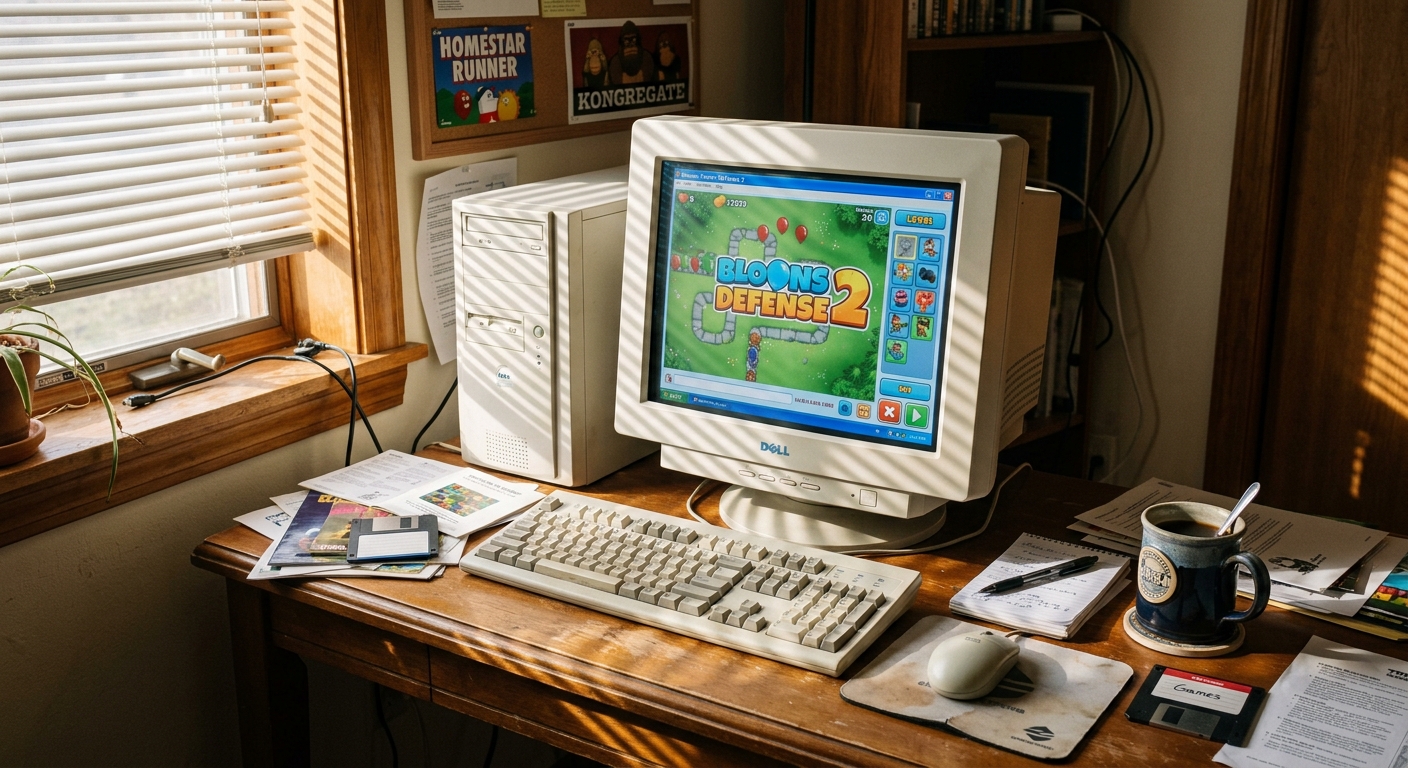
When Flash was the web's favourite shortcut to animation and interactivity
There was a time, not so very long ago, when visiting a website meant waiting for a little loading bar to fill up whilst something called Flash Player did its thing. You'd see animated splash pages, interactive menus that whooshed about when you moved your mouse, and browser games that somehow made spending an afternoon at work feel almost justifiable. Flash wasn't just a technology—it was the glue holding together a more playful, experimental corner of the web.
Before HTML5 came along and made everything rather more sensible, Flash was the go-to solution for anything beyond static text and images. Want to embed a video? Flash. Fancy a bit of animation? Flash. Interactive game? Flash again. It brought audio, video, animation and proper interactivity to websites at a time when browsers themselves were still catching up with the idea that the web might be used for more than displaying academic papers and terrible colour schemes.
The plugin that could do almost anything
Flash started life in the mid-1990s as FutureSplash Animator before Macromedia acquired it and turned it into the multimedia Swiss Army knife of the early web. Adobe eventually bought Macromedia in 2005, inheriting what had become an absolutely dominant technology. At its peak, Flash was installed on something like 99% of desktop computers with internet access. That's the sort of market penetration that makes current tech giants weep into their quarterly reports.
What made Flash so appealing was its ability to deliver consistent experiences across different browsers and operating systems—something that was decidedly not guaranteed in the bad old days when "works in Internet Explorer 6" was an actual selling point. Designers and developers could create something once and reasonably expect it to work the same way whether someone was using Netscape Navigator or whatever Microsoft was threatening people with that week.
The creative possibilities were genuinely remarkable. Entire cottage industries sprang up around Flash game development. Websites like Newgrounds became launching pads for animators and game designers who went on to proper careers. Flash gave people tools to make things that moved and responded and felt alive in ways that basic HTML simply couldn't manage at the time.
The cracks begin to show
Of course, no technology stays on top forever, and Flash's problems were becoming increasingly difficult to ignore. Security vulnerabilities seemed to pop up with alarming regularity, turning the plugin into something of a favourite target for people with malicious intent. Performance was another issue—Flash content could make even decent computers wheeze and stutter, and it had an unfortunate habit of turning laptop fans into impersonations of small aircraft.
Battery life on mobile devices was particularly dire when Flash was involved, which became rather important as smartphones stopped being something only executives pretended to need. The plugin was also designed for a world of mouse cursors and hover states, not touchscreens and finger-based navigation. These weren't minor niggles; they were fundamental mismatches with where the web was heading.
Browser manufacturers and standards bodies had been quietly working on alternatives. HTML5, along with CSS3 and JavaScript improvements, was gradually making it possible to do many of the things Flash had monopolised. Native video playback, canvas-based animation, and increasingly sophisticated APIs meant the web could finally handle rich content without requiring a proprietary plugin.
Steve Jobs weighs in
In 2010, Steve Jobs published an open letter titled "Thoughts on Flash" that laid out Apple's reasoning for not supporting Flash on iOS devices. It wasn't exactly subtle. He criticised Flash's security record, its impact on battery life, its touch-unfriendly design, and its proprietary nature. Apple was betting on open web standards instead, and given that the iPhone was rapidly reshaping how people accessed the internet, this wasn't a decision Adobe could simply ignore.
Jobs' letter got an enormous amount of attention, partly because he had a gift for the public technical argument and partly because leaving Flash off the iPhone was genuinely controversial at the time. Many saw it as Apple being controlling and anti-competitive. In retrospect, though, Jobs was articulating problems that were already apparent to many developers. He didn't single-handedly kill Flash—the technology's limitations were doing a perfectly adequate job of that themselves—but he certainly gave it a memorable shove toward the exit.
The long goodbye
Flash's decline was gradual rather than immediate. YouTube had already started moving to HTML5 video. Browser makers began requiring explicit permission to run Flash content rather than loading it automatically. Developers found they could achieve their goals with open standards and better performance. The business case for maintaining Flash became increasingly difficult to justify.
Adobe announced in 2017 that Flash would reach end-of-life at the end of 2020. When that date arrived, browsers stopped supporting it entirely. Suddenly, vast swathes of early web history became inaccessible—games, animations, interactive art projects and experimental websites simply stopped working. Preservation efforts like Ruffle, which attempts to emulate Flash using modern web technologies, are trying to keep some of this content alive, but much has been lost.
Flash's legacy is complicated. Yes, it had serious problems and needed to go. But it also enabled an era of web creativity that might not have happened otherwise. It gave people tools to make things that genuinely hadn't been possible before, and it made the web feel less like a collection of documents and more like a platform for genuine interaction and expression.
What it meant for the web
The transition away from Flash marked a turning point for the web. Open standards proved they could deliver rich, interactive experiences without requiring proprietary plugins. Browsers became far more capable, and the distinction between "web apps" and "proper software" became increasingly blurry. The web became more secure, more performant, and more accessible in the process.
But something was also lost in the shift toward standardisation and mobile-first design. The experimental, slightly chaotic creativity of the Flash era gave way to something more uniform and, occasionally, a bit sterile. Not everything needs to whoosh and sparkle, admittedly, but there was a playfulness to that period that's worth remembering. Flash represented a moment when the web was still figuring out what it wanted to be, and people were trying absolutely everything to see what might stick.
More where this came from
If you've found yourself nodding along to memories of loading bars and overly elaborate website intros, you might enjoy rooting through our other pieces on technology that's shuffled off into history. We've got plenty more articles in our Retro Tech section about the hardware, software and general digital curiosities that defined their eras before becoming museum pieces. These ought to get you started.
The Rise and Fall of the PalmPilot
Watching the Blocks Move in Disk Defragmenter
When Windows XP refused to die (and why IT departments were still clinging to it in 2014)
Why we write about old technology
We spend quite a bit of time writing about technology that's no longer with us, which might seem odd for a company that builds modern websites and software. The thing is, none of what we do today would be possible without the experiments, failures and occasional triumphs of everything that came before. Understanding how we got here—what worked, what didn't, and why—makes us better at building things that will actually be useful rather than just technically possible.
Every questionable design decision, every security vulnerability, every performance bottleneck from the past taught someone something important. Flash's story is a particularly good example: it showed what people wanted from the web, even if the implementation couldn't quite deliver it sustainably. Those lessons informed HTML5, modern JavaScript frameworks, and pretty much everything we use to build websites today.
Speaking of building things
If you've got a project in mind—whether it's a website that needs building, software that needs creating, or a digital problem that needs solving—we'd genuinely like to hear about it. We build things the modern way, with open standards and without any proprietary plugins that might become technological embarrassments in a decade's time. No hard sell, no corporate waffle, just a conversation about what you need and whether we're the right people to help build it. Get in touch and we'll take it from there. Guide Prices and info can be found below.
How We Build Custom Software Around Your Business
Why did Flash Player stop working on my computer?
Adobe ended support for Flash at the end of 2020, and all major browsers stopped supporting it entirely at that point. This means any old Flash content—games, animations, websites—simply won't run anymore without special emulation software like Ruffle.
What did Steve Jobs say about Flash?
In 2010, Jobs published an open letter criticising Flash's security problems, poor battery life, lack of touch support, and proprietary nature—explaining why Apple wouldn't support it on iOS devices. Whilst controversial at the time, he was highlighting issues that were already pushing developers toward HTML5 and open standards.
Why was Flash so popular in the first place?
Flash could do things browsers simply couldn't handle at the time—video, animation, games, and proper interactivity. It worked consistently across different browsers and operating systems, which was a massive advantage in the early 2000s when that sort of compatibility was far from guaranteed.