
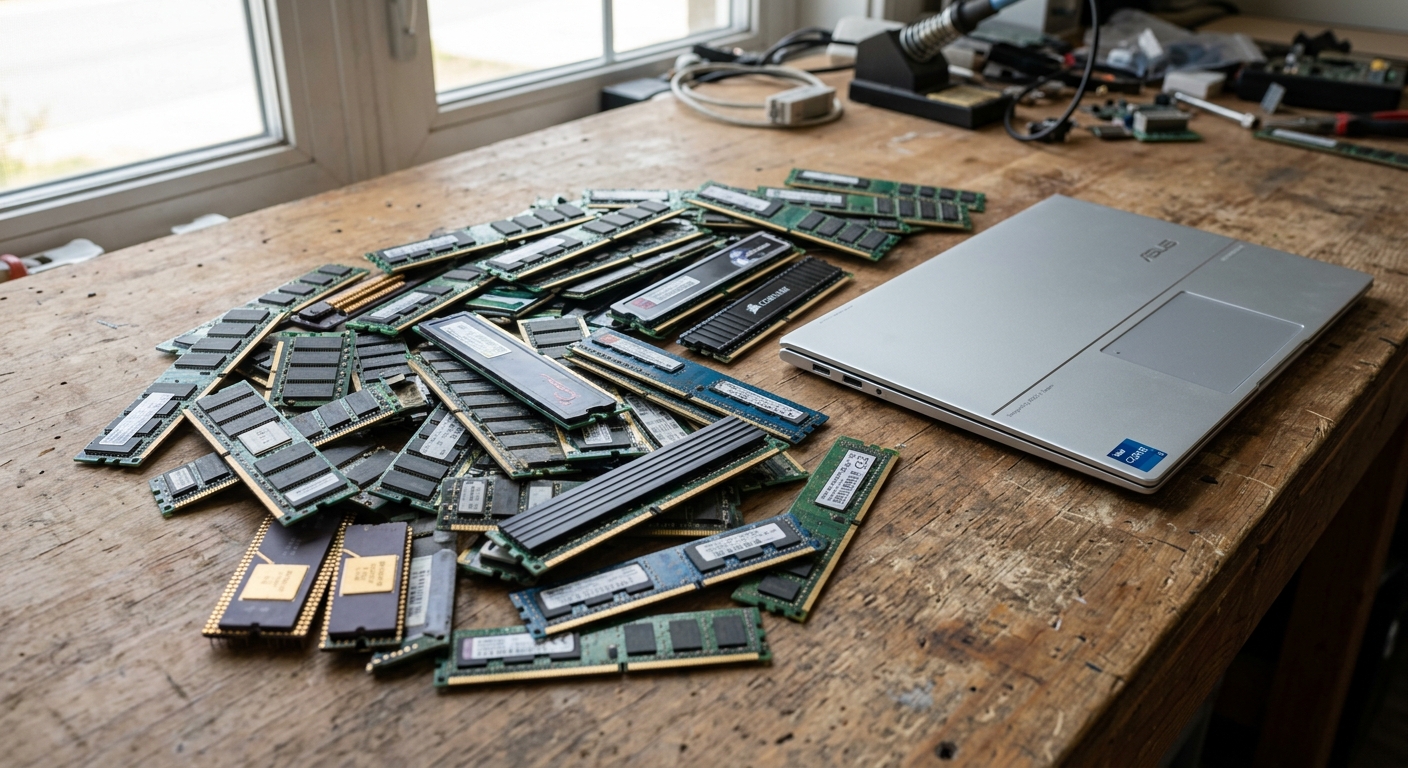
When RAM Came on a Little Card You Could Actually Swap Out Yourself
Before everything was soldered down and sealed behind warranty stickers, upgrading your computer's memory meant opening the case, clicking a circuit board into place, and watching Windows suddenly run like it had remembered how to walk. Now most devices treat user-installed RAM like a health and safety violation, and 'upgrading' means buying an entirely new machine. Somewhere between planned obsolescence and genuine engineering constraints lies the question of whether we've become better off or just more dependent on the people selling us things.
The Golden Age of Clicking Things Into Place
There was something deeply satisfying about upgrading RAM in the late nineties and early two-thousands. You'd open your beige tower—or if you were fancy, your translucent iMac G3—locate the memory slots on the motherboard, and push in a new stick until it clicked. That click was important. It meant you'd done it properly, and your computer would now have enough memory to run three programs at once without freezing like a rabbit in headlights.
The barrier to entry was wonderfully low. You didn't need training or certification. You needed a screwdriver, sometimes not even that, and the ability to follow instructions that came printed on actual paper. The worst that could happen was you'd put it in backwards, which was surprisingly difficult because the notches were designed to prevent exactly that sort of nonsense.
This accessibility meant ordinary people could extend the life of their machines. Your computer was slowing down after a couple of years? Forty quid and ten minutes later, it was sprightly again. No need to bin the whole thing and queue up at PC World for whatever they were flogging that week.
When Thin Became the Enemy of Fixable
Then somewhere around 2010, computer manufacturers discovered that people quite fancied slim laptops. Fair enough—nobody enjoyed lugging around machines that could double as doorstops. But the pursuit of thinness came with casualties, and user-replaceable RAM was one of the first against the wall.
Soldering RAM directly onto the motherboard saved a few millimeters of height. It also meant that when you bought a laptop with 4GB of memory, you were stuck with 4GB of memory until the heat death of the universe, or until you bought a new laptop, whichever came first. Usually the latter, and usually sooner than you'd planned.
Apple led this particular charge with typical conviction, but everyone else followed along soon enough. Microsoft's Surface line, Dell's XPS range, most of the Ultrabook category—all of them treated the idea of user-upgradeable RAM like an archaic practice from less enlightened times, like bloodletting or using Internet Explorer by choice.
The Case for Soldering Everything Down
To be fair to the manufacturers, it's not entirely about forcing you to buy new hardware every three years, though that's certainly a pleasant side effect from their perspective. Soldered RAM does offer legitimate technical advantages.
It's faster, for one thing. When memory chips sit directly on the motherboard without slots and sockets in between, signals travel shorter distances and encounter less electrical resistance. This matters more as RAM speeds increase. DDR5 running at silly speeds doesn't play as nicely with removable modules as DDR2 did when it was ambling along at a comparatively glacial pace.
Soldered components are also more reliable in certain contexts. No slots means fewer points of potential failure, nothing to work loose if you drop your laptop, no contacts to corrode if you live somewhere damp. For devices that get carried about and jostled, this isn't nothing.
And yes, it does enable thinner, lighter designs. Whether you actually need your laptop to be 14mm thin instead of 18mm is another question entirely, but the market has apparently decided that we do.
What We Lost Along the Way
The problem isn't that soldered RAM exists—it's that it's become the only option for most devices, even ones where the technical justification is questionable at best. Your desktop tower doesn't need to be thin. It sits under your desk gathering dust and radiating heat. There's no reason it couldn't have accessible memory slots except that it's cheaper to manufacture everything the same way.
What we've lost isn't just the ability to upgrade. It's the sense that you own your device in any meaningful sense. When you can't open it without voiding the warranty, can't replace components without replacing everything, can't extend its useful life without the manufacturer's permission, you're not really owning anything. You're renting it on a vague, undefined lease that expires whenever the next model comes out.
This has environmental implications that manufacturers acknowledge in their sustainability reports while simultaneously making devices less repairable. It has economic implications for people who can't afford to replace entire machines when they just need a bit more memory. And it has philosophical implications about our relationship with technology—whether we're users who understand and control our tools, or consumers who accept what we're given and buy new when the old stops working.
The Framework Exception
Every now and then, someone remembers that computers don't have to be sealed boxes of mystery. Framework, a relative newcomer, has built an entire company around the radical notion that laptops could be thin and light and also repairable. Their machines have user-replaceable RAM, storage, batteries, even ports. You can upgrade components or replace broken ones without sending the whole thing to a landfill.
They're not alone—some gaming laptops and business machines still offer accessible memory—but they're rare enough to be noteworthy. The fact that this is remarkable rather than routine tells you everything about how far the pendulum has swung.
Where This Leaves Us
We're probably not going back to the days when every computer was a Lego set you could reconfigure at will. Some design constraints are real, and some advances genuinely require different approaches. But we might occasionally ask whether every device needs to be quite so aggressively un-upgradeable, and whether the benefits of shaving off another millimeter outweigh the costs of throwing away entire machines because they need more RAM.
That satisfying click of a memory module snapping into place represented more than just a successful upgrade. It was a reminder that technology could be accessible, understandable, and fixable by regular people. Somewhere in our rush toward thinner, prettier, more integrated devices, we've given up more than a few millimeters of thickness.
More Where This Came From
If this particular trip down memory lane appealed to you, we've written rather a lot about old technology and why it mattered. Our Retro Tech section covers everything from forgotten file formats to obsolete connection standards, all written with the same affection for things that used to work perfectly well until someone decided they needed improving.
the surprising longevity of fax machines
The sound your dial-up modem made (and what it was actually doing)
When Windows XP refused to die (and why IT departments were still clinging to it in 2014)
Why We Write About Old Technology
We don't write about retro tech purely for nostalgia, though there's certainly some of that. We do it because understanding where technology came from helps us build better things now. Every website we create, every piece of software we develop, every system we put together draws on lessons from things that worked and things that didn't. The past isn't just interesting—it's useful.
Let's Build Something Together
Speaking of building things, if you need a website that actually works, or software that solves a problem rather than creating new ones, or just someone to talk to about technology who won't baffle you with nonsense, we'd be happy to help. Get in touch and we'll have a proper conversation about what you need and whether we're the right people to build it.
How We Build Custom Software Around Your Business
Why did manufacturers stop making laptops with upgradeable RAM?
Soldered RAM allows for thinner laptop designs and offers technical benefits like faster speeds and better reliability. It also saves millimeters of height, though it does mean you're stuck with whatever memory you bought initially.
Is soldered RAM actually better than removable RAM sticks?
Yes, in some ways. Soldered RAM is faster because signals travel shorter distances, it's more reliable with fewer failure points, and it enables thinner designs. But you lose the ability to upgrade or repair it yourself.
Are there any modern laptops that let you upgrade the RAM yourself?
Yes. Framework laptops are specifically designed to be repairable with user-replaceable RAM, storage, and other components. Some gaming laptops and business-oriented machines also still offer accessible memory slots.