
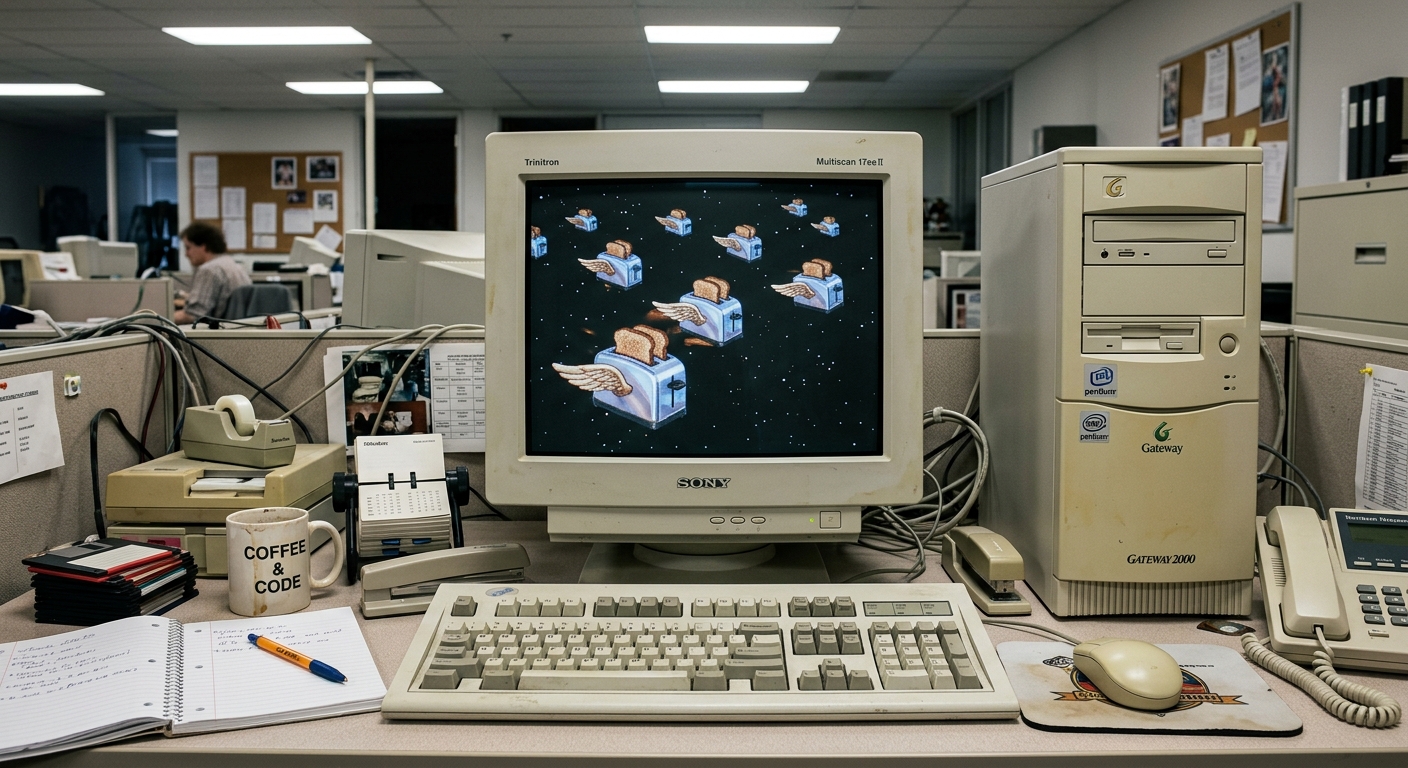
When screensavers protected CRTs (and Flying Toasters took over the office)
Once upon a time, screensavers had an actual job to do. Before they became nostalgic desktop curiosities or animated adverts for your company's brand values, they were solving a rather specific problem: the phosphor coating inside CRT monitors had an unfortunate tendency to remember things it shouldn't.
If you left the same image sitting on a CRT screen for too long—a spreadsheet, a word processor's menu bar, or the eternally judgemental blinking cursor—those glowing phosphors would eventually burn in. You'd switch to something else and there it would be: a ghostly shadow of your work haunting every subsequent screen. Windows 3.1 users who spent too long staring at the same interface found their monitors permanently tattooed with spectral toolbars.
The solution was elegantly simple: keep the pixels moving. If nothing stayed still long enough, nothing could burn in. Hence the screensaver, which would politely take over your display after a few minutes of inactivity and ensure those phosphors got a proper workout doing something else instead.
Why CRTs were so temperamental
Cathode ray tubes worked by firing electrons at a phosphor-coated screen, making it glow in precisely controlled patterns. Brilliant technology for its time, genuinely impressive engineering, and absolutely fine until you asked it to display the same thing for hours on end. The phosphors that got hammered repeatedly by the same pattern would age faster than their neighbours, leaving permanent bright or dark patches where static elements used to be.
This wasn't just an aesthetic concern for the particularly fastidious. A monitor with serious burn-in became genuinely harder to use. That ghostly menu bar lingering over your actual work wasn't charming; it was irritating. For businesses investing in expensive displays that they expected to last years, burn-in represented actual money down the drain.
Screensavers meant you could leave your desk without returning to a ruined monitor. They were practical workplace tools that happened to look quite nice whilst they were at it.
Enter the flying toast
Of course, once you've established that your screensaver needs to keep things moving, the question becomes: moving how, exactly? Early efforts were functional but dull—blanking the screen entirely, or showing a simple bouncing logo. Then someone had the extremely 1990s idea that what office workers really needed was surrealist animation.
Flying Toasters became the screensaver everyone remembers, largely because it was so utterly baffling. Slices of toast with wings soared gracefully across beige monitors in beige offices, sometimes accompanied by flying alarm clocks or other domestic items that had no business being airborne. It was absurd, it was strangely hypnotic, and it was absolutely everywhere.
The appeal wasn't just novelty. These screensavers gave personality to otherwise sterile computing environments. Your office might have been a sea of identical cubicles and identical computers, but at least your flying toasters were your flying toasters. It was a small act of digital decoration in an era when customisation options were otherwise rather limited.
The great screensaver era
Once the concept took off, screensavers became their own peculiar software category. You could have 3D pipes constructing themselves into impossible configurations, or a matrix of stars streaking past like you were piloting the Enterprise, or fish swimming serenely across your screen, or cryptic messages typed out one letter at a time.
Some were genuinely beautiful. Others were aggressively ugly in that special way that mid-90s 3D graphics could achieve. Many came bundled with your operating system; others you'd acquire from shareware collections or magazine cover discs, installing them with the same enthusiasm people now reserve for phone wallpapers.
There were even screensavers that claimed to do useful work whilst protecting your display—running scientific simulations or searching for extraterrestrial intelligence by processing radio telescope data. Whether your computer was actually finding aliens or just pretending to look busy remained delightfully unclear.
When screensavers stopped being necessary
The thing about solving a specific technical problem is that someone eventually solves it better. As power-saving display modes became standard, monitors learned to simply turn themselves off after a period of inactivity. This was more effective at preventing burn-in than any screensaver, and had the added benefit of not wasting electricity keeping your flying toasters aloft.
Then LCD screens arrived and didn't suffer from burn-in the same way CRTs did—at least, not in normal use patterns. The original purpose of screensavers became mostly obsolete. Modern displays can sit there showing the same image indefinitely without permanent damage, which is fortunate given how many people leave their email client open all day.
Screensavers didn't disappear entirely, but they became vestigial. They're still there in your operating system settings, still available if you want them, but few people bother. The flying toasters have mostly landed.
What we lost when we stopped needing them
There was something quite pleasant about screensavers, beyond their ostensible function. They marked the boundary between working and not-working, a visual indicator that you'd stepped away from your desk. They gave computers a resting state that wasn't just blank and dead.
More than that, they represented a brief moment when personal computers were becoming genuinely personal, when people started thinking about what their computing environment looked like and felt like, not just what it could calculate. The flying toasters were silly, but they were user-chosen silliness in a workplace that often allowed very little of it.
Modern screensavers are mostly corporate branding or photo slideshows—functional enough, but somehow less charming than flying breakfast items. Perhaps we've become too sensible. Perhaps toast was never meant to fly in the first place.
Either way, screensavers did their job. They protected countless CRT monitors from permanent damage, they gave office workers something moderately interesting to look at when they returned from lunch, and they established that computers could be whimsical as well as practical. Not bad for something that only existed because phosphor coatings were a bit temperamental.
More where this came from
If you enjoyed this particular stroll down computing's more peculiar back alleys, you'll be pleased to know we've written rather a lot about retro technology. There's something satisfying about understanding how we got here from there, and why certain solutions existed for problems you didn't know needed solving. We've got plenty more articles in our Retro Tech section—here are a few to get you started.
the surprising longevity of fax machines
When MSN Messenger let you annoy people with custom emoticons and nudges
Why we bother writing about old technology
We write about retro tech because none of the things we build today appeared from nowhere. Every modern web application, every sleek interface, every bit of software that actually works properly stands on the shoulders of decades of people solving problems—sometimes elegantly, sometimes with flying toasters.
Understanding what came before makes us better at building what comes next. The constraints people worked within, the creative solutions they found, the mistakes they made that we don't have to repeat—it all matters. We build modern things professionally, and we build them better because we know where the ideas came from. Here are some examples of things we've built that benefit from actually understanding computing history rather than just following the latest framework tutorial.
TrailTrack - The Best Ever Outdoor Hiking Website
Speaking of building things
If you've got a website that needs creating, software that needs building, or a digital problem that needs solving with a bit more thought than the average agency brings to the table, we'd be happy to hear from you. We work with people who appreciate that good work comes from actually understanding what you're doing, not just stacking together the trendiest tools and hoping for the best.
No flying toasters involved—unless you specifically request them, in which case we'll have questions but we'll certainly have a conversation about it. Get in touch and let's talk about what you're trying to build.
How We Build Custom Software Around Your Business
RiCollection Pricing and Customisation Guide
What is screen burn-in and why did it happen on old monitors?
Screen burn-in happened when the same image stayed on a CRT monitor for too long—the phosphor coating inside would age unevenly, leaving permanent ghost images of static elements like toolbars or cursors. It made monitors genuinely harder to use and represented wasted money for businesses.
Do modern LCD screens need screensavers?
No, they don't. LCD screens don't suffer from burn-in the same way CRTs did and can display the same image indefinitely without permanent damage. Modern displays also have power-saving modes that simply turn the screen off, which is more effective than any screensaver.
What were Flying Toasters and why were they so popular?
Flying Toasters was a screensaver featuring winged toast (and sometimes alarm clocks) flying across your screen. It became hugely popular in the 1990s because it added personality and whimsy to sterile office environments when customisation options were otherwise very limited.